Showing posts with label abandoned philadelphia cemetery. Show all posts

Thursday, March 3, 2022

Secrets Revealed from Philadelphia's (Underwater) Monument Cemetery

On Saturday, March 12, 2022 – at 6 p.m. –  I will be giving a virtual presentation on the 1956 destruction of Monument Cemetery in Philadelphia. Many of you have seen my photographs or read my blogs from 2011 and 2012 (see links at end) concerning this landmark event in the city's history. Some of you have probably attended one of my physical or virtual presentations, which I've been calling, "Secrets Revealed from Philadelphia's (Underwater) Monument Cemetery." With each successive presentation, I update the content based on new research. 

The 2022 edition will follow suit and is being sponsored sponsored by the Philadelpha bookstore, A Novel Idea. I appreciate their help and urge you to visit this lovely boutique bookstore in the Passyunk Avenue neighborhood of South Philly. 

A Novel Idea
1726 E Passyunk Ave, Philadelphia, PA 19148 
(267) 764-1202

Each time I make this presentation, I advertise the event on social media. I typically get a slew of comments from people who were unaware of the situation. Last week when I posted the event, someone wrote, “How could this happen?” Another person responded quite succinctly:

70 years ago Temple needed parking. A cemetery was in the way.

That is, of course, the gist of it. However, my presentation fleshes out the story, covering the history of Monument Cemetery (established in 1837), its destruction, and the aftermath of its obliteration. 


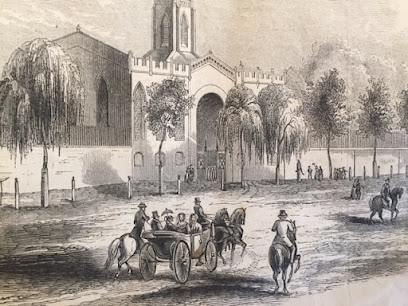
Above you see the Monument Cemetery gatehouse is it stood on North Broad Street in Philadelphia, in 1852 (Gleason’s Pictorial, Vol. III, No. 9, Aug. 28, 1852).


The comments people make (at both my in-person presentations as well as in Zoom virtuals) often provide me with missing details or ideas for further research. Examples include eye-witness accounts by people who were Temple students at the time the cemetery was razed, which certainly casts doubt upon the care which was supposedly exercised in the removal of the bodies.

When I advertise this presentation on Instagram or Facebook, I might get thirty comments, 95% of which will be in the “OMG-how-could-they-let-this-happen” category (which I expect), but there might be another 5% that will go something like this:

“…the graves were relocated, the headstones were used as backfill - no disrespect ...”
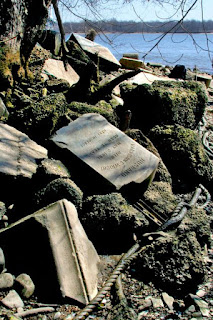
Gravestones along the Delaware
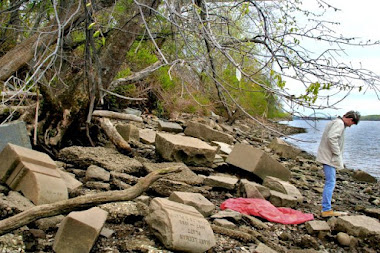
So yes, many of the gravestones were dumped into the Delaware River to help create a strong foundation for the Betsy Ross Bridge (which was then in the planning stage). Dozens of gravemarkers can still be seen at low tide under the bridge. There are differing points of view on this situation, and I am certainly open to everyone's opinion. We learn more about ourselves when we listen to others. Removal of cemeteries happened on a grand scale across the United States after the Industrial Revolution, as cities grew. Small church graveyards as well as large cemeteries often found themselves occupying land that was valued highly by developers. Probably the most disruptive example of this was in 1912 when San Francisco evicted all existing cemeteries - and those buried in them - from within the city limits. In 1929, it began moving the majority of its cemeteries to the town of Colma, California, just outside San Francisco. About 150,000 bodies were moved and many of the gravestones ended up in San Francisco Bay, where some can still be seen today. All in the name of progress.

Monument Cemetery was no different. It sat squarely in the way of the city’s expansion. Like San Francisco, Philadelphia’s population was growing, housing and factories needed to be built. And Monument Cemetery was not the only Philadelphia cemetery moved in that time period. While Monument held about 28,000 bodes, Lafayette Cemetery held about 47,000. Lafayette occupied the land where the present day Capitolo Playground sits in South Philly, next to the two famous cheese steak emporiums – Pat’s and Geno’s. The city paid a contractor to relocate the bodies, but wasn’t much concerned about their actual, eventual destination. But that's another story…

Vault being excavated from Monument Cemetery, Philadelphia, in 1956

And as you might guess (or maybe you might not), when cemeteries are moved, they never seem to move all the bodies. Which may be one reason Temple never went ahead with its plan to build a massive football field on the site previpously occupied by Monument Cemetery. You may have heard of the 2017 discovery of hundreds of bodies in a construction dig at Third and Arch Streets in Philadelphia, the site of the First Baptist Church of Philadelphia's burial ground. The bodies were supposedly relocated to Philadelphia’ Mount Moriah Cemetery in 1860. Well guess what - hundreds of bodies in wooden coffins were excavated from that construction site in 2017. Even when written accounts say that all the bodies were moved, well, all the bodies are never moved. Which is one reason they seldom build anything other than a ball field, playground, or parking lot over an old cemetery.


In conclusion, I try not to be critical. I just present the facts. We would all like to believe that we are, for the most part, good, honest, well-intentioned people. The actions described above were made by our ancestors, not us, right? 

Beware the Ideas of March! 

When I gave this presentation last year to an audience of about 175 attendees (hosted by the Athenaeum of Philadelphia), there was a comment in the Zoom chat – “We should raise money to have a commemorative bronze plaque made and attached to the original cemetery wall on the Temple University campus.” Yes, oddly, the cemetery’s stone border walls were kept in place! They are still there! What a fitting memory to this historic cemetery to have an historic marker or plaque placed on or near that wall.

Please join me at 6 p.m. on March 12! Here is the registration page for the presentation:


Further Reading:
My original three blog posts on the destruction of Monument Cemetery from my Cemetery Traveler blog:


If you want to read about the destruction of Lafayette Cemetery, please follow this link:


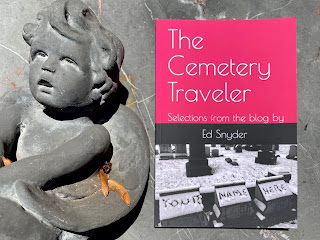
Also, my book, The Cemetery Traveler, which includes excerpts from these blogs, is available from Amazon:
Thursday, May 3, 2012

2nd Anniversary of "The Cemetery Traveler!"


Well, it’s been two years since I began writing The Cemetery Traveler blog. That’s most of my two-and-a-half year-old daughter’s lifetime – a fact that puts all that work into startling perspective for me. I’ve posted 120 articles and have 144 regular subscriber/followers. I greatly appreciate the fact that you’re reading this and hope you will continue. 

Daughter Olivia at Laurel Hill Cemetery
After 120 blog postings, you might think I’ve run out of material, especially since these postings have not been just a photo and a few sentences. They’ve been more substantial than even I expected they would be. The articles began as short pieces, but then the content took on a life of its own. I began to get carried away – the blogs started to read like mid-career Dickens. Frankly I’m surprised they held peoples’ attention. But readers responded. In blog comments and private emails, they expressed opinions. Many of the most commented-on pieces were about abandoned cemeteries.

When I started The Cemetery Traveler, my intent was mostly to recount my past experiences traipsing through the graveyards of America (and Europe), camera in tow. However, through Facebook I’ve encountered new ideas, new friends, and made new excursions. I’ve written (or will write) about a variety of people with whom I’ve had interactions in reference to my blog – a psychic, a film maker, descendants of people whose graves I’ve photographed, Andy Warhol’s niece and nephew, Victorian-era and Civil War re-enactors, and fellow writers. I’ve also met new companion adventurers (or ‘gravers,’ as we’re sometimes called!).


Ed's photograph in "175 Years of Reflections"

On rare occasion, I actually wrote about photography (e.g. my blog about ‘painting with light’ in a cemetery at night). This past year saw the publication of the book, 175 Years of Reflections, Laurel Hill Cemetery, which one of my photographs was chosen to be in. The book celebrates Philadelphia’s Laurel Hill Cemetery and its 175th anniversary.

Abandoned Cemeteries

Probably one of the least expected results of the The Cemetery Traveler blog has been my interest in helping to restore abandoned and run-down cemeteries around Philadelphia .

Mt. Moriah Cemetery, Philadelphia
Initially, I started exploring and photographing them like they were carnival sideshow attractions. However, my postings generated quite a bit of heated discussion, mostly from the “how could they let this happen” crowd, but also from descendants of people buried in those cemeteries! I received messages like this (related to Philadelphia’s gigantic abandoned Mt. Moriah Cemetery):

"Mount Moriah holds different emotions for different people. I have family here. As a child in the 70s, I actually played and rode my bicycle with my friends in this place. The people buried here need people to speak for them and try to undo the damage that has been done to them. Help us to do that with your lens. And if you are adventurous, come to a clean-up. They are inspiring and lets those buried here that someone still gives a damn."

Primarily as a result of people commenting on my blogs, I have participated in several clean-up days, and the comment is correct – the work is inspiring.

Tombstone under Betsy Ross Bridge
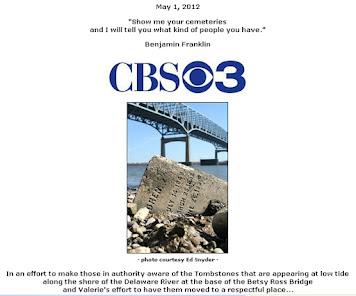
I also received many comments and emails about the destruction of Monument Cemetery (Philadelphia, 1956), and the unceremonious dumping of its thousands of headstones into the Delaware River. I received dozens of emails from descendants, looking for traces of their ancestors. The stones can still be seen under the Betsy Ross Bridge (at low tide), so I photographed them, and added the names, dates, and photos of the stones to the online database at FindAGrave.com, as suggested by one reader, whose initial comment to me was:

"While their graves may never be found, their information would be of great interest to family, historians, and genealogists."

The majority of comments  related to the destruction of Monument Cemetery were of this nature:

"I came across your site while trying to locate this cemetery so I could visit my ancestors' tombstones, as many of them were buried at Monument. I feel a bit sick realizing they're now in a mass grave and their tombstones have been dumped like this."

"I join many of those who are horrified that this could have happened in Philadelphia during the 1950's.  It seems so disrespectful and almost sinister in that advertisements were not required to be made in the newspapers if relatives could not be reached.....I think my family, especially my grandmother would have rallied the family (a large one) to relocate the graves of her mother, aunt and grandparents.  I gave a presentation of our family history at our reunion a year ago and my generation was horrified at what we discovered about the cemetery."
  
Opinions on the travesty of Monument Cemetery ran to the other extreme as well:

"I understand that moving a cemetery for parking seems crass, but the world belongs to the living and the not-yet-living - and Temple [University] has been and remains the most-affordable, best-hope for higher Education in Philadelphia. Isn't that worth more than a decaying cemetery?"

Some people were upset that I wrote about the cemeteries in their neighborhoods in a sensationalistic way. It got peoples’ attention, though, didn’t it? I am sure it helped with public awareness and the need to restore, rehab, and care for what we have.

What’s on The Cemetery Traveler’s  event horizon?

So what is on The Cemetery Traveler’s event horizon for "Year Three" of the blog? Well, a few things.

  • Publish a book of selections of essays from The Cemetery Traveler blog. I expect this to be available in about six months, with eBook versions on Nook  and Kindle. I have to thank the observant reader who commented on this photo a while back, “This photo screams ‘Book Cover’!”
  • Pay closer attention to comments made and emails sent by my readers, as your feedback adds another dimension to my writing. That said,  I’ve not been prompt with my replies. I’ll do better – or at least the best I can with two-and-a-half year-old vying for my attention! 
  • More travel! I plan to have a vendor table at the AGS (Association for Gravestone Studies) Conference in West Long Branch, New Jersey on June 22, 2012. Hope to become a member and interact with the conference attendees. I’m also planning to visit some of the historic cemeteries in Charlotte, North Carolina next month.
In Conclusion…

An advantage the living have over the dead:  we can go to sleep at the end of a long day, then wake up and do it all over again. So, shall I keep on writing? In the words of author/screenwriter S.J. Perelman, “To the fiery temperament, decision is consonant with action.” In other words, I intend to continue shooting off my mouth without thinking. Stay tuned – all shall be revealed.

Sunday, February 19, 2012

Warholized Cemetery Angels

It’s rather odd that my own fifteen minutes of fame actually involved Andy Warhol. In the February 2012 DaVinci Art Alliance exhibit, “Warholized (The Silver Show),” one of my two photographic entries, “Vibrating Angels,” was awarded Honorable Mention. What made this truly an honor was that the judges were Andy Warhol’s niece and nephew, Madalen and James Warhola.

DaVinci’s multimedia group exhibition (February 4-26, 2012) features artistic interpretations of the impact, influence, and inspiration of Andy Warhol, on the silver anniversary of his death (25 years ago). The exhibition is accompanied by a full-color catalogue/book including essays by various Warhol notables.
For the show’s opening a couple weeks ago, the Warholas (“Warhola” was Andy’s real last name) involved the audience in a panel discussion (led by art historian and Warhol scholar Debra Miller, PhD), explaining their own art and telling stories about growing up with Uncle Andy. Madalen runs the family silkscreening business, “Warhola Designs,” and James is an illustrator. (In addition to books, he has drawn for Mad Magaine and the popular “Garbage Pail Kids” trading card series.) James was kind enough to sign a copy of his children’s book, “Uncle Andy’s Cats” for my 2-year-old daughter Olivia. (See photos from Opening Night.)

A week after the opening, it was my turn to gallery-sit. When I showed up, the gallery director congratulated me on the award, and totally surprised me by telling me that “Vibrating Angels” had been purchased on opening night. I was knocked out when he told me that Madalen Warhola bought it! This is probably the single highest art honor I’ve ever received – that my work will reside in the Warhol family collection.

At Andy's Grave (Photo by George Ondis)
Warholized (The Silver Show)” is really a wonderful exhibit, with photography, sculpture, painting, and fabrics – some of which include the inevitable Campbell’s soup can idea. (Appropriately enough, Campbell’s sponsored the show!) You can’t really get away from this, as the soup can is Andy’s most recognizable image - so much so that people still place them on his grave in Pittsburgh!

Andy Warhol's grave, Bethel Park, PA (Photo by George Ondis)
Last month I asked my friend George, who lives in Pittsburgh, to take the cemetery photos you see here. I had visited St. John the Baptist Byzantine (note the cross on his headstone) Cemetery in Bethel Park, PA near George’s home about a decade ago, but could not locate my photos. I appreciate the fact that he made these photographs as they are much more interesting than my old snapshots -  the soup cans stand out so nicely in the snow! (Note the “Warhola” name on a stone behind Andy’s.) The Andy Warhol Museum, by the way, is located in Pittsburgh, where Andy was born and grew up. This is simply an amazing place to visit.

You can visit the DaVinci Art Alliance to see the exhibit until February 26, 2012. There’s also a book that can be purchased with an image of each artist’s work along with a paragraph explaining how the artist was influenced by Andy Warhol’s art. There are fascinating essays as well, by James and Madalen Warlola, Debra Miller, poet and Warhol Factory associate Gerard Malanga, and Warhol Superstar Ultraviolet.

"Vibrating Angels," by Ed Snyder
I had to write up a bit of an artist’s statement for my work in the book. Here’s the story behind “Vibrating Angels,” a “Warholized” rendition of a photograph I made years ago in the Metairie Cemetery in New Orleans:

"Vibrating Angels" - Statement
It’s been said that religion may have been Andy’s only emotion. He began and ended his professional art career with religious iconography, heavily influenced by the piety of his mother Julia. People view my own work - photographs of cemetery statuary - as religious, though in large part it addresses society's desire to come to terms with death and dying. I’ve “Warholized” one of my own images in tribute to Andy’s final decade of work, in which he seemed to contemplate the promises of popular religion. As he said about his paintings in 1985-6, "Heaven and Hell are just one breath away!"

My second piece in the show is called “Cherubs,” which you see below. I created the 20 x 20 inch print in Photoshop with two images of cherubs – the one on the left is from Mount Auburn Cemetery in Cambridge, Massachusetts, and the other from Laurel Hill Cemetery in Philadelphia. Essentially, both “Cherubs” and  "Vibrating Angels" are “digital art, ” printed on watercolor paper, as opposed to being strictly photographs. I am reminded how Warhol turned his photographs into artistic presentations using various types of media – they were no longer actually ‘photographs.’

"Cherubs," by Ed Snyder

One of the most interesting panel discussion ideas discussed at the opening of “Warholized (The Silver Show),” was "DIY POP," an app you can purchase (for your iPhone, iPad, and iPod Touch) from the Andy Warhol Museum that allows you to “Warholize” a photograph! Kind of wish I knew of its availability before I spent hours manually creating my images in Photoshop! (With this marvelous app, you can make your own people photo-portraits look like Warhol's famous images of Mick Jagger and Jackie O!)

"Cherubs" - Statement
In the Bottom of My Garden of cemetery angel photography, there are a few slightly suspect cherubs. I never knew what to do with them. I thought back to Warhol’s early days (1950s) when he illustrated advertising campaigns with mischievous cherubs - basically black line drawings on white, with some color added. Andy had a playful and joyous side before he adopted the Pop Art stance of distance and evasiveness. His version of folk art angels made me think about ways to give life to my own black and white cherubs. If they’re lacking color, why not follow Andy’s lead and just add some? I also spray-painted the frame for Cherubs with silver, in commemoration of the 25th anniversary of his death.

Epilogue

A few weeks before I was to deliver my work to DaVinci for the show, and picked up my prints at a local art supply store, I experienced fifteen seconds of fame. The guy taking care of my transaction told me he bought one of my photographs at a show two years ago, as a gift for his brother. I’m always flattered when people remember such things. He asked about my two prints and I told him about the upcoming Warhol-themed show. He said, “My aunt went to elementary school with Andy. She used to ride the bus with him. The only thing she ever said about him was, ‘He was a  very strange bird.’

References and Further Reading:
The Warhola Family Album website
James Warhola's Mad Magazine illustrations 

"Garbage Pail Kids," by James Warhola (Peel Slowly and See...?)

Wednesday, August 10, 2011

Mount Moriah Cemetery, on the Cusp

Who thinks about visiting an abandoned cemetery while in the dentist’s chair? Well, yours truly, for one. I apologize if I ever gave you the impression that I was normal. Yesterday afternoon, I drove out to Delaware County where I used to live, to let my dentist have his way with my teeth. Afterwards, I figured I would check out the Cobbs Creek Parkway side of Mount Moriah Cemetery.

This is the side of the massive abandoned cemetery that has been untamed by weedwhackers since last year. The city, as well as volunteer groups, are going in on a regular basis to try and clean up the other side (Kingsessing Avenue) of Mount Moriah, but 380 acres is a lot of land. Obviously due to limited manpower, the Cobbs Creek side is overgrown with weeds.

It’s an interesting sight, and not for the faint of heart. The densely wooded ridge off in the distance that is home to about seven huge, ornate (albeit abandoned, graffitied, and blocked up) mausoleums only allows a glimpse of one of these structures. While it peeks out like a Cyclops from the overgrown trees and bushes, the aggressive foliage camouflages the others. All but the very tops of fifty-foot obelisks are cloaked in green.

Mausoleums, Mt. Moriah Cemetery, Philadelphia

I pull my car into the lone parking area that’s not blocked with Jersey barriers and get out. The gate to the Cobbs Creek entrance across the street boasts this sign, which seems incongruous given the sad state of the grounds. Well-meaning, of course, and intended to stop the fuckheads who had been dumping loads of trash, old building materials, and old cars in here for years. The gate itself is meant to prevent vehicles from entering, but you can easily enter by foot.
The place is waist-high with weeds. Old tree branches lay on monuments, I trip over knocked-over headstones as I try to make my way through what the papers are calling a “public nuisance.” The crushed stone and broken blacktop roads are still walkable, the weeds not having totally covered them. Trying to capture the atrocity of this place photographically is like trying to photograph the Grand Canyon – it’s just too expansive to portray in one, all-encompassing image. One must simply experience it in person. What must families of recently-buried loved ones think of this place? (Some in fact want to remove their family members, but cannot do so until the cemetery's legal owners are found!) What can people in the cars zooming up and down the parkway possibly be thinking as they drive past this place? Probably nothing, they’re too busy honking their horns at each other.

 
Only two angels are left on this side of Mount Moriah. Most have abandoned ship. The remaining two are forever earthbound, caught in a tangle of vines. Kind of analogous, I suppose, to the red tape that must bind the city’s efforts to wrest control of Mount Moriah from its mystery owners via the Pennsylvania Orphan’s Court. (Kind of wish the dentist had used something that strong to bind up my mouth wounds, as I feel the stitches break loose.) The perceived “owners” of the cemetery flew the coup back in the Spring of 2011 when they were sued by plot owners for not maintaining the grounds in proper condition. For those readers new to my blog, my opinion is that these people were just squatters, taking money to bury bodies! If you can believe it, during the legal proceedings, it was not possible to determine the actual owners of Mount Moriah, the largest cemetery in Pennsylvania! Maybe the mafia is involved, as my father would have said. Certainly a great place to bury bodies.

I spent about an hour just on the front hillside of the cemetery - I didn’t want to lose sight of my car. About the time my stitches broke, I saw a red, late model Dodge Charger pull in next to my parking space. Realizing I was unarmed (not typical of me during visits to Mount Moriah), I picked up a piece of broken white marble just in case. As I came down the hill toward the road, I saw a guy get out of the Charger and pull out a bottle of car wax. He’s going to shine up his car in front of this atrocity of a cemetery, a cemetery that will probably never shine again.

Related News