Saturday, May 28, 2022

Black Swamp Cemetery and Annie Oakely

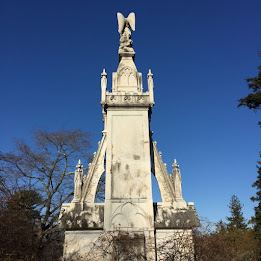
Community mausoleum, Black Swamp Cemetery

Back in early April 2022, I flew to Versailles on business. Not France, unfortunately, but Ohio. Where they pronounce it “Ver-SALES.” Private jet, strictly a one-nighter, no time for cemetery travel. Bummer. The real kicker is that the factory I was visiting had a cemetery right behind it, Black Swamp Cemetery, though I would have no opportunity to visit. The overnight accommodations were in a fancy lodge type deal a few miles away, so I couldn’t even get to the cemetery on my very little time off. Sigh. 

Cemetery enthusiasts have been in this situation many times – they drive by an interesting graveyard, and are not able to stop. Pining for the grave. The photos you see here, actually, are photos of Black Swamp Cemetery in Versailles, Ohio, the main one that I didn’t get to visit. I snapped these out the van window as our small group was en route to the lodge after leaving the factory tour on the day of our arrival. 

Versailles is a small mid-Western town surrounded by thousands of acres of cornfields. Old Victorian-era downtown buildings and old wooden houses. Another cemetery I didn’t get to visit is just outside Versailles in Greenville - Brock Cemetery, where Annie Oakley is buried. Super bummed about that. 


The lodge where we stayed outside Versailles was creepy, though, so the trip was interesting in that regard. An absolutely vacant, private lodge owned by this company to board its short-term guests during factory visits. There were six of us in our party, and we were the only guests. There was no check-in desk, no personnel. We were each shown by the van driver to a private suite on various levels of the building. It was cold outside, the lake behind the building was being rained on. The doors to the rooms had no locks. Weird.

The huge dining area was empty – oddly, there was an acoustic guitar on a stand off to the side of the room. I asked if there was going to be entertainment later. Our driver pointed out, that no, anyone can pick it up and play. Again, weird.

As we were being led around to our rooms (hopefully not our final resting places), I felt like we were in the hotel from the movie, “The Shining.” I dumped my stuff in room 13 – a ground-level room with a private door out to the lake – perfect access for the madman to gain entry to my room in the night. Our driver said dinner would be served at 7 pm and there was an open bar. Shortly, I headed up to the bar, hoping that it was not us on the menu.

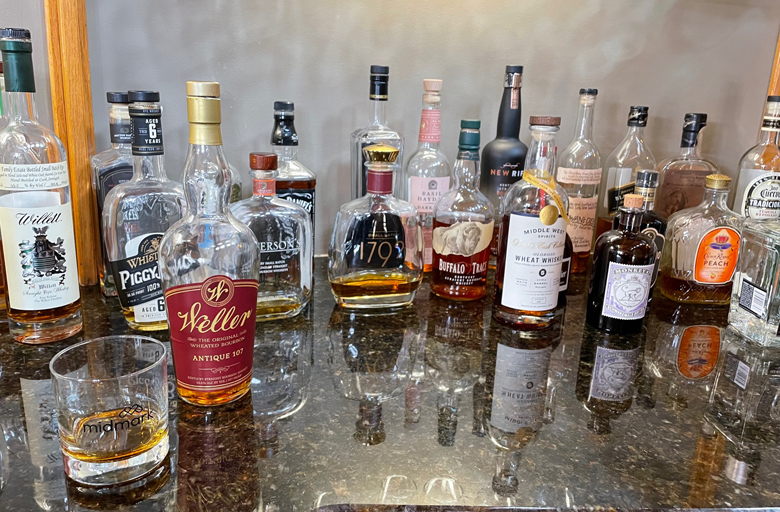
Turned out to be a completely unattended fully-stocked hotel-style bar, that was, well, open. You just went behind the bar and helped yourself. Truly fine choice of bourbons, I must say. We gathered there for an hour, in the emptiness, wondering where the dinner would come from. I went over and grabbed the guitar, slid the capo up the neck and played “Here Comes the Sun” to dispel the gloom.

At 7, the kitchen opened and a chef with full crew began serving a fine five-course meal. Truly sumptuous. Afterwards, a few drinks and off to bed - fattened up, hoping I would actually wake up alive in the morning.

A random lake in Ohio, outside my room, in the bleak dawn.

Which I did, and strolled out into the dawn to shoot a few photos of the still lake. Got Wordle in four tries. We packed, were fed breakfast, then were picked up and taken to the factory for the second half of the tour. Lunch and then back to the little Darke County Airport in Versailles and the trip home (you’ll agree, I’m sure, that “Darke County” is a great name!). We didn’t even get to fly over a cemetery at take off.


We cracked open a bottle of champagne at altitude, nibbling fresh fruit. Here’s my cup and the book I was appropriately reading during this whirlwind of a trip, William Gibson’s Mona Lisa Overdrive. The flight was only about forty minutes between Darke County Airport and Philly International. And I have to say – don’t ever feel sorry for those rock stars touring across the country in a private jet. There’s no baggage claim, TSA, fighting over masks, stowing luggage, barf bags. Just hop on, have a chat with your mates, and get off at the next stop. 

My next business trip, to San Antonio, Texas, will definitely include a planned cemetery excursion. Planning is good. Hell, when Mott the Hoople toured the U.S. for the first time, maybe in 1973, the band planned all their free time hitting pawn shops looking for cool guitars. That is where Ian Hunter, according to his autobiography (Diary of a Rock ‘N’ Roll Star), found that weird “H” shaped electric guitar he played – I always thought it was custom made for him. As Space Ghost says, you gotta make your own fun.

Saturday, May 14, 2022

Old Tennent Church and Graveyard

While procursive behavior can potentially lead to defenestration, running to the cat lady posed no such issue. When our informal tour guides led us to her final resting place in the graveyard at Old Tennent Church in Tennent, New Jersey, I just had all these catastrophic thoughts going through my head. I could not help but think of Mark Twain’s cat story, “A Cat Tale,” in which he composes a bedtime story for his young daughters based on words beginning with “cat.” They would pick a word from the dictionary, and he would use it in the fictitious story, even if he did not know its meaning. Then the daughters would catch him in his fib and make him alter the story to make the word fit into the story! I actually know the meaning of the two five-dollar words in the first sentence, by the way.

Cat Lady

Old Tennent resides in Manalapan Township in Central New Jersey (my Jersey-native neighbors can actually pronounce “Manalapan”). This is near Freehold, which I suppose is where Bruce Springsteen’s ranch is – I probably drove past it on the way. 

Zinc memorial marking family plot
I don’t know the story of the woman who has cat reliefs carved in her granite memorial, it was just our first stop on our wonderful spring walk through a colonial-era graveyard. There was so much more to see – the old church which was built in 1753 (https://www.oldtennent.org), the death’s head soul effigy gravemarkers, the mausoleums, and so on. The Old Tennent graveyard was established in 1731, and is STILL an active cemetery, i.e., there are still new burials. 

Old Tennent Presbyterian Church, Tennent, New Jersey
The property is quite large, and the grave markers are arranged in sort of a timeline, with the oldest around the church, and branching out by era (and that era's symbolism) as the stones appear to orbit the church. The newest stones are in the outermost orbit. There are even a few zinc, or "white bronze" markers to be found near the church (these were popular from the late 1800s until about 1930).

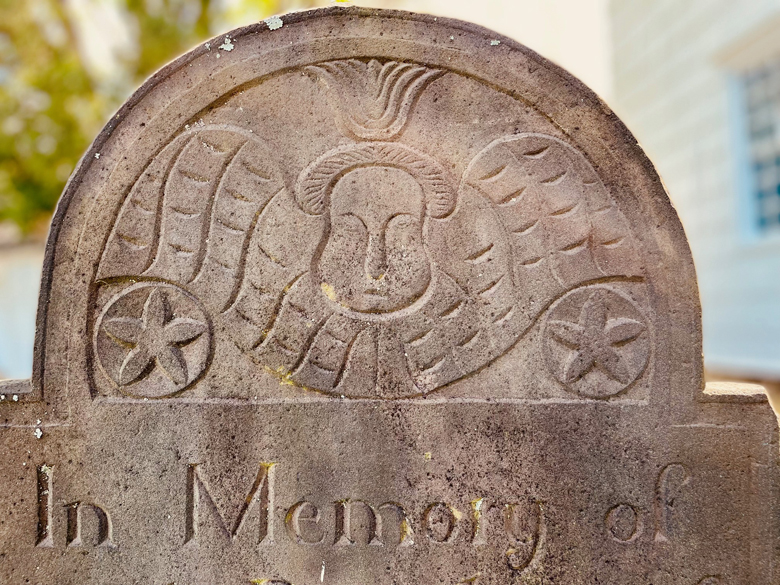
"Starfish" angel soul effigy?
Most fascinating for me were the soul effigy brownstone carved stones. I had never seen so many in one place – there were dozens. Most seemed to be carved by two or three carvers, as the styles were all quite similar. The state of preservation of most of these stones is intriguing. Some have lichens growing on them, but are for the most part in great condition. There is a caretaker of the graveyard, and that person obviously does a wonderful job. Simply keeping the grass cut between all these stones and monuments is, well, a monumental task!

I must mention the reason I was here in the first place. Some friends who are part of the Instagram Cemetery Meetup group we formed last year live in the area and have suggested we all meet there for a walking tour. The group has done this about six times so far, congregating in various cemeteries between Philadelphia and Perth Amboy, New Jersey. About fourteen of us met on this sunny spring Sunday in Tennent – one of the largest attendances we’ve had. There are about twenty people who are part of the group and maybe ten on average will attend a meetup.

Some members of our meetup group outside church

We had hoped, as our guide had planned, to see the inside of the church. We arrived as a service was letting out and we asked if we could go inside. The people in the church politely declined, so we went about the grounds exploring and photographing. I made these group photos with my iPhone 12 on self-timer. I also brought my new old camera, a forty-year-old Leica R4 35mm film camera, which I needed to test before the warranty expired. A few members of our group graciously posed for photo portraits, as I wanted to test out the camera’s (with Leica 28-70mm f3.5 lens) ability to capture humans, which I have seen can be done with astounding crispness on a shallow depth of field.

Someone asked me how the camera has been performing, and I said, “I’ll let you know in a week when I get the film back.” I don’t photograph live people, generally, so the results will also reflect my paucity of skill in that regard. I say “live” people, because I intend to visit the dead as well at Saint John Neumann church in Philadelphia soon. One of our group mentioned that in addition to his headless corpse which is preserved in state behind glass under the altar at this national shrine in Philadelphia  (https://stjohnneumann.org/our-st-john-neumann/about-st-john-neumann), they’ve also put on display Neumann’s personal collection of saint’s skulls. I mean, what’s not to like there?! Oh, and if you go, this IS the place “where prayers are answered” (https://stjohnneumann.org).

A bit later, I was surprised to see members of our group filing into Old Tennent church! It seemed that our guide somehow convinced one of the church volunteers to not only let us in, but to also give us a half-hour tour! This was wonderfully educational and totally appreciated by everyone. The old wooden structure has been kept in fine shape, inside and out. The subscription pew boxes are labelled with small bronze plaques indicating the name of the person or family who pays “rent” on the box. 

Notch in church pew caused by saw used in amputation

The church had been used as a hospital for the American army (led by General George Washington himself) during the Battle of Monmouth, which was fought on the hill opposite the graveyard on June 28, 1778. As you would expect, then, there are many Revolutionary War soldiers buried in Old Tennent. Our guide pointed out blood stains on a wooden pew seat and another pew with a notch in it’s seat – supposedly this was made by a saw as a soldier’s leg was being amputated.

So that’s all very sobering, right? There was also a display case with cannonballs, rifle shot, and other historic memorabilia from the local battle. The Monmouth fight was pivotal in Washington’s career, as he, personally, along with his army, successfully drove the British farther from Philadelphia (which the British had occupied), a victory which prompted people to begin describing Washington as the Father of Our Country (https://en.wikipedia.org/wiki/Battle_of_Monmouth).

After our tour of the church, our group continued its exploration of the grounds. We all posed for a group photo (again, taken with my iPhone 12) in front of a mausoleum. I’ve noticed that many members of the group sport great T-shirts and other items of clothing which serve as an effective starting point to begin a conversation with someone you’ve only ever met on Instagram! The social media platform is being used to create and nurture actual social in-person relationships. I look forward to our next planned meetup, which may be around Elizabeth or Newark, New Jersey. Our friends (and we truly have all become friends) from that area are anxious to show us two cemeteries that boast even more gravemarkers with angel and death’s head soul effigy carvings. 

In parting, let me just say that it always pays to look inside mausoleums. You can see some amazing stained glass, or even engraved crypt covers such as the one you see below. Seriously, would you ADVERTISE that you were a descendant of witch burners Cotton and Increase Mather? This Puritan clergy father/son duo was responsible in large part for the witch hunts and resulting murders in New England during the late 1600s. But seriously, if it hadn’t been for the Salem Witch Trials, how would we ever have known that witches can’t swim? Turns out that the Monty Python witch trial scene from the movie, “Monty Python and the Holy Grail,” was a fairly accurate depiction of how skewed this Puritanical logic was (https://www.youtube.com/watch?v=rJFA6uEfUlM). As an aside, “Cotton Mather” is also the name of a pretty cool power pop band. 


Thursday, March 3, 2022

Secrets Revealed from Philadelphia's (Underwater) Monument Cemetery

On Saturday, March 12, 2022 – at 6 p.m. –  I will be giving a virtual presentation on the 1956 destruction of Monument Cemetery in Philadelphia. Many of you have seen my photographs or read my blogs from 2011 and 2012 (see links at end) concerning this landmark event in the city's history. Some of you have probably attended one of my physical or virtual presentations, which I've been calling, "Secrets Revealed from Philadelphia's (Underwater) Monument Cemetery." With each successive presentation, I update the content based on new research. 

The 2022 edition will follow suit and is being sponsored sponsored by the Philadelpha bookstore, A Novel Idea. I appreciate their help and urge you to visit this lovely boutique bookstore in the Passyunk Avenue neighborhood of South Philly. 

A Novel Idea
1726 E Passyunk Ave, Philadelphia, PA 19148 
(267) 764-1202

Each time I make this presentation, I advertise the event on social media. I typically get a slew of comments from people who were unaware of the situation. Last week when I posted the event, someone wrote, “How could this happen?” Another person responded quite succinctly:

70 years ago Temple needed parking. A cemetery was in the way.

That is, of course, the gist of it. However, my presentation fleshes out the story, covering the history of Monument Cemetery (established in 1837), its destruction, and the aftermath of its obliteration. 


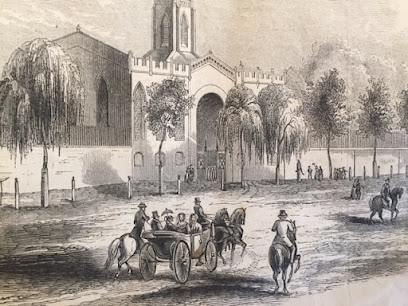
Above you see the Monument Cemetery gatehouse is it stood on North Broad Street in Philadelphia, in 1852 (Gleason’s Pictorial, Vol. III, No. 9, Aug. 28, 1852).


The comments people make (at both my in-person presentations as well as in Zoom virtuals) often provide me with missing details or ideas for further research. Examples include eye-witness accounts by people who were Temple students at the time the cemetery was razed, which certainly casts doubt upon the care which was supposedly exercised in the removal of the bodies.

When I advertise this presentation on Instagram or Facebook, I might get thirty comments, 95% of which will be in the “OMG-how-could-they-let-this-happen” category (which I expect), but there might be another 5% that will go something like this:

“…the graves were relocated, the headstones were used as backfill - no disrespect ...”

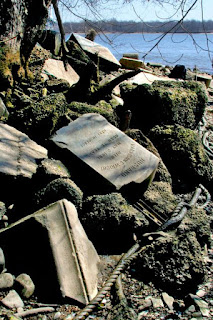
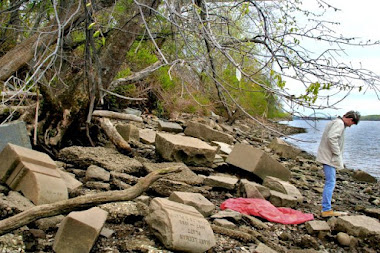
Gravestones along the Delaware
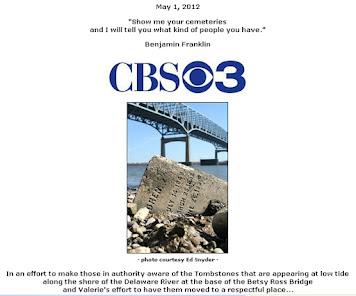
So yes, many of the gravestones were dumped into the Delaware River to help create a strong foundation for the Betsy Ross Bridge (which was then in the planning stage). Dozens of gravemarkers can still be seen at low tide under the bridge. There are differing points of view on this situation, and I am certainly open to everyone's opinion. We learn more about ourselves when we listen to others. Removal of cemeteries happened on a grand scale across the United States after the Industrial Revolution, as cities grew. Small church graveyards as well as large cemeteries often found themselves occupying land that was valued highly by developers. Probably the most disruptive example of this was in 1912 when San Francisco evicted all existing cemeteries - and those buried in them - from within the city limits. In 1929, it began moving the majority of its cemeteries to the town of Colma, California, just outside San Francisco. About 150,000 bodies were moved and many of the gravestones ended up in San Francisco Bay, where some can still be seen today. All in the name of progress.

Monument Cemetery was no different. It sat squarely in the way of the city’s expansion. Like San Francisco, Philadelphia’s population was growing, housing and factories needed to be built. And Monument Cemetery was not the only Philadelphia cemetery moved in that time period. While Monument held about 28,000 bodes, Lafayette Cemetery held about 47,000. Lafayette occupied the land where the present day Capitolo Playground sits in South Philly, next to the two famous cheese steak emporiums – Pat’s and Geno’s. The city paid a contractor to relocate the bodies, but wasn’t much concerned about their actual, eventual destination. But that's another story…

Vault being excavated from Monument Cemetery, Philadelphia, in 1956

And as you might guess (or maybe you might not), when cemeteries are moved, they never seem to move all the bodies. Which may be one reason Temple never went ahead with its plan to build a massive football field on the site previpously occupied by Monument Cemetery. You may have heard of the 2017 discovery of hundreds of bodies in a construction dig at Third and Arch Streets in Philadelphia, the site of the First Baptist Church of Philadelphia's burial ground. The bodies were supposedly relocated to Philadelphia’ Mount Moriah Cemetery in 1860. Well guess what - hundreds of bodies in wooden coffins were excavated from that construction site in 2017. Even when written accounts say that all the bodies were moved, well, all the bodies are never moved. Which is one reason they seldom build anything other than a ball field, playground, or parking lot over an old cemetery.


In conclusion, I try not to be critical. I just present the facts. We would all like to believe that we are, for the most part, good, honest, well-intentioned people. The actions described above were made by our ancestors, not us, right? 

Beware the Ideas of March! 

When I gave this presentation last year to an audience of about 175 attendees (hosted by the Athenaeum of Philadelphia), there was a comment in the Zoom chat – “We should raise money to have a commemorative bronze plaque made and attached to the original cemetery wall on the Temple University campus.” Yes, oddly, the cemetery’s stone border walls were kept in place! They are still there! What a fitting memory to this historic cemetery to have an historic marker or plaque placed on or near that wall.

Please join me at 6 p.m. on March 12! Here is the registration page for the presentation:


Further Reading:
My original three blog posts on the destruction of Monument Cemetery from my Cemetery Traveler blog:


If you want to read about the destruction of Lafayette Cemetery, please follow this link:


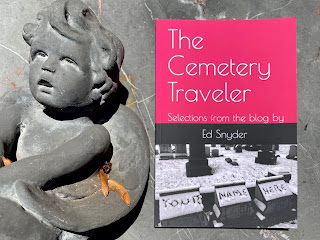
Also, my book, The Cemetery Traveler, which includes excerpts from these blogs, is available from Amazon:


Saturday, February 5, 2022

Moaning in the Gloaming

Any time of year is good for a scary story, right? This involves a visit from maybe around 2017 to the old Leverington Cemetery in Roxborough, Pennsylvania. The cemetery has been in existence since 1744 and the Church next door, with its own graveyard in back, has been around since about 1789 (ref.). The graveyard (the technical term for a churchyard burial ground) was closed to new burials in the 1980s, though the adjoining Leverington Cemetery remains active. The much larger Leverington Cemetery (about nine acres) has a gated entrance on Ridge Avenue.

It was the waning end of a crisp fall day, as I recall. Leverington is one of the few Philadelphia area cemeteries that is safe to explore in the gloaming, safe from being locked in, anyway. The main gate is missing, so anyone can wander in (or out) at their leisure. Which has been a problem, from what I’ve heard. Some have related encounters with ne’er-do-wells who had been hanging about the property, but I personally never had a problem. On this visit I was by myself. I’d been here many times over the years. I checked out the Civil War monument in the back of the cemetery and the old graves back behind the church. Made some photographs as I explored the grounds.

As I was walking behind the maintenance shed in the center of the cemetery, I heard the most god-awful moaning, and stopped short. Where could that be coming from? My blood froze. It was broad daylight, so it wasn’t TERRIBLY frightening, but still, this is a cemetery, right? Anything can happen.

Then ANOTHER god-awful moan! Traffic on Ridge Avenue is a block away; Bob’s Diner, which borders the cemetery, the same distance. No creature anywhere nearby that could make such a sound - Whisky – Tango – Foxtrot (WTF) ...!? As I slowly walked around the front of the shed, I noticed that one of the red, barn-style doors was open. I gingerly approached the opening. Maybe the moaning was coming from inside the shed? As I neared the open door, I peered inside ….. was someone hurt or dying? Was someone already dead?

What I saw came as rather a shock. A gentleman, who I took to be the groundskeeper, was sitting on a white plastic five-gallon bucket. His pants at his ankles, apparently taking a fierce dump! I assume the poor guy had nowhere else to go. 

I backed away, so as to give him his privacy, allowing him to continue to focus on this quotidian event. I made my way out of the area and out of the cemetery, vowing to always take care of business BEFORE going on any long explore. 

References and Further Reading:

https://books.google.com/books?id=161AAAAAYAAJ&printsec=frontcover&source=gbs_ge_summary_r&cad=0#v=onepage&q&f=false

https://roxboroughpa.com/news/leverington-cemetery-preservation-a-family-mission-for-owner-with-deep-roxborough-roots7

Saturday, January 22, 2022

Sleepy Hollow Cemetery

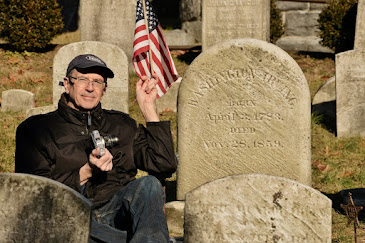
Author Ed Snyder by Frank Rausch

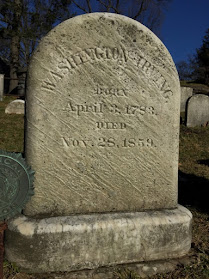
I am not the world’s biggest Washington Irving fan (even less so a John Irving fan), so his grave is not why I visited Sleepy Hollow Cemetery in Sleepy Hollow, New York back in 2018. Not being an Irving fan seems almost un-American to me. I guess this hit home when I was visiting his grave – every once in a while I just play tourist, and go for the celebs. I got my friend Frank to photograph me at Irving’s gravesite. 
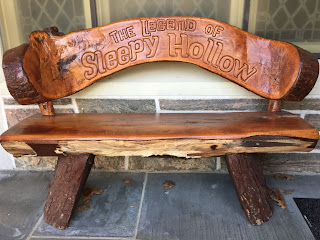
Bench at gatehouse, Sleepy Hollow Cemetery

Irving (1783-1859) lived near Sleepy Hollow and was bewitched by the spookiness of the area. It helped stoke his imagination for writing such tales as the Legend of Sleepy Hollow and Rip Van Winkle in the early 1800s. I read The Legend of Sleepy Hollow as an adult, and it was anticlimactic. Having grown up with this pervasive tale, there was no magic left in the words. I realize that at the time it was written, Irving created a Victorian gothic masterpiece. For me, Rip Van Winkle was a much more enjoyable tale – the game of ninepins in the dark Catskilll Mountains and falling asleep for twenty years to avoid the nuisances of everyday life. A goal as sought after, yet as unattainable, as a bottle of Pappy Van Winkle bourbon. 
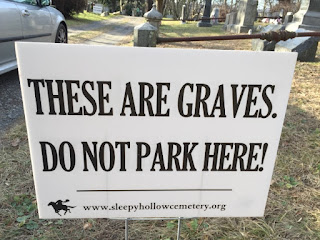
Anyway, I stray from my topic. Which is one of the reasons you read this blog, right? I seldom pander to people’s expectations. Sleepy Hollow Cemetery is certainly worth the visit. The trip was mainly a reason to hang out with my buddy Frank, who had left Philly for Connecticut after he retired. Sleepy Hollow was a good halfway point to meet, and since we both photograph cemeteries, what better place? Frank had been there before, I had not.

Sleepy Hollow is bit north of New York City, near tiny Tarrytown, New York. Which is near White Plains. As I crossed the Tappan Zee Bridge from Nyack, New Jersey, I couldn’t get the great power pop Fountains of Wayne song, “Little Red Light,” out of my head:

“Sitting in traffic on the Tappan Zee

Fifty million people out in front of me

Trying to cross the water but it just might be a while

Rain's coming down I can't see a thing

Radio's broken so I'm whistling

New York to Nyack feels like a hundred miles ….”


It wasn’t raining when I made the trip from Philadelphia up New Jersey’s Garden State Parkway; rather, it was a crisp winter’s day (actually December 27, 2018 – thank you metadata). Being a Thursday, I did hit all the wonderful rush hour traffic – which was not without its charms. I got a slo-mo view of a car fire near the Bronx exit, serendipitously playing out as James Brown’s “Hot Pants” blasted from my car stereo. (By the way, I only recently found out that cars don’t explode when they catch fire -That only happens in the movies. I am so impressionable.)
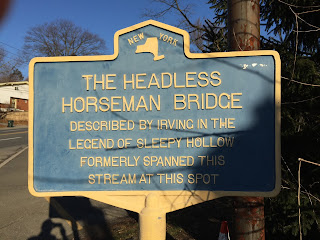
Pulling into small-town Tarrytown is quite a culture shift from the hectic highway driving. The Palisades and the woods are breathtakingly beautiful – and quiet. You quickly realize how the creepiness of the area got to Irving, and sparked his imagination. I’ve only been in a few areas of the country where I got such a creepy vibe, one being the Brandywine River battle grounds in Pennsylvania, famed for George Washington’s lost Revolutionary War battles. You drive along that little river through the woods, and you can feel the ghosts of all the dead soldiers in the morning mist rising off the water. There were Revolutionary War battles fought in the White Plains area as well.
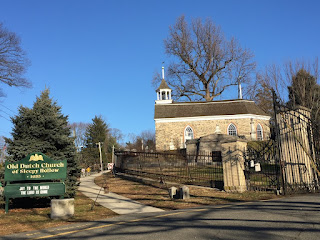
The Old Dutch Church, Sleepy Hollow, New York

Sleepy Hollow Cemetery has the same vibe. It’s quiet, its Gothic, and I’m sure it is creepy any time of year. While the cemetery itself was established in the Victorian era (1849), it is situated near the small graveyard of the Old Dutch Church (established in 1660), the final scene of Irving’s Headless Horseman tale. I can’t picture local Victorian era residents picnicking in either of these places. They just seem too dark. The whole place reminded me somewhat of Georgetown’s Oak Hill Cemetery, wet, scary, not very welcoming. Which of course makes them great places to visit around Halloween.
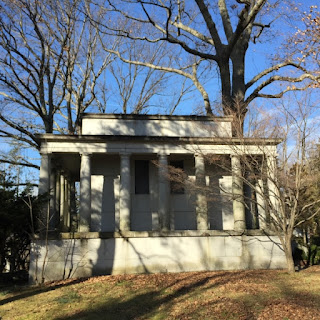
Helmsley Mausoleum

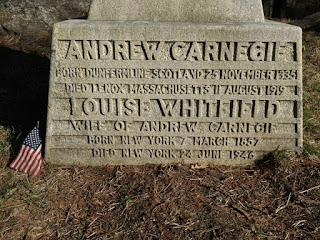
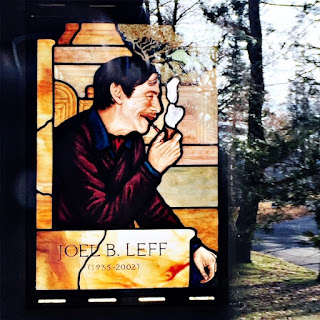
Sleepy Hollow Cemetery has got it all – size (90 acres), angel statuary, and hidden gems like Leona Helmsley and Andrew Carnegie’s graves - Helmsley’s memorial is bigger, in case you’re wondering! (Did you know that Helmsley left $13 million to her dog when she died in 2007?!)  Leona and husband Harry Helmsley owned the largest real estate holding company in the United States, and their huge mausoleum is quite extravagant. Large stained glass windows depicting the New York City skyline are astounding. This other stained glass window in another mausoleum was quite unique – probably a portrait of the deceased above his crypt.
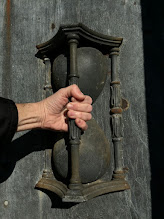
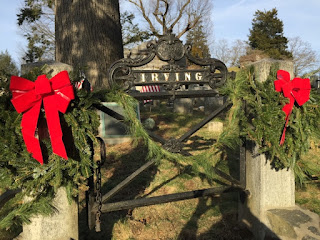
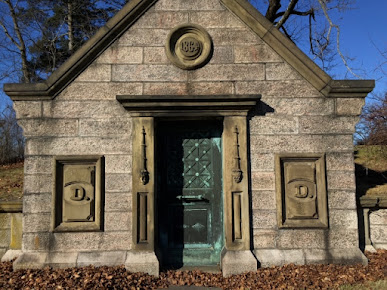
Sleepy Hollow’s landscaping disorients even the most experienced gravewalker. Rolling hills, bridges and streams, graves under a dark canopy of trees – you can just get lost in the place. I’m not sure what a “cheerful” mausoleum looks like, but most of the mausoleums here are, while stately, are rather grim and foreboding. I don’t think I’ve ever been as surprised by the varied and imaginative DOOR HANDLES as I was on the mausoleums at Sleepy Hollow. The hourglass door handle is near Washington Irving’s grave, which is marked with a simple headstone. The creepiness of this specific plot was not lost on me. It’s all very quiet – almost too quiet. Even with remnants of Christmas decorations, it is gothic and dark here. It is not joyous. 
If you are into celebrity graves, Sleepy Hollow is jam packed with them. Washington Irving gets all the press, but there is something for everyone here, people who are much more famous – American labor leader Samuel Gompers, automobile magnate Walter Chrysler, Standard Oil Company founder William Rockefeller, Elizabeth Arden of the famed cosmetics company, IBM pioneer Thomas J. Watson, and so on.


See more famous interments on the Sleepy Hollow Cemetery website: http://sleepyhollowcemetery.org/about-us/famous-interments/
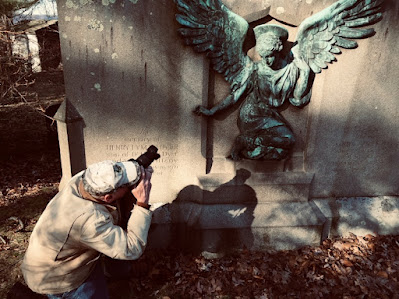
Frank shooting an angel

This marvel of a cemetery must be enjoyed while walking (or kneeling, as my friend Frank shows us here). It is one of the few places I’ve been that is so dense with amazing architecture, art, sculpture, and history, that you simply can’t appreciate it by driving along its sinuous roads. It is full of Victorian quirkiness, like iron fencing and gates with cast angels; there are assorted zinc monuments, bronze and marble sculptures, huge monuments, and unique mausoleum stained glass. The fencing is unusual both in style and quantity. Decades after the Victorian era, people felt that the iron plot fencing and decorative gates were rather gauche – so much ironwork around the U.S. was removed and destroyed. 
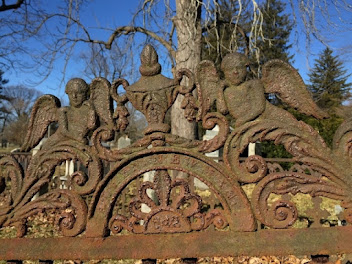
Not so at Sleepy Hollow. Maybe people were too scared of this place to trash the decorative ironwork. Walking through this wonderful chunk of history, you almost expect to find a shadowy figure crumpled at the foot of a monument, as did the protagonist in Irving’s Adventure of the German Student. “A beautiful young woman in black, slumped over with her tangled black hair falling over her face.” After taking her home with him, he awakens the next morning to find her dead. Decapitated, in fact, having been guillotined the day before he met her.

Additional Reading:

http://sleepyhollowcemetery.org/
https://olddutchchurch.org/history/our-history/