Showing posts with label George Washington. Show all posts

Saturday, May 14, 2022

Old Tennent Church and Graveyard

While procursive behavior can potentially lead to defenestration, running to the cat lady posed no such issue. When our informal tour guides led us to her final resting place in the graveyard at Old Tennent Church in Tennent, New Jersey, I just had all these catastrophic thoughts going through my head. I could not help but think of Mark Twain’s cat story, “A Cat Tale,” in which he composes a bedtime story for his young daughters based on words beginning with “cat.” They would pick a word from the dictionary, and he would use it in the fictitious story, even if he did not know its meaning. Then the daughters would catch him in his fib and make him alter the story to make the word fit into the story! I actually know the meaning of the two five-dollar words in the first sentence, by the way.

Cat Lady

Old Tennent resides in Manalapan Township in Central New Jersey (my Jersey-native neighbors can actually pronounce “Manalapan”). This is near Freehold, which I suppose is where Bruce Springsteen’s ranch is – I probably drove past it on the way. 
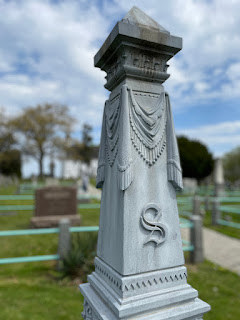
Zinc memorial marking family plot
I don’t know the story of the woman who has cat reliefs carved in her granite memorial, it was just our first stop on our wonderful spring walk through a colonial-era graveyard. There was so much more to see – the old church which was built in 1753 (https://www.oldtennent.org), the death’s head soul effigy gravemarkers, the mausoleums, and so on. The Old Tennent graveyard was established in 1731, and is STILL an active cemetery, i.e., there are still new burials. 
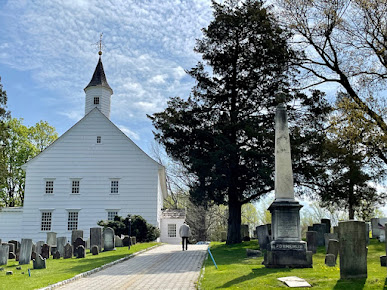
Old Tennent Presbyterian Church, Tennent, New Jersey
The property is quite large, and the grave markers are arranged in sort of a timeline, with the oldest around the church, and branching out by era (and that era's symbolism) as the stones appear to orbit the church. The newest stones are in the outermost orbit. There are even a few zinc, or "white bronze" markers to be found near the church (these were popular from the late 1800s until about 1930).
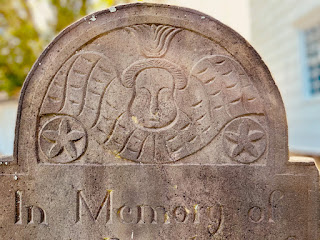
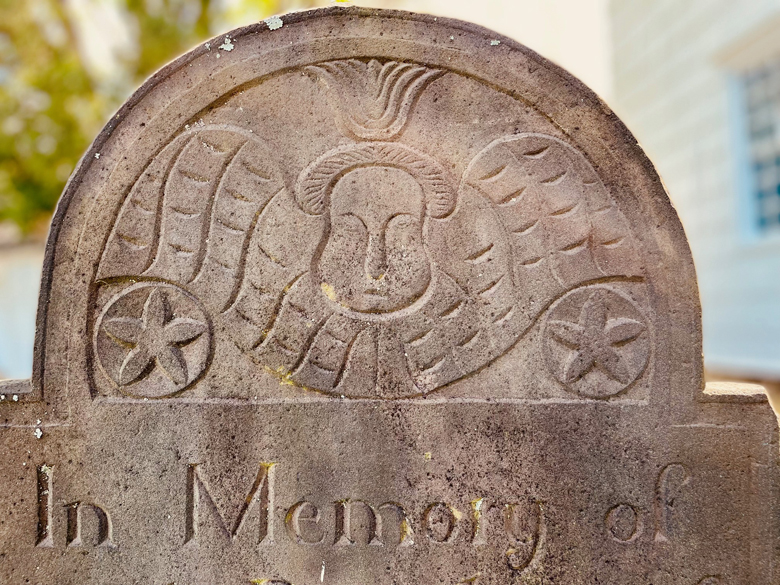
"Starfish" angel soul effigy?
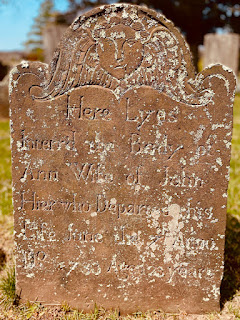
Most fascinating for me were the soul effigy brownstone carved stones. I had never seen so many in one place – there were dozens. Most seemed to be carved by two or three carvers, as the styles were all quite similar. The state of preservation of most of these stones is intriguing. Some have lichens growing on them, but are for the most part in great condition. There is a caretaker of the graveyard, and that person obviously does a wonderful job. Simply keeping the grass cut between all these stones and monuments is, well, a monumental task!
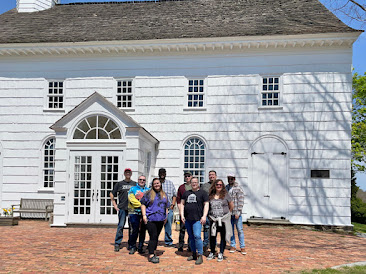
I must mention the reason I was here in the first place. Some friends who are part of the Instagram Cemetery Meetup group we formed last year live in the area and have suggested we all meet there for a walking tour. The group has done this about six times so far, congregating in various cemeteries between Philadelphia and Perth Amboy, New Jersey. About fourteen of us met on this sunny spring Sunday in Tennent – one of the largest attendances we’ve had. There are about twenty people who are part of the group and maybe ten on average will attend a meetup.

Some members of our meetup group outside church

We had hoped, as our guide had planned, to see the inside of the church. We arrived as a service was letting out and we asked if we could go inside. The people in the church politely declined, so we went about the grounds exploring and photographing. I made these group photos with my iPhone 12 on self-timer. I also brought my new old camera, a forty-year-old Leica R4 35mm film camera, which I needed to test before the warranty expired. A few members of our group graciously posed for photo portraits, as I wanted to test out the camera’s (with Leica 28-70mm f3.5 lens) ability to capture humans, which I have seen can be done with astounding crispness on a shallow depth of field.
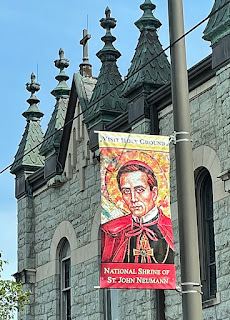
Someone asked me how the camera has been performing, and I said, “I’ll let you know in a week when I get the film back.” I don’t photograph live people, generally, so the results will also reflect my paucity of skill in that regard. I say “live” people, because I intend to visit the dead as well at Saint John Neumann church in Philadelphia soon. One of our group mentioned that in addition to his headless corpse which is preserved in state behind glass under the altar at this national shrine in Philadelphia  (https://stjohnneumann.org/our-st-john-neumann/about-st-john-neumann), they’ve also put on display Neumann’s personal collection of saint’s skulls. I mean, what’s not to like there?! Oh, and if you go, this IS the place “where prayers are answered” (https://stjohnneumann.org).

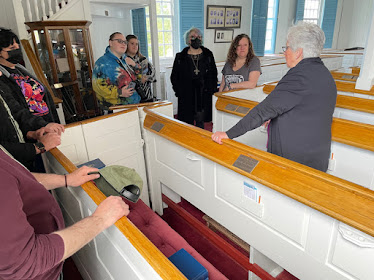
A bit later, I was surprised to see members of our group filing into Old Tennent church! It seemed that our guide somehow convinced one of the church volunteers to not only let us in, but to also give us a half-hour tour! This was wonderfully educational and totally appreciated by everyone. The old wooden structure has been kept in fine shape, inside and out. The subscription pew boxes are labelled with small bronze plaques indicating the name of the person or family who pays “rent” on the box. 

Notch in church pew caused by saw used in amputation

The church had been used as a hospital for the American army (led by General George Washington himself) during the Battle of Monmouth, which was fought on the hill opposite the graveyard on June 28, 1778. As you would expect, then, there are many Revolutionary War soldiers buried in Old Tennent. Our guide pointed out blood stains on a wooden pew seat and another pew with a notch in it’s seat – supposedly this was made by a saw as a soldier’s leg was being amputated.

So that’s all very sobering, right? There was also a display case with cannonballs, rifle shot, and other historic memorabilia from the local battle. The Monmouth fight was pivotal in Washington’s career, as he, personally, along with his army, successfully drove the British farther from Philadelphia (which the British had occupied), a victory which prompted people to begin describing Washington as the Father of Our Country (https://en.wikipedia.org/wiki/Battle_of_Monmouth).

After our tour of the church, our group continued its exploration of the grounds. We all posed for a group photo (again, taken with my iPhone 12) in front of a mausoleum. I’ve noticed that many members of the group sport great T-shirts and other items of clothing which serve as an effective starting point to begin a conversation with someone you’ve only ever met on Instagram! The social media platform is being used to create and nurture actual social in-person relationships. I look forward to our next planned meetup, which may be around Elizabeth or Newark, New Jersey. Our friends (and we truly have all become friends) from that area are anxious to show us two cemeteries that boast even more gravemarkers with angel and death’s head soul effigy carvings. 
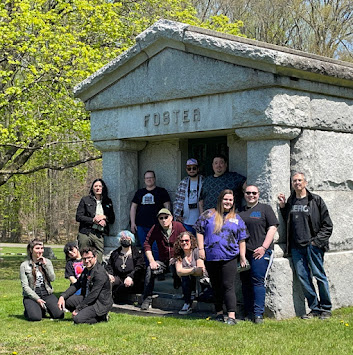
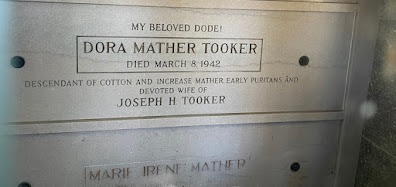
In parting, let me just say that it always pays to look inside mausoleums. You can see some amazing stained glass, or even engraved crypt covers such as the one you see below. Seriously, would you ADVERTISE that you were a descendant of witch burners Cotton and Increase Mather? This Puritan clergy father/son duo was responsible in large part for the witch hunts and resulting murders in New England during the late 1600s. But seriously, if it hadn’t been for the Salem Witch Trials, how would we ever have known that witches can’t swim? Turns out that the Monty Python witch trial scene from the movie, “Monty Python and the Holy Grail,” was a fairly accurate depiction of how skewed this Puritanical logic was (https://www.youtube.com/watch?v=rJFA6uEfUlM). As an aside, “Cotton Mather” is also the name of a pretty cool power pop band. 


Friday, July 1, 2016

Sons of the Revolution

Prior to finding this grave marker in a cemetery, I had not heard of the "Sons of the Revolution." As we near America’s Independence Day, the Fourth of July, let’s delve a bit deeper into this. I found it as I was roaming through St. Andrew’s Cemetery in Mount Holly, New Jersey, back in the spring of 2016, when I noticed this bronze plaque at a veteran’s grave. I’ve been drawn to these small bronze memorial markers for the past several years – mainly because they seem to be slowly disappearing as people steal them for scrap.

I had heard of the Daughters of the American Revolution, the D.A.R., but oddly, not the Sons. A fraternal organization, the Sons of the Revolution was formed in 1876 to keep the history of the American Revolution alive, through people with direct lineage to those who fought in the war. There are some links at the end where you can investigate the Sons and Daughters further.

The Sons of the Revolution annual board meeting will be held Oct. 7-9, 2016 at Fraunces Tavern at 54 Pearl Street (near Battery Park, Lower Manhattan) in NYC. This is an awesome place to grab a beer, by the way - it is where Gen. George Washington took his men for beers! This place is steeped in American history. On the eve of July 4, 2016, the museum at Fraunces would be a wonderful place to spend a few hours, if you happen to be in New York City. The tavern is about a block from the port of the Staten Island Ferry, which itself is a wonderful attraction – you glide by the Statue of Liberty!

I was at Fraunces a few years ago and I must say, the period furniture, flags, signed documents, paintings, and sculpture are amazing to see. Rooms upon rooms were filled with artifacts (some of which you can see at this link to Fraunces Tavern® Museum), and the rooms themselves were filled with Wall Street-types at happy hour! It’s interesting to consider this place has been in continuous operation since 1719, making it the oldest restaurant in New York City; Samuel Fraunces purchased the property in 1762.

Fraunces Tavern, from the website http://forknplate.com/2014/10/21/the-7-oldest-restaurants-in-new-york-city/

Not many people think of New York when they think about the Revolutionary War. However, Fraunces’ was a central meeting place for Loyalists during the war. Samuel Fraunces kept the tavern open during the period of British occupation of New York. Once the British were defeated at the Battle of York Town in 1781, the tavern evolved into an American government “headquarters while negotiations with the British concerning their evacuation from the City were underway” (ref.).
 
George Washington in the Continental Army, by C.W. Peale (Ref.)


I was fascinated by the account below, which describes an emotional scene from the end of the war (excerpted from the Memoirs of Colonel Benjamin Tallmadge (1830) in the collection of Fraunces Tavern Museum)

"On November 25, 1783, British troops left New York City – the last American city to be occupied. This day would later be referred to as Evacuation Day. George Washington led his Continental Army in a parade from Bull’s Head Tavern in the Bowery to Cape’s Tavern on Broadway and Wall Street. New York Governor George Clinton’s Evacuation Day celebration was held at Fraunces Tavern. During the week of Evacuation Day George Washington was in the City, and he made use of the Tavern by dining in and ordering take-out.

On December 4, 1783, nine days after the last British soldiers left American soil, George Washington invited the officers of the Continental Army to join him in the Long Room of Fraunces Tavern so he could say farewell."

Washington then headed to Annapolis where he resigned his commission as Commander-in-Chief of the Continental Army. From there, he went on to bigger and better things. Thanks to the Sons of the Revolution and their bronze grave marker, for giving me the idea to research this piece. Another bit of history as we celebrate the anniversary of our nation's independence.

References and Further Reading:

Thursday, October 31, 2013

Flesh off the Bone

Some friends of mine were fortunate enough to visit Sleepy Hollow Cemetery in Tarrytown, New York last week. I’ve seen the photos and I must go there! Looks like a fabulous place. Washington Irving’s grave is there, of, course – the author of The Legend of Sleepy Hollow. The headless horseman idea got me thinking about another odd, though true Halloween-appropriate tale. While not as riveting as the Legend of Sleepy Hollow, it nonetheless involves missing body parts.
 
Read more at Amazon.com
I came across this story just a couple years ago when reading Allan Heller’s book, Philadelphia Area Cemeteries. The story concerns Mad Anthony Wayne, one of George Washington’s maniacal generals, a person to whom we owe our independence from Britain. Wayne is buried in St. David’s Cemetery in Radnor, Pennsylvania (near Wayne, PA, out side Philadelphia). Well, actually only half of him is buried there.


General Anthony Wayne (ref.)
Wayne's “fiery temper and battlefield bravado,” says Heller, earned him the title of “Mad,” and there was nothing he would not do to further the cause. His greatest triumph “was the capture of the nearly impregnable British fort of Stony Point, New York, in 1779 - "the beginning of the end of the American Revolution." (ref.). When General George Washington asked the brash general if he would be willing to attack the enemy stronghold, Wayne supposedly replied, ‘Issue the orders, sir, and I will lay siege to Hell.’” Now THAT’s patriotism. Or perhaps insanity. Or both.

American assault on British at Stony Point, NY (ref.)

"Mad" Anthony Wayne monument, Radnor, PA
When you’re standing in a graveyard, it is weird enough knowing that the bones of people are buried beneath your feet. And most of us assume there was flesh on those bones at the time of burial. However, Mad Anthony Wayne only had his bones buried at St. David’s Cemetery in Radnor, Pennsylvania. What happened to the flesh, you may ask? Or you may not think to ask (who would?). Well, this is such a juicy, creepy story that we must not let it go the way of Purgatory and Pluto - we must keep it alive. 

When Wayne died in 1796, his body was buried at Fort Presque Isle near Lake Erie, his final military post. according to UShistory.org, “He was buried in a plain coffin, his initials and date of death driven into the wood using round-headed brass tacks, at the foot of the blockhouse's flagstaff on garrison hill.” Twelve years after his death (1808), Wayne’s son Isaac decided that his father should be buried in the Wayne family plot at St. David’s (this graveyard actually pre-dates the Revolutionary War, having been established in 1715). So he traveled to the military base and paid to have his father’s body exhumed. He was met with a grisly surprise - twelve years after General Anthony Wayne’s death, his body was still intact! Remember, there was no embalming until much later, during the Civil War. (Embalming only became widely popular after Abraham Lincoln's embalmed body traveled from Washington, D.C. to Illinois, where at every train stop, thousands witnessed this new wonder of preservation.)

St. David's Churchyard Cemetery, Radnor, Pennsylvania

Isaac Wayne's "sulky" (ref.)
So an actual body presented a problem, as Isaac had only brought a small horse-drawn cart (known as a sulky) to carry the remains back to Chester County, PA, a 400-mile trek. A local physician, Dr. James Wallace (who had actually been at Wayne’s dying bedside), proposed to boil the flesh off Wayne’s bones, and give the bones to Isaac to be taken away. The flesh and the General’s uniform (along with Wallace’s surgical instruments) were reburied under the flagpole at the military base.

Then Isaac began his return journey, with his father's bones in a box in the back of the carriage. Along the rough road from Erie to Radnor, diagonally across the state of Pennsylvania, the box fell off a few times, supposedly scattering bones here and there. In 1809, the remainder of Mad Anthony Wayne’s bones were buried in the Wayne family plot you see in my photographs here, in Radnor, Pennsylvania. The story goes that every year on New Year’s Day - Mad Anthony Wayne’s birthday – “he rises from his grave at St. David’s and rides all the way across the state, looking this way and that for his missing parts.” (ref.)

Standing in St. David’s Cemetery, you are certainly tempted to believe this. The place has a “Sleepy Hollow” feel to it, and is a bit spooky in many ways. It’s old, it’s surrounded by woods, and seems to be away from civilization. The stone walls separating the nearby farmers' fields were standing while the War was being fought. You feel the spirit of the Revolution here. During a visit to this quite little graveyard last winter, I witnessed a fleeting spectral appearance inside the small church near Wayne's grave. I invite you to read about it in one of my prior blogs, "Anchored Souls in St. David's Cemetery.

Happy Halloween!

References and Further Reading:
Wayne Buried in Two Places

St. David's Episcopal Church website

Monday, February 6, 2012

The Cemeteries of Germantown

Days after our mid-January tramp through Philadelphia’s Germantown cemeteries, I’m worshiping the Neti (pot) god, hoping the water doesn’t contain any parasitic brain-eating amoebas (see link at end). The frigid winter weather made my cold worse, in addition to freezing my fingertips off. But it was worth it.  Two fellow cemetery travelers and I checked out St. Luke’s and St. Michael’s churchyard cemeteries in Germantown, a Philadelphia neighborhood northeast of center city.

I had been to both locations in the past, but my friends hadn’t. I certainly didn’t mind, as you find something new in a cemetery each time you visit. For instance, the first time I visited St. Michael’s Lutheran Church cemetery around 2006, it was just for a few minutes. I was in a hurry to get somewhere and saw it as I drove by. Never one to pass up an opportunity, I pulled over and checked it out. I came away with the "Sacred" image below and these hourglasses-and-crossbones stones. So I was anxious to spend more time there. Turns out these are the only examples I’ve ever found in Philadelphia cemeteries that have markings similar to the old skull and crossbones symbols that are so prevalent in New England.

Both St. Luke’s and St. Michael’s are fairly large cemeteries, densely populated with Civil War and Revolutionary War veterans’ graves - most notably American soldiers who fought the British in the Battle of Germantown in October 1777.   

About six blocks from St. Michaels, down Germantown Avenue, is the Chew House (now known as “Cliveden”), the site of the Battle of Germantown. General Washington led his troops to attack the British on this spot, about five miles outside Philadelphia. The British, led by General Howe, won the battle, ensuring that Philadelphia, the capital of the self-proclaimed United States of America, would remain under British control throughout the winter. It was a key battle, in that it convinced the French government to side with the Americans.

"Christopher Ludwick was a resident of Germantown, a baker whom George Washington befriended at the time of the Battle of Germantown in the fall of 1777. Ludwig was a master baker of gingerbread, which seemed to one of Washington’s favorite treats. General Washington asked Ludwick (an ardent Patriot) if he would consent to becoming the Baker-General of the Continental Army, in charge of baking bread for the officers and soldiers. He consented, and thus became a part of the war effort for the Americans. He was personally responsible for causing a great many Hessians (German mercenaries) to forsake their cause and become American citizens after the war. Ludwig was also well-known for his generosity, and he funded many charities for orphan children with his estate money." (Ref.)

Ludwick is buried in St. Michael’s cemetery, having died in 1801. Both St. Luke’s and St. Michael’s appear to be closed to new burials, as we didn’t see any dates past the 1940s. St. Michaels seems quite a bit older, with graves dating back to 1742. While all the graveyards of Germantown are historic in their own right and definitely worth visiting, something about St. Michaels took me by surprise. After photographing there, I looked it up on the Internet and was amazed to find such an organized parishioner effort geared toward restoration and preservation of the cemetery! I invite you to read it on St. Michael’s website, where you’ll find photographs and historical information like the above quoted description of a quite notable grave.

The cemetery is at road level, and the iron fencing is bent and broken in spots – the unfortunate result of auto accidents on Germantown Avenue. It’s a very busy road, and apparently has been since the 1680s! Certain grave markers have actually been damaged by cars, if you can believe that. Though restoration efforts continue, many stones toward the back of the cemetery are toppled over, graffittied, and surrounded by empty beer cans. Sections of fence are missing all along the Phil Ellena Street side of the cemetery, inviting delinquents and vandals.

Axe's Burial Ground, Germantown
The ”Battle of Germantown” could actually be a current descriptor for the area’s fight to keep itself from totally collapsing under the weight of crime and urban blight. While the neighborhoods on Germantown Avenue are not horrible, they’re close. St. Michaels is just up the road from Germantown High School, where other battles rage - the students here have been known to beat up the teachers. The area around St. Luke’s is a bit safer, but not by much. It’s situated kind of between St. Michael’s and the more famous Axe’s Burial Ground further down Germantown Avenue. That area is definitely sketchy. The fortress-like wall around the burial ground thwarts vandals and has been painted with anti-graffiti paint.

A few years ago I pulled the car over to duck into a nearby package store for a cold six-pack, and was stunned to see the Asian clerk looking at me from behind bullet-proof glass. After taking my beer from behind the spinning security door, I walked out onto the avenue toward my car. Now realize that this is broad daylight on a warm Saturday afternoon. A well-dressed African-American gentleman in his seventies stopped me. In a hushed voice, he said, “Son, you really don’t want to be here.”

Times change, don’t they? While I found no additional hourglass-and-crossbones carvings in St. Michael’s cemetery, I was rather shocked to come upon a giant Roman-numeralled clock face lying amidst some stones – its bent metal hands and motor mechanism strewn across the grass. Luckily no one was standing here photographing the tombstones when it blew out of the clock tower above our heads. Time flies. After photographing the remains of the timepiece, it just got too cold to continue. Frozen on this late January day, with both my memory card and bladder full, we all beat a hasty retreat from St. Michaels’ for some winter ales and hot soup at McMenamin’s pub, a ways up Germantown Avenue, to contemplate life and all its quirks.

References and Further Reading:
Germantown Avenue (Philadelphia City Paper, 2003)

Wednesday, October 12, 2011

Indian Summer (Graves)

I don't even know if its politically correct to call it "Indian Summer" anymore! (Do kids play 'Cowboys and Native Americans' these days?) So here it is, Columbus Day, almost mid-October, and its 85 degrees in Philadelphia! The tomato plants in my garden are still putting out, yet the osage oranges are beginning to fall in St. Peter's Churchyard cemetery! (Osage oranges, or 'hedge apples' are baseball-sized citrus-y pounders that do a bit of damage when they fall out of the trees.)


Columbus Memorial, South Phill
I started thinking about Indians today, which is what Christopher Columbus called them when he hit the shores of the Americas, thinking he had landed in India (get it, Indie-ans...?). Columbus carried with him a passport from Ferdinand and Isabella of Spain, written in Latin and dispatching him "toward the regions of India" on their behalf (ref). My friend Tom asked me today if I knew how you're supposed to celebrate Columbus Day. He said, "Walk into somebody's home and say, 'I live here now.'"

Osage orange
As there are no Indian graves nearby for me to photograph on this Indian Summer day, I did the next best thing. I went to the St. Peter's Churchyard cemetery in Philadelphia (3rd and Pine Streets) and photographed the "Tribal Chieftains 1793" sign you see above.

St. Peter's Church, est. 1791


I had originally read about the story in Tom Keel's book, Philadelphia Graveyards and Cemeteries, and was kind of surprised to actually see more evidence of it on a sign in the graveyard itself. In our continued effort to take land away from the Native Americans, the late 1700s saw pioneering expansion of the land west of the Ohio River. Several Indian tribes from the area were, naturally, against it.

Excerpt from sign in st. Peter's Cemetery
In the summer of 1793, U.S. President George Washington invited all the tribal chiefs from the region to Philadelphia (then the capital of the country) to discuss a treaty and "negotiate." In the meantime, Washington had Revolutionary War General "Mad" Anthony Wayne assemble a highly trained army to fight the area's Indians and take the land. In an amazing coincidence, during Washington's "peace" negotiations, all eight chiefs contracted smallpox, died, and were buried in unmarked graves in St. Peter's churchyard. Without their leaders, all the tribes were easily defeated at the Battle of Fallen Timbers a few months later in 1794. Gee, that's pretty sickening, don't you think? I don't believe I'll call it Indian Summer anymore.

Here's how the sign in St. Peter's Cemetery tells the story:
"In January of 1793, a delegation of tribal chieftains from what are now Illinois, Indiana, Ohio and Michigan arrived in Philadelphia, the U.S. capital. The Indians had been invited by President George Washington to a Peace Council to resolve boundary disputes in the newly created Northwest Territory. No agreement was reached at this time and war followed. The Indians were defeated at the Battle of Fallen Timbers in 1794." (ref.)
Godd ol' USAir flying over 'our' amber waves of grain.

References and Further Readings: 

Does "Indian" derive from Columbus's description of Native Americans? 
St. Peter's Church, Philadelphia, PA 
Find A Grave site related to the seven Indian Chiefs in St. Peter's Cemetery smallpox
Philadelphia Graveyards and Cemeteries, by Tom Keels

The Divided Ground: Indians, Settlers, and the Northern Borderland of the American Revolution (text)

The Divided Ground: Indians, Settlers, and the Northern Borderland of the American Revolution (book)