Sunday, June 11, 2023

The Face of Pride and the Grave of Divine

Its Pride Month as I write this, June, 2023 – the celebration of lesbian, gay, bisexual, and transgender (LGBTQ +) rights and culture. In honor of this, The New Yorker Magazine (June 12, 2023 issue) has this artwork on its front cover, entitled, “The Look of Pride,” a self-portrait by the artist Sasha Velour. Now, I don’t know if this is supposed to be an updated homage to drag queen Divine, but that’s immediately who I thought of when I found the mag in my mail slot the other day. I’m also using this cover shot as my lead photo since I can’t find any public domain images of film legend Divine! (Maybe if John Waters reads this he can send me a link to one...?)

At the end of April, 2023, I drove from Philly to the Baltimore area to attend the spring meeting of the Pennsylvania Chapter of the Association for Gravestone Studies. The meeting was held a bit north of Baltimore, in York, PA, at the Penn State Campus. The connection to Baltimore was a planned group trip after the morning presentations, to Druid Ridge Cemetery, which is on the northwest outskirts of Baltimore (Pikesville, MD). But this story is about the cemetery I stopped at on the way to York, a prequel.

When in Baltimore … 

I searched the internet for cemeteries to visit on the drive to York. I thought about taking I95 south to Havre de Grace, then heading northwest to York on the smaller roads there were some small graveyards to check out. Another option was to take I95 south to the Baltimore Beltway, head west to 83 north and up to York. A longer route, but probably more direct. Getting lost I can handle, but wasting time annoys me. So I checked on available cemeteries along the latter route. 

As I looked for cemeteries I’d never visited, I came across one called Prospect Hill Cemetery, near the intersection of 83 and the Beltway. I don’t usually go star hunting before a visit to any cemetery (I find that I miss out on more that way, lol!), i.e., to see if there are any notable people buried within. However, many of the links I followed for Prospect Hill Cemetery came up with the same, one notable burial there – Divine!

Divine in center
Yes! Divine, star of several John Waters films - you know, she played Tracy Turnblad’s mother Edna in “Hairspray.” Or maybe you don’t know. Divine is probably the world’s best known drag queen (my thirteen-year-old daughter believes that to be Ru Paul – but she’s wrong). So that sealed it for me – take I95 to the Beltway, get off at the Towson, Maryland exit and hit Divine’s grave. Or should I say the grave of Harris Glenn Milstead.

“Waters and I were not heading to a beach. Instead, we were going to Prospect Hill cemetery, where his longtime friend and early star of his films, Divine, is buried. Divine, aka Harris Glenn Milstead, a larger-than-life drag queen, died from a heart attack at the age of 42 in 1988, just a week after the premiere of Waters’s film Hairspray. Prospect Hill is also where Waters himself has a plot, as does his friend (and actor in many of his films) Mink Stole. “We call it Disgraceland,”….” 

https://www.theguardian.com/film/2014/oct/12/john-waters-on-hitchhiking-across-the-us

Several things on the internet intrigued me about the star’s grave, like the article from The Guardian quoted above. One item said that it is easy to find – in the lower area, with all the flowers and other decorations that fans leave. Prospect Hill is a relatively small cemetery and his grave would be the ONLY one adorned with visitors’ chalk-written messages on the stone. Another site showed photos of a sign the cemetery had placed, asking visitor’s to Divine’s grave to be respectful. I’ve visited a lot of cemeteries over the past two decades, and I do not recall EVER seeing a sign like this calling attention to a specific grave. Here’s what the sign says:

“Fans of Harris Glenn Milstead (“Divine”) are welcome in Prospect Hill Cemetery, but please be respectful of the impact of your visit on families who have loved ones buried nearby. Writing on or defacing a gravestone is illegal under Maryland law. Items left will be removed at the cemetery’s discretion. By all means, pay your respects to an iconic performer, but help preserve the dignity of this burial ground.”

So what sort of “items” might one find at Divine’s grave? The imagination wanders. Apparently, visitors leave “appropriate” mementos, which, if you’ve seen any of Waters’ films, these could be …. well, let’s let Mr. Waters explain:

According to a Baltimorefishbowl.com article from 2021:

“Divine’s grave is on the cemetery’s lower level, next to his parents’ grave. Waters’ lot is across a private road from Divine’s and slightly up a hill but still close by.

Waters has suggested that getting buried near Divine will make it convenient for their fans: One-stop grieving. 

He acknowledges that Divine’s admirers can be “a little misguided” in the way they sometimes behave at the cemetery.

“People do leave crazy stuff,” he said in a talk organized by Literati Bookstore in Michigan. “I said to the graveyard: Wait ‘til I get there.” 

- https://baltimorefishbowl.com/stories/divines-gravestone-gets-a-restoration-and-cemetery-warns-fans-please-be-respectful-of-others/

Raining in Disgraceland

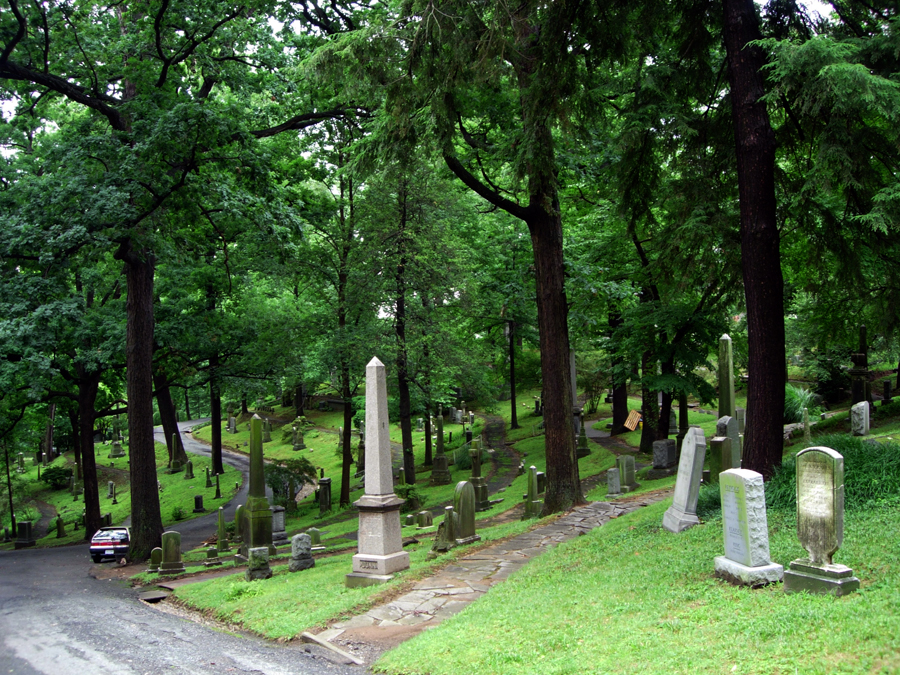
When I arrived in the vicinity of the cemetery, I was surprised to see that it was in a densely congested retail area, with the cemetery hidden on a hill overlooking the stores on Dulaney Valley Road. It was easy enough finding the cemetery entrance with Google Maps on my smartphone. Prospect Hill is an elegant yet relatively small spot – it would take you two minutes to drive through it. The single one-way paved road snakes through the upper level, then down through the lower one, and out the exit. Its been here since 1893 and there are many old gravemarkers among the new ones. The brightly-blooming azaleas presented a rather cheery accent to this heavily wooded setting in the light rain. 

Rear view of Divine's gravemarker

I wasn’t seeing any gaudily decorated stones as I drove through the lower level, so I checked Google Maps for “Divine’s Grave.” Sometimes this works. And it did. Just over there on the right, about fifty feet away. I pulled over, parked, and approached what thought must be Divine's grave - there appeared to be a small sign and some things around the stone. The light rain stayed mercifully light during my visit. 

Turned out to be the one. Divine's stone did have some small decorations around it - some plastic flowers and, of course, pink flamingoes - tastefully situated around the base. The grounds were quiet, no one else there.

Plastic dog poo at base of Divine's grave stone

So what else did I find at Divine’s grave? Nothing terribly outlandish. I mean, you WOULD expect to find a ring of brown plastic dog poo, right? And I did. Everything’s relative. If I have to explain, I’d rather just direct you to watch the movie, “Pink Flamingos.” And as Mr. Waters has stated during the wonderful Q & A section in his standup live performances, “In answer to everyone’s first question, ‘yes,’ Divine really did that.” Yet another reason why Divine’s legend will live on. 

There were three plastic pink flamingos in front of the stone – one of which had it’s butt cut off and stuffed with Styrofoam to accommodate a makeshift makeup kit. There were beads and coins, and some worn chalk messages on the face of the stone. Some crystals, some earrings. 


The makeup kit was a rather clever memento to leave. Divine’s unique makeup is iconic (click here for examples https://divineofficial.com), and I would think in some way influenced Sasha Velour’s artwork on the cover of the New Yorker. It is interesting to note that the John Waters movies Divine starred in – Pink Flamingos, Polyester, Female Trouble, Multiple Maniacs, Hairspray – were made in the 1970s and 80s, eras when flamboyantly made up drag queens were not quite as acceptable as they are today. (Oh, I am going to get SO much feedback for that last sentence!). But if you search the internet for photos of Divine, that face literally BEAMS with pride, does it not? The title of Velour’s self-portrait can just as well describe Divine’s countenance, “The Look of Pride.” So, hats off to Harris Glenn Milstead for taking such great risks and by doing so, becoming immortal.

Custom makeup kit at Divine's grave

I didn’t leave anything at Divine’s grave, but I did come away with a greater appreciation for Milstead’s art. I’ve long been a fan of John Waters and his work, but I hadn’t fully appreciated Divine’s role in all that. They both pushed boundaries that forced people to think differently about the world around them.

After paying my respects, I took a walk up the hill, thinking I might see a stone engraved with the name, “Waters,” but saw no such thing. Maybe John bought the plot, but not yet the stone. Or the stone is there, but not yet engraved. I can’t imagine it will say, “America’s Filth Elder,” but, who knows? It may pay to visit around Christmas, if you’re in the area:

“Waters himself is a regular visitor to the grave site, especially around the holidays, when he and Baltimore casting agent Pat Moran annually carry in a decorated tree. "Divine was a Christmas fanatic," he explains.” - https://www.baltimoresun.com/news/bs-xpm-2000-10-15-0010230265-story.html

And speaking of Christmas, I'll leave you with this item. As I was searching the internet for public domain images of Divine, this is what immediately popped up on my computer screen:


Wednesday, April 26, 2023

Death's Head and Soul Effigies in the Graveyard, West Orange, NJ


I mapped out my pre-meeting destination a few days before my trip to north Jersey – the West Orange Presbyterian Church. Why? If I got to the Newark area a couple hours before our group meetup time (11 a.m.), I can fit in a visit to this place and photograph some of the death’s head and angel head gravestones not commonly found in the Philadelphia area.

The morning of my trip from Philadelphia to the Oranges (near Newark, NJ) was rather busy. This was a Sunday morning at the beginning of April, 2023. I drove my wife and daughter to the airport at 3:30 am, as they needed to catch a 6:30 am flight to Miami. The airline demanded a three-hour arrival time because of the near-tornado situation that occurred the night before. After dropping them off, I came home and packed my photo gear for the trip north (about a 2-hour drive). I figured if I got there early, I would just explore one or two other nearby cemeteries.

After I packed the SUV and started to drive out of my neighborhood, the “Low Air in Tire” light came on my dashboard. A nuisance that crops up once every six months or so. In BMW’s wisdom, they don’t actually tell you which tire is low, so you have to check them all. Sigh. So I drove a mile to my local air pump station at the car wash in South Philly, checked the tires, found out the driver’s side rear tire was low. Filled it up and hit the highway. 

Our meetup group of cemetery photographers planned to begin the day in Holy Sepulchre Cemetery, in East Orange, then close the day down the road at Fairmount Cemetery. My early solo trip would be a prequel. On the way up the Jersey turnpike, I decided on which of two nearby cemeteries I’d visit first – the 18th century churchyard of the Presbyterian Church in West Orange, and then, if time permitted, Mount Pleasant Cemetery in East Orange.


I found the church and graveyard without much difficulty, arriving about 8 a.m. Sunny, but chilly – maybe 40 degrees. My friend Phil told me this burial ground had a lot of “soul effigy” headstones, which I was eager to see. He believes it has the largest number of existing stones carved in this style by Newark’s Uzal Ward and his several imitators.

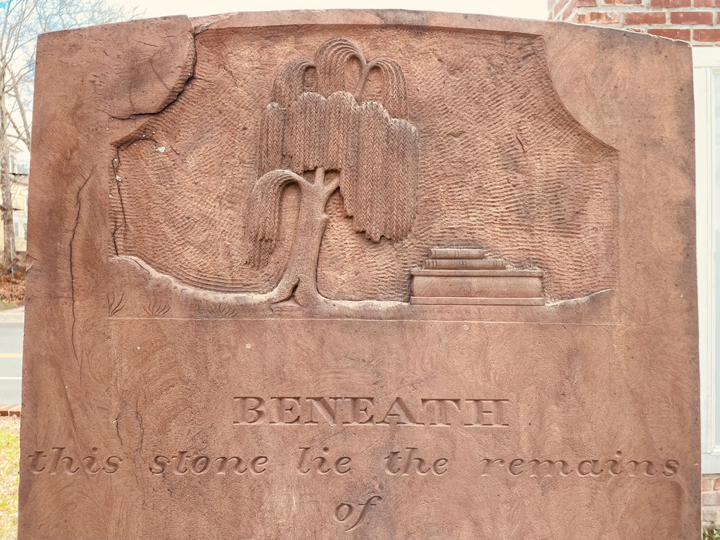
Soul effigy stones

Although there are some marble grave markers scattered along the front and sides of the church, the vast majority (literally hundreds) of markers here are of the brownish-red sandstone variety, commonly found from central New Jersey north throughout New England. Most are adorned with either the winged death’s head skull, or the angel head with wings. Inscribed death dates range from the early 1700s to the early 1800s. 

According to the Atlas Preservation article (ref.), Gravestone Evolution in America From the First Settlers to the Early Victorian Era, this locally quarried sandstone has “a very fine grain, and was relatively high in silicates. It tends to weather minimally and … concise lettering on stones dating back to as early as the middle to late 1600s can be easily read today…. “

This material is commonly known as “brownstone,” the slang term for sandstone that is brown in color. In the Atlas Preservation article, the author states that the reason sandstone was used was because “Stones needed to be soft enough to split and carved with hand tools, but durable enough to resist erosion.” It seems odd that it is so durable – you would think the “sands of time” would wear it down easily. The author accurately states, “A historical graveyard, and all that goes into it, is a kind of ancient puzzle, that I hope will intrigue you as it does me.”https://atlaspreservation.com/pages/american-gravestone-evolution-part-1

I’m no aesthete, but what I find most fascinating about these stones is the soul effigy carvings, as my friend Phil refers to them. He been sort of a death’s head divining rod for me lately – I really had no idea where to find them. Phil has explained to our Cemetery photography meetup group that such imagery is quite common in the old church graveyards of central and northern Jersey. 

Side door of First Shiloh Baptist Church, West Orange

This particular church, formerly Presbyterian, established in 1718, is now operated as the First Shiloh Baptist Church. The gargantuan brick and wooden structure has seen better days. It appears to be abandoned, but it is hard to say. Partially eaten food and canned goods rest near the entrances, trash surrounds the front grounds of the church, the woodwork is cracked and peeling. Although I saw no homeless people or vagrants in the area, it did appear to be a rest stop of sorts. 

Food at the front door.


Why such an equal mix of death’s head and angel head grave markers? Perhaps a hundred of each? I should have paid more attention to the death dates to see if they validated the following statement from Archeology.org:

“…the death's-head motif accompanied the harsh beliefs of orthodox Puritanism. Its replacement by the cherub reflected eighteenth century religious liberalization during the "Great Awakening," a period when some scholars believe orthodox Puritan views were being replaced by a more liberal perspective.” - https://archive.archaeology.org/8309/etc/gravestones.html


It would be interesting to see if the death’s head stones were generally older than the angel head ones. Maybe on my next trip - I guess that’s why they make tomorrows. 

My Next Adventure

Statue at First Shiloh
My next adventure turned out not to be Mount Pleasant Cemetery. After walking the grounds and photographing the headstones at First Shiloh for an hour, I jumped into the car to warm up, find a coffee shop, then zoom off to Mt. Pleasant Cemetery (about five miles away). As soon as I started my car, that pesky “Low Air in Tire” light came on my dashboard again. Rats! Obviously, I’ve got a slow leak. Where to find a tire repair place?!


Luckily, it was only 9 a.m. and I was scheduled to meet up with my friends at 11 a.m. So I had two hours. With my usual sangfroid, I typed “Tire Repair Near Me” into Google Maps on my cellphone instead of my typical message, “Cemetery Near Me.” Most places were closed, Firestone, gas stations, etc. However, there was a Mavis Discount Tire that opened at 9 am about five miles in the direction opposite my preferred direction. Beggars can’t be choosers, so off I went, tout de suite.

Took about half hour to get there, through lots of congested traffic areas, but I arrived about 9:30, and pulled into a large suburban retail resort. Drove past a Whole Foods in a strip mall to the Mavis at the bottom of the parking lot. Many cars in the parking lot. Ouch. Docked the Pequod and went into the customer area. At the counter I asked the fellow if they could fix a slow leak quickly. 

The guy started filling out the work order and asked me how far away I was visiting from, as he took the info from my Pennsylvania auto registration card. I told him a hundred miles away, and I need to get to a cemetery in an hour. He quickly looked up and a bit startled, said, “We’ll get you on the road as quickly as possible, sir.” I didn’t think I needed to explain that I was not heading for a funeral.

First Shiloh (Presbyterian) Church
I left my keys with him and told him I would walk up to the Whole Foods and be back soon. Feeling way more comfortable with the situation, I walked over to the Food Hole for coffee and a breakfast sammie. When I walked in I noticed they had potted gardenias on sale. I like having one in front of my house, so I figured I would buy one before I left. So after downing some breakfast, I bought a gardenia and headed down the parking lot toward Mavis Tire.

When I was about a hundred yards away, my cell phone rang. My car was ready. Thirty-two dollars to fix the nail hole in my tire and off I headed toward Holy Sepulchre Cemetery. For anyone’s reference, I give a five-star rating to the Mavis Tire Supply, LLC, at 235 Prospect Avenue in West Orange, New Jersey!

I ended up putting in a full day with my meetup friends at Holy Sepulchre and Fairmount Cemeteries, experiencing zero lassitude given the fact that I was running on about three hours’ sleep from the night before! But more on that excursion another time. The preprandial at Dunkin Donuts across from Holy Sepulchre helped me begin my day a third time - like a new angel getting its wings.


Sunday, February 19, 2023

"Lincoln in the Bardo" - Oak Hill Cemetery


As I sit here in my living room typing this passage, my thirteen-year-old daughter is practicing Bach’s Prelude in C minor on our piano. I can’t help but think it would be the perfect soundtrack to George Saunders’ recent novel, Lincoln in the Bardo.  The music is somber, as is the book. 

You may be wondering what a “bardo” is. I didn’t know before I read the book. I actually didn’t know until AFTER I read the book and started writing this essay. Saunders does not actually mention the word, or define it, in his book. According to Wikipedia:

'' ...bardo is the state of existence intermediate between two lives on earth. According to Tibetan tradition, after death and before one's next birth, when one's consciousness is not connected with a physical body, one experiences a variety of phenomena."

The bardo, then. And you might also assume “Lincoln” refers to Abraham. But it does not, It refers to his son Willie, who died at age twelve.

Oak Hill Cemetery gatehouse, Georgetown

The image you see at the beginning of this article is my photograph of the sculpture from the entrance to a mausoleum in Oak Hill Cemetery, in the Georgetown section of Washington, D.C. It is near the Carroll mausoleum, where Lincoln’s son was temporarily laid to rest when he died in 1862. As the story goes, Lincoln visited the mausoleum in the days following his son’s death, opening the casket and holding him in his arms.

I’ll let you digest that for a few moments. Maybe a few more moments if you are a parent.

Library of Congress

I made the "There Shall Be No Night There" photograph as well as many other images when I explored Oak Hill Cemetery back around 2005. I was unaware of the Willie Lincoln story at the time. In the fall of 2022, I learned of it through George Saunders’ novel, Lincoln in the Bardo (Random House, 2017). A librarian friend of mine told me about the book when I gave a lecture on abandoned cemeteries at her library. Sounded intriguing, so I bought and read the novel.

Densely wooded Oak Hill Cemetery

The book brought back vivid memories of how eerie Oak Hill was. I was there after a spring rain, and everything was slick and dripping. The caretaker warned me to stay on the sidewalks so I didn’t slip or fall into a sunken grave. He could easily have been Jack Manders, Oak Hill’s night watchman at the time of Lincoln’s visits. Manders, lantern in hand, would guide the President from the entry gate (see photo below) where he tied his horse, to the Carroll mausoleum in the dark. Manders would unlock the mausoleum door, and leave the father alone with his grief. This is all documented in Manders’ actual logbook from 1862.

Entrance to Oak Hill Cemetery

I never saw the Carroll mausoleum – didn’t go looking for it when I was at Oak Hill. Didn’t know anything about Willie Lincoln at the time. So why was Willie “temporarily” laid to rest there? Well, the Lincolns expected to move the family back to Illinois after the President’s term had ended. They planned to take Willie back with them for a proper burial. A clerk of the Supreme Court, William Carroll, let the Lincolns use his family mausoleum as a temporary resting place until they returned to Illinois. Abe never made it back to Illinois alive.

Willie Lincoln’s death: A private agony for a president facing a nation of pain - The Washington Post

“The remains of Willie Lincoln lay in the marble vault, locked behind an iron gate, for more than three years. On numerous occasions, author James L. Swanson wrote, “his ever-mourning father returned to visit him, to remember, and to weep,” even as he tried to hold the country together.

After Lincoln’s assassination in April 1865, Willie’s casket was exhumed and placed aboard the presidential funeral train for the journey back to Illinois. Father and son headed home together.”

Again, I’ll pause and let you think about that for a bit.

The majority of Saunders’ book is about the experience of Willie’s “ghost,” after his body was delivered to the mausoleum in a funeral procession. Willie’s experience involves many other people – or, ghosts” - with which he interacts while in Oak Hill Cemetery. It is a rather riveting story, one that you want to end well. But the way it ends is quite unsettling. 

The chapel on the cemetery grounds where Willie’s funeral service was held is shown in the above photo - Saunders refers to it in his story. I remember getting a creepy feeling walking past it those many years ago. The entire cemetery was gloomy, dark from its tall trees. I had a distinct sense of being alone.

Were I to return, I would probably not be able to think of anything but the characters and scenes from Lincoln in the Bardo, and the “matterlightblooming” phenomenon where the ghosts, or souls, disappear in a snap from the bardo and head to some other, undefined, state of existence. They avoid all talk (yes, they can talk to each other) of death, how they got to the bardo, or life itself – referring to our mortal world as the place they were before. They cannot admit to themselves that they are dead. Hence, the deep denial evinced by the sculpted phrase, "There Shall Be No Night There." Were I to return to Oak Hill Cemetery at this point, I think I would feel anything but alone. 

Further Reading: 

A review of Lincoln in the Bardo 

https://sevencircumstances.com/2018/01/10/a-triumph-of-imagination-lincoln-in-the-bardo-by-george-saunders/


Sunday, January 29, 2023

Clutching


Laurel Hill Cemetery, Philadelphia

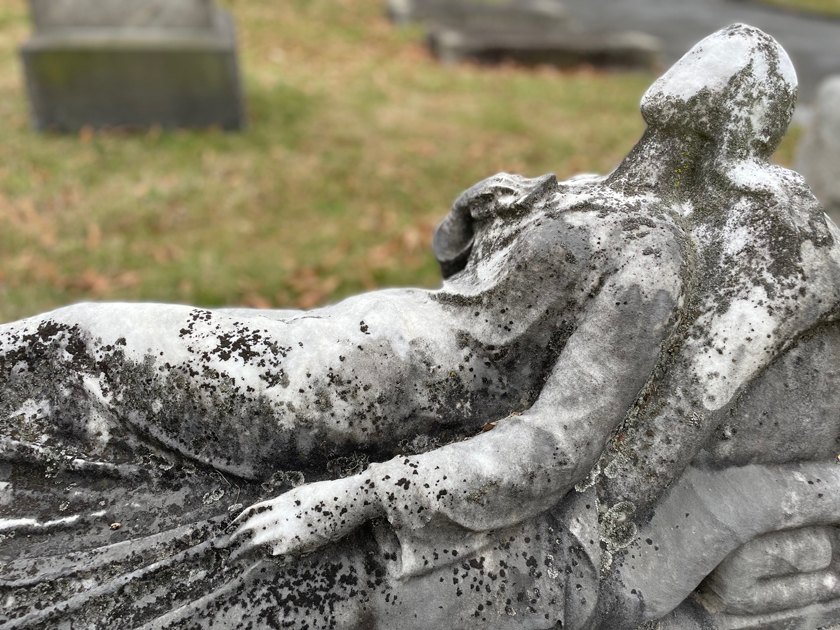
Look closely at the hand above, see how it is pulling on the bed covers? It appears to have a death grip on the sheets. This is a fairly common sculptural element in cemetery art. It’s impact was rather lost on me until I made this photograph. Well, not exactly when I MADE it, more so when I reviewed the images on my phone the next day. Why? Mainly because it reminded me of a Cemetery Traveler blog I had written some years ago. 

As I described in my June 17, 2020 post, “Johnny Thunders Dead in New Orleans,” (link below) I described how the guitarist formerly of the New York Dolls had a death grip on his bed covers when the hotel caretaker found his lifeless body. This was at the St. Peter Guest House – a rooming house - in New Orleans, in 1991. Thunders’ death grip may have looked just like what you see carved in this statue.

http://thecemeterytraveler.blogspot.com/2010/06/johnny-thunders-dead-in-new-orleans.html

So, what exactly is a “death grip?”

 “Death grip: A cadaveric spasm described as an instantaneous tightening of the hand or other body part at the time of death, the mechanism of which is unexplained.”

https://medical-dictionary.thefreedictionary.com/

Woodlands Cemetery, Philadelphia

At some point back in 1999, I spent a couple days photographing New Orleans cemeteries. As I described in the blog post mentioned above, I also visited the St. Peter Guest House, being a New York Dolls fan. Johnny Thunders died here. The Dolls were a flamboyant glam rock punk band that came into being in 1973, the mechanism of their popularity being also largely unexplained. Back then, you would rarely admit in public that you listened to glam or punk. Now, of course, their music is almost considered “classic rock.” I doubt the Dolls would have expected that their music would be listened to FIFTY years later!

By the same token, I certainly did not expect to be talking to the man who found Johnny’s body when I visited the St. Peter Guest House. As I have previously written, “Royce found Johnny on the floor next to his bed with the bedsheets crunched in a deathgrip by his stiff hands.” I invite you to read my account of this adventure here.

It is odd how things you see, smell, hear, and taste can remind you of a past experience. Often, the memory jumps to the forefront of our consciousness without warning. This is actually a good description of the New York Dolls themselves. In 1973, they jumped to the forefront of the music world’s consciousness without warning. 

In the same way as the death grip adds a stark, mortal detail to the serene form of these statues, we can be reminded of how Johnny Thunders and the Dolls added a stark, mortal detail to music’s serene form in 1973. The Dolls were scraping, clutching their way toward stardom, in the midst of the serene popular music hits of 1973. Take a look at the list below to see what they were up against. We always need someone to continually claw at the sheets of complacency.

Top Songs of 1973  (https://top40weekly.com/top-100-songs-of-1973/)

1 Tie a Yellow Ribbon Round the Ole Oak Tree - Tony Orlando & Dawn

2 Bad, Bad Leroy Brown - Jim Croce

3 Killing Me Softly with His Song - Roberta Flack

4 Let’s Get It On - Marvin Gaye

5 My Love - Paul McCartney & Wings

6 Why Me - Kris Kristofferson

7 Crocodile Rock - Elton John

8 Will It Go Round in Circles - Billy Preston

9 You’re So Vain - Carly Simon

10 Touch Me in the Morning - Diana Ross


Saturday, December 10, 2022

Cold Spring Church Graveyard, Cape May


During a wedding my wife and I attended in Cape May, New Jersey in June, 2022, I made a side trip to a local cemetery and a graveyard. Well, not DURING the wedding, the day after. One was St. Mary’s Catholic Cemetery, and the other was the graveyard of the Cold Spring Presbyterian Church. Why the distinction, cemetery versus graveyard? Graveyards are technically the burial place surrounding a church, while a cemetery is not. Technically.

I had received a heads up about Cold Spring Presbyterian, that it was an interesting old Victorian church and graveyard. I had no idea how absolutely fascinating it was! But I’m getting ahead of myself.

On Saturday morning, I got up around 7 a.m. and left my wife sleeping at the beachfront motel. The hotel was conveniently situated on Broadway, at the east end of the cape, where the commercial, touristy bustle winds down. Broadway becomes Seashore Road, and heads directly north to both locations I wanted to visit. It was a bit cool outside, so I grabbed a light jacket and headed out to the car. 

When I arrived at St. Mary’s, maybe two miles north, I drove in to a long, narrow cemetery with a center road. The place was maybe two city blocks long, with a separate cemetery to the left towards the end – Mt. Zion Cemetery. Both were rather nondescript, St. Mary’s had a few statues and one mausoleum. I got out of the car to check out the lovely headstone at the beginning of this essay and was surprised at how hot the air had gotten in the fifteen minutes since I left the hotel. Sunny Saturday at the beach, and here I am in a cemetery!

I didn’t spend much time here as it was not terribly interesting, and headed north another two miles. A quick drive made quicker as I listened to Black Sabbath’s song “Snowblind” on the car stereo. Cold Spring Presbyterian Cemetery is also known as the Old Red Brick Church Cemetery, which is what the sign says - “cemetery,” even though it’s a technically a graveyard. Go figure. But I don’t stand on ceremony. Saturday morning is preferable to Sunday when visiting a church graveyard, by the way. Why, you may ask? No services going on. When I arrived, there was not a car in the lot, not a soul around – well, not a living one anyway. 

Cold Spring Church, North Cape May, New Jersey

But oh were there the gravemarkers! All styles, all eras. And the ornamentation! I’ve not been this fascinated with Victorian ironwork since I visited Sleepy Hollow Cemetery in New York. Everywhere and in all directions, family plots with all the original Victorian fencing, decorative gates, and other design elements. The graveyard was immense, covering many acres on all sides of the church. Given the established date on the church itself – 1766 – I assume the graveyard is as old. There were modern graves on the south side of the property, with the oldest nearest to the church. 

Victorian-era ironwork

There was a fascinating bronze art deco style family plot with just one headstone. The green patina of the posts and other decorative elements were breathtaking. The date of the stone – 1922 – coincides with the art deco era. Decorative. Personalized gates were plentiful – on some plots, the fencing was gone, leaving only the gates. Such metal work is usually absent from cemeteries for a variety of reasons. Scrap metal was of great value during WWII, so much of the cast iron was scrapped to build more weapons.


Also, the decorative ironwork prevalent in Victorian cemeteries fell into disfavor among the fashionistas of the 1920s – it was viewed as being too gaudy, elaborate, and dated. In essence, an embarrassment to the family owners, descendants! GOMI, or trash, as the Japanese would have called it. People forget that the avant garde of the 1920s was Art Deco. Families would remove and discard such beautiful Victorian Gothic ironwork as this harp-shaped gate, along with all the associated fencing surrounding a dynasty plot. 


Whatever ironwork remained in U.S. cemeteries after the 1920s was probably removed in the 1940s to help with the war effort. World War II ushered in a massive recycling era for scrap metal, as this was needed to build battleships. Americans were instructed to collect even the smallest hoard of scrap material so as to help the war effort. If you check the photos in this article, you can easily surmise how cemetery fencing may have disappeared (https://www.bygonely.com/scrap-metal-drives-world-war-ii/). 

Yet so much of it remains here around the graves of the Cold Spring Presbyterian Church. I wish I knew why. Winters here in North Cape May (right on the Delaware Bay) are brutal, but the surrounding trees must protect the stones from the elements. The massive brick church is in fine shape. Many of the thousands of gravemarkers here are also in fine condition, marking the many more thousands buried here beneath the sand. 

Certainly makes one ponder the whole idea of solipsism. None of my surroundings here are open to doubt, as far as I can tell. Such a scene that is all so different to me and unexpected just cannot be a figment of my imagination. My imagination is not that creative. Around 9:30 a.m., my cell phone rang. It was not Rene Descartes, it was wife. “Where are you?” she asked. I responded, “Where else would I be?” Knowing the answer, she asked if I could bring coffee back for her.