Showing posts with label Abraham Lincoln. Show all posts

Sunday, February 19, 2023

"Lincoln in the Bardo" - Oak Hill Cemetery


As I sit here in my living room typing this passage, my thirteen-year-old daughter is practicing Bach’s Prelude in C minor on our piano. I can’t help but think it would be the perfect soundtrack to George Saunders’ recent novel, Lincoln in the Bardo.  The music is somber, as is the book. 

You may be wondering what a “bardo” is. I didn’t know before I read the book. I actually didn’t know until AFTER I read the book and started writing this essay. Saunders does not actually mention the word, or define it, in his book. According to Wikipedia:

'' ...bardo is the state of existence intermediate between two lives on earth. According to Tibetan tradition, after death and before one's next birth, when one's consciousness is not connected with a physical body, one experiences a variety of phenomena."

The bardo, then. And you might also assume “Lincoln” refers to Abraham. But it does not, It refers to his son Willie, who died at age twelve.

Oak Hill Cemetery gatehouse, Georgetown

The image you see at the beginning of this article is my photograph of the sculpture from the entrance to a mausoleum in Oak Hill Cemetery, in the Georgetown section of Washington, D.C. It is near the Carroll mausoleum, where Lincoln’s son was temporarily laid to rest when he died in 1862. As the story goes, Lincoln visited the mausoleum in the days following his son’s death, opening the casket and holding him in his arms.

I’ll let you digest that for a few moments. Maybe a few more moments if you are a parent.

Library of Congress

I made the "There Shall Be No Night There" photograph as well as many other images when I explored Oak Hill Cemetery back around 2005. I was unaware of the Willie Lincoln story at the time. In the fall of 2022, I learned of it through George Saunders’ novel, Lincoln in the Bardo (Random House, 2017). A librarian friend of mine told me about the book when I gave a lecture on abandoned cemeteries at her library. Sounded intriguing, so I bought and read the novel.
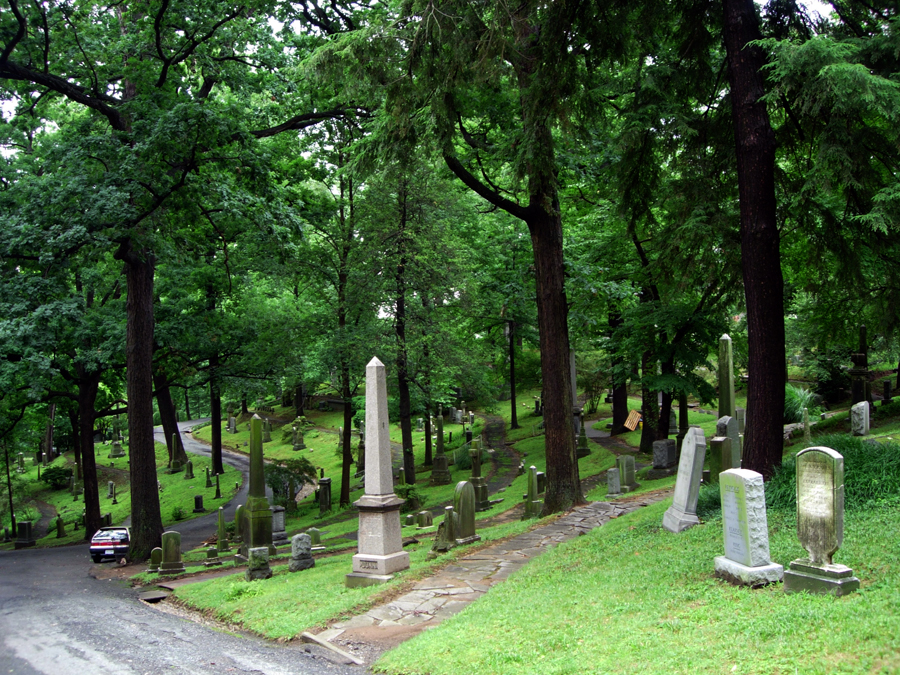
Densely wooded Oak Hill Cemetery

The book brought back vivid memories of how eerie Oak Hill was. I was there after a spring rain, and everything was slick and dripping. The caretaker warned me to stay on the sidewalks so I didn’t slip or fall into a sunken grave. He could easily have been Jack Manders, Oak Hill’s night watchman at the time of Lincoln’s visits. Manders, lantern in hand, would guide the President from the entry gate (see photo below) where he tied his horse, to the Carroll mausoleum in the dark. Manders would unlock the mausoleum door, and leave the father alone with his grief. This is all documented in Manders’ actual logbook from 1862.

Entrance to Oak Hill Cemetery

I never saw the Carroll mausoleum – didn’t go looking for it when I was at Oak Hill. Didn’t know anything about Willie Lincoln at the time. So why was Willie “temporarily” laid to rest there? Well, the Lincolns expected to move the family back to Illinois after the President’s term had ended. They planned to take Willie back with them for a proper burial. A clerk of the Supreme Court, William Carroll, let the Lincolns use his family mausoleum as a temporary resting place until they returned to Illinois. Abe never made it back to Illinois alive.

Willie Lincoln’s death: A private agony for a president facing a nation of pain - The Washington Post

“The remains of Willie Lincoln lay in the marble vault, locked behind an iron gate, for more than three years. On numerous occasions, author James L. Swanson wrote, “his ever-mourning father returned to visit him, to remember, and to weep,” even as he tried to hold the country together.

After Lincoln’s assassination in April 1865, Willie’s casket was exhumed and placed aboard the presidential funeral train for the journey back to Illinois. Father and son headed home together.”

Again, I’ll pause and let you think about that for a bit.

The majority of Saunders’ book is about the experience of Willie’s “ghost,” after his body was delivered to the mausoleum in a funeral procession. Willie’s experience involves many other people – or, ghosts” - with which he interacts while in Oak Hill Cemetery. It is a rather riveting story, one that you want to end well. But the way it ends is quite unsettling. 

The chapel on the cemetery grounds where Willie’s funeral service was held is shown in the above photo - Saunders refers to it in his story. I remember getting a creepy feeling walking past it those many years ago. The entire cemetery was gloomy, dark from its tall trees. I had a distinct sense of being alone.

Were I to return, I would probably not be able to think of anything but the characters and scenes from Lincoln in the Bardo, and the “matterlightblooming” phenomenon where the ghosts, or souls, disappear in a snap from the bardo and head to some other, undefined, state of existence. They avoid all talk (yes, they can talk to each other) of death, how they got to the bardo, or life itself – referring to our mortal world as the place they were before. They cannot admit to themselves that they are dead. Hence, the deep denial evinced by the sculpted phrase, "There Shall Be No Night There." Were I to return to Oak Hill Cemetery at this point, I think I would feel anything but alone. 

Further Reading: 

A review of Lincoln in the Bardo 

https://sevencircumstances.com/2018/01/10/a-triumph-of-imagination-lincoln-in-the-bardo-by-george-saunders/


Thursday, January 30, 2014

John McCullough and Edwin Adams at Mount Moriah Cemetery

John McCullough
This is a continuation of last week’s Cemetery Traveler blog, a fine piece guest-written by my friend Julie Esty, entitled, “Death’s Playhouse” (a link to that blog is provided at the end). It is a brief account of the friendship between two celebrated thespians from nineteenth century America, John McCullough and Edwin Adams, who are buried in Philadelphia’s Mount Moriah Cemetery. In the present article, I’d like to give you some “behind the scenes” information on their monuments and their grave sites.

McCullough monument, c. 1888 (ref.)
The McCullough monument is a grand affair, a large and ornate tower of Quincy granite rising 36 feet off the ground. It rests over the McCullough family plot in Section 122, on the Yeadon side of the cemetery, behind the hilly section where all the mausoleums are. The Adams monument is much smaller, and is on the Philadelphia side of the cemetery. While McCullough was likely held in greater esteem by many more people than was Adams, it is interesting to note that theatrical actors in general found greater favor with the American public as time marched on past 1865. Edwin Adams died in 1877, whereas McCullough died in 1885. With the assassination in 1865 of President Abraham Lincoln by the actor John Wilkes Booth, the American public, for a time, held actors in great disdain. (Edwin Booth, John Wilkes' brother, is considered by many historians to be the greatest American actor of the nineteenth century. Both John McCullough and Edwin Adams were members of Edwin Booth's acting company.)

Like the bond of friendship shared by Adams and McCullough, their graves are similarly forgotten and overgrown. The grave sites of these two celebrated stage actors, being inaccessible to the public, do nothing, currently, to help keep them in our memory. The Friends of Mount Moriah Cemetery, Inc., will undoubtedly do something about that.

Regardless of the size and fanciness of one memorial relative to the other, both are hidden by the densely overgrown foliage. You would never find either grave without very specific directions. The McCullough monument, aside from having the large bronze bust of John McCullough removed, is in relatively good condition. It is fairly easy to discern through the Japanese knotweed in the winter time. In summer, the dense trees and other growth hide most of it, save its ascending granite flame, "typical of the aspiring soul in its escape from mortal encasement" (ref.).

Edwin Adams' grave site, Mount Moriah Cemetery, Philadelphia

I’ve known of the existence of the McCullough monument for some time now. With the help of the Friends of Mount Moriah Cemetery, Inc., I located Adams’ grave a couple weeks ago. It is in Section 203, in as much of a jungle of dense woods as is McCullough’s. Deer are probably the most frequent visitors to his grave, evidenced by the numerous beds and runs. The Friends’ group has not yet gotten back to this area to do any weed or tree cutting, but that’s just a matter of time. There is, however, work being done to access the area around the McCullough monument.

“The massive base from which it springs is adorned on its front face with a design of crossed foils, and the fasces of the Roman lictors, flanked on either side by the masks of Tragedy and Comedy, and crowned by the Scotch thistle.” (ref.)
Center pedestal where bust originally sat
 The McCullough monument is quite impressive for its sheer grandeur. When it was created in 1888, it cost $9300.00 (which equates to $232,000 in 2014 terms based on the Consumer Price Index). At this point the monument is easily accessible via the roadway behind the hill atop which the mausolea reside. The monument is actually situated at the highest elevation within the cemetery’s 240 acres (ref.). “Late in the summer of 1888 the granite monument, with a massive and splendid bronze bust of John McCullough, was placed at the actor's grave …,” so says William Winter in his 1889 book, “In memory of John McCullough ....” A cursory glance will show the bust to be gone – removed or perhaps stolen somewhere along the line. The bust appears to be very similar to the image at the very beginning of this article. A fascinating point that makes the McCullough memorial unique and notable is that “it is the first monument ever raised to the memory of an actor in this country, if not in the world (ref.)”

Following the death of his good friend Edwin Adams in 1877, McCullough was asked to supply an inscription for the late thespian’s memorial in Mount Moriah Cemetery.  McCullough selected this line from Shakespeare’s Julius Caesar, Act 5, Scene 5 –

Inscription on John McCullough's monument

His life was gentle, and the elements so mixed in him that Nature might stand up and say to all the world, “This was a man.”

Edwin Adams (ref.)
John McCullough's own memorial, incidentally, bears the same quotation (which appears in the photo above). My principal reason for trying to locate Adams’ memorial was to see this Shakespearean inscription reputed to be on his stone. Unfortunately and after much searching, I discovered that the black marble Adams monument had fallen, and was being eaten by the earth. It appears to be about four feet long and about twenty inches square. Only about an inch of the stone’s back is visible, meaning that the inscription lies buried face down.

Edwin Adams' grave site, Mount Moriah Cemetery
With ground subsidence and maybe a little help from vandals, this small, yet elegant memorial has all but disappeared. The only thing left to be readily seen are the twin granite entry posts to the plot. Sometimes the family name is engraved on the steps leading up to the plot, but this does not seem to be the case here. All in all, this presents itself as a springtime project, i.e. excavating Adams’ monument so the inscription can be read. It will be another in a steadily progressing series of notables being brought to light in Mount Moriah, as Pennsylvania’s largest Victorian-era cemetery continues its renaissance under the direction of the Friends of Mount Moriah Cemetery, Inc.

Front of McCullough family plot, Mount Moriah Cemetery
John McCullough was a serious actor, a tragedian, whereas Edwin Adams was a comedian. The former attained greater notoriety, and apparently, wealthier friends. McCullough’s friends’ names appear on the rear of the monument [most notably William M. Conner, who suggested having the monument built as a lasting tribute to his friend, shortly after McCullough’s death]. McCullough was something of a superstar in his own time. “Genial” John Edward McCullough “was one of the most popular and successful actors on the American stage, earning an average of $50,000 a year” (ref.). In the late 1800s, this was obviously an enormous sum of money.

“When the superintendent of Mount Moriah Cemetery, where rests the dust his great spirit once vitalized, could express profound surprise at the enduring longevity of the affection this man inspired, since the tomb of none other among the many silent occupants of his vast city of the dead, is ever sought out and inquired for with such abiding interest, such pathos of tender memory, as is that of the great actor today [in 1905, twenty years after McCullough’s death], a tribute is thereby paid to the majesty of a soul, which, in its passage through this world, briefly ‘pressed the earth but stained it not.’”                                                                                                                              -From the book, John McCullough as man, actor and spirit, by Susie Champney Clark, 1905.

John McCullough as Virginius
William Winter, in his book, In Memory of John McCullough ..., states:
“The McCullough monument stands at the head of the grave, over which the bust of the actor, in his favorite [Shakespearean] character [the ill-fated Roman centurion] Virginius, seems an image of perfect and noble repose, as calm and majestic as the day that it greets at its coming. The main fabric of the monument, imposed upon a commodious pedestal, is a huge block of polished granite. On this are reared four pillars, which support a stone canopy surmounted by an urn. Beneath the canopy stands the bust, which is of colossal size. The pillars are sculptured with vines of ivy. The top of the urn is thirty-six feet from the ground.”

The formal dedication of John McCullough’s memorial occurred on November 27, 1888:

"The scene at McCullough's grave when his monument was dedicated lacked no element of impressive simplicity. The day was somber and chill. A sad, gray sky brooded, as if in sorrow, over the still and melancholy landscape — of withered lawn and leafless trees, with, all around, the cold memorials of the dead. It was one of those pensive, soundless days when Nature seems to sympathize with the grief, the perplexities, the wistful anxiety of man." (Ref.)

William F. Johnson’s introductory address at the dedication:

"Heroes have had their last resting-places marked with imperishable marble, in admiration of their power to slaughter men and wreak misery upon their fellow-creatures; poets for the sweetness of their songs; rulers for their excellence in statecraft; but few are honored, as our dead friend is to-day, for personal worth, unostentatious charities, and a beneficent life." (Ref.)

McCullough family crypt cover
John Edward McCullough enjoyed national renown, having made his professional debut at the Arch Street Theatre, Philadelphia, in 1857. He became more famous than his good friend Edwin Adams, both during and after his lifetime. McCullough’s ghost supposedly haunts the National Theatre in Washington, D.C, where he was shot and killed by a fellow stage performer in 1885. Maybe he hangs around there looking for his head. His wife Letitia had it autopsied after he died so maybe it’s not buried with the rest of him at Mount Moriah! Letitia is buried in the family plot with John; a large black marble crypt cover lies in front of the monument, on which are inscribed the names of later burials of the McCullough family.

References and Further Reading:
John McCullough as man, actor and spirit by Susie Champney Clark 1905
In memory of John McCullough ..., by William Winter, 1889, De Vinne press 
"GENIAL" JOHN MCCULLOUGH: ACTOR AND MANAGER
The Last Days of John McCullough, by Joseph Haworth, 1894
JohnMcCullough — The Ghost of the National Theatre? 

Death's Playhouse (Part one of the McCullough/Adams story on the Cemetery Traveler)
Friends of Mount Moriah Cemetery, Inc.

Thursday, November 24, 2011

Thanksgiving and Abandoned Cemeteries

Its six a.m. and raining outside. I’m nursing a head cold. Still, I’m thanking the Lord for yet another day above ground. It is Thanksgiving Day, as it happens. Rainy, bleak mornings like this make me think of abandoned graveyards, and how the cold and dismal rain beats down on the old stones. It can be a pitiful sight.

Prior to my cemetery travels, I don’t remember even being aware of the existence of an “abandoned cemetery.” Surely, when I bring up the subject at parties, people look at me funny. You’d be surprised how many folks are unfamiliar with the concept. They might ask, “How do cemeteries become 'abandoned?'" Well, that’s the topic for today, friends. How do they become abandoned? And what happens to them after they attain this substandard status? 

Mount Vernon Cemetery, Philadelphia
Well, first off, what do we mean by ‘abandoned?’ Intuitively, we would think no new burials have occurred in decades, and there is no “perpetual care” of the graves. Relatives stopped visiting ages ago. The place becomes overgrown and filled with trash. While this is mostly true, there are actually LEGAL definitions. For instance, state of Missouri law says an abandoned cemetery is one in which no one has been buried for at least 25 years (RSMo 214.131). 

Resurfaced Texas Cemetery
When I was headed for Texas last spring, I went searching for abandoned cemeteries on the Internet, when I realized, “Hey, there are ghost towns throughout the old west!” In many of these deserted places, the last structures standing are – you guessed it – tombstones. A news item was brought to my attention last week by my friend Renee Rausch: a Texas town, complete with cemetery – recently reappeared as the lake covering it dried up in a drought! Tex-Atlantis had been submerged beneath 30 feet of water for the past 50 years! There are little forgotten small-town graveyards still standing all across America,from long-gone 1850s gold and silver mining towns in California and Nevada to long-exhausted coal mining towns in Pennsylvania.

There are probably hundreds of reasons why cemeteries get abandoned − I’ve only run into a few of them. Religious sect cemeteries that are left standing and unattended after the congregation is disbanded (a la B'nai Israel Cemetery in West Philly). Private little family plots on the old homestead (I’ve seen these in Virginia), where the homestead had long ago been divvied up and sold off as small land parcels leaving the little graveyard in the woods. Or the farmer’s field where they’ve plowed around an island of headstones for as long as anyone can recall. Facebook friends tell me these exist all over the country. In some states, you have legal right to cross private property to visit a cemetery that has no public access!

Philadelphia's Mt. Moriah Cemetery
Most people think cemeteries simply exist. You know, just hovering out there on the fringes of polite society. Far from fact. Even if you had come across the reality of an abandoned cemetery, you probably never even thought about how it got that way. People may ask, “How could ‘they’ let it go to pieces like that?” The key word here is ‘THEY.’ In the case of Philadelphia’s most notorious abandoned cemetery, Mount Moriah (which happens to also be the largest cemetery in Pennsylvania), the owners can’t be found. They’ve all long since died and there’s no one left from the original board of directors to take responsibility for the upkeep of this several-hundred-acre overgrown forest. The city has an albatross on its hands.

Sometimes I think we have the same false notions about cemeteries as we have about Thanksgiving (which had nothing to do with turkey and pumpkin pie, or giving thanks, for that matter). Thanksgiving Day was a single event in 1621, one day when politics brought pilgrims and Indians together. Tension and posturing by each group was evident as Pilgrims and Indian tribes attempted to ensure their own survival. What has come to be accepted as a harvest celebration or day of thanks wasn’t even referred to as “Thanksgiving” day until 1841. Thanksgiving as we know it did not become a national holiday until 1863, when Abraham Lincoln could no longer take the relentless badgering by Godey’s Lady’s Book editor Sarah Josepha Hale. He conceded that it might help national unification after the Civil War. Needless to say, the idea of a New England-originated Thanksgiving Day Holiday was not embraced by Southern states.

But I seem to be getting off track here. I apologize. My narrative may become more linear as the effects of whatever medication I ingested last night wears off. The Native American community calls our Thanksgiving Day their “National Day of Mourning,” the day they mourn the genocide of their ancestors and the theft of their land.  This largely fabricated holiday of ours is a prime example of history re-written to make us feel better about ourselves. Kind of reminds me of the following story.

Franklin Cemetery, c. 1940
When you read about how bodies are reinterred elsewhere so a cemetery can be repurposed, think about what happened to the residents of Philadelphia’s Franklin Cemetery in the 1940s. This cemetery in the city’s Kensington neighborhood was at the center of a political swindle gone bad. Its 8,000 buried bodies disappeared when someone was promised a huge profit if he sold the cemetery land back to the city after the bodies had been removed. An outraged citizen (Margaret Alice Butler) even wrote a song about it! Part of it goes like this:
"I'm telling you, in this day and age,
The dead people aren't even safe.
. . . Everyone's out for that almighty dollar.
Now only if the dead could holler."
What can happen after a cemetery is abandoned is that it can get condemned and then obliterated, if the land has any value. The bodies are (theoretically) moved and the land is repurposed. That’s the case with the photo at the beginning of this article. It may seem shocking, and it is. In 1922, Philadelphia condemned the Hanover Street Burial Ground, and left it up to relatives of the deceased to remove the bodies!

The Business of Running a Cemetery
Unless a non-profit group is responsible for it, a cemetery is run as a business. As such, it is susceptible to all the financial problems any business might experience – a bad year, a drop in popularity, embezzlement of funds by the owners or other financial mismanagement, and of course, over time, it can become filled up, so no more burials are possible!

Discarded tombstones along Delaware River
After cemeteries are abandoned, what happens to them? The Hanover Cemetery situation is one hard dose of reality. A derelict cemetery can be an eyesore, blight on the community. Back in the 1950s, people just were not into cemetery upkeep like they are today – it could easily get plowed over in the name of urban renewal. Sometimes relatives are contacted to move the bodies before the city either paves over the cemetery or moves the bodies to a mass grave somewhere. This happened in many major cities. Both San Francisco and Philadelphia dismantled many old cemeteries (because the land was getting too valuable) and dumped the monuments and grave markers in the local waterways.

Though they seem to be in the limelight right now (with many neighborhood efforts to clean them up and restore them), abandoned graveyards are not a modern issue, a contemporary conundrum. The Hanover photo at top was taken around 1922! By then, the Hanover Street Burial Ground in Philadelphia’s Fish town neighborhood had long been abandoned (it was about 117 years old). (My thanks to Ken Milano for allowing me to use the image from his superb book, Palmer Cemetery and the Historic Burial Grounds of Kensington and Fishtown). Capitola Playground in South Philly and Johnson Cemetery Park (I swear this is really what it’s called, see blog) in Camden Jew Jersey were both originally forgotten cemeteries landscaped over to become neighborhood parks.

Some forsaken cemeteries reside on land that is worthless to real estate developers. These are the ones that languish, and may never get revitalized by any charitable organization. Small ones seem forlorn and pitiful, larger ones can be frightening, like sleeping monsters. The detritus of a civilization, one that doesn’t seem to attach much value to its own history.


As I watch a scavenger outside my kitchen window pick through my trash, I’m taken by its parallel to my interest in abandoned cemeteries. I feel like I’m picking through things other people no longer want. Looking for something that interests me, never really knowing what I might find. The more we educate ourselves about cemeteries, the more can we learn about ourselves – information is preservation. Preserving memory is supposed to be what cemeteries are all about, isn’t it? Well, maybe there are some things we’d just rather not be reminded of.

References and Further Reading:

Ed Snyder has written many Cemetery Traveler blogs about abandoned cemeteries. Here are a few:
New Jersey: Abandoned Cemetery...or just Repurposed?