Showing posts with label sandstone grave markers. Show all posts

Wednesday, April 26, 2023

Death's Head and Soul Effigies in the Graveyard, West Orange, NJ


I mapped out my pre-meeting destination a few days before my trip to north Jersey – the West Orange Presbyterian Church. Why? If I got to the Newark area a couple hours before our group meetup time (11 a.m.), I can fit in a visit to this place and photograph some of the death’s head and angel head gravestones not commonly found in the Philadelphia area.

The morning of my trip from Philadelphia to the Oranges (near Newark, NJ) was rather busy. This was a Sunday morning at the beginning of April, 2023. I drove my wife and daughter to the airport at 3:30 am, as they needed to catch a 6:30 am flight to Miami. The airline demanded a three-hour arrival time because of the near-tornado situation that occurred the night before. After dropping them off, I came home and packed my photo gear for the trip north (about a 2-hour drive). I figured if I got there early, I would just explore one or two other nearby cemeteries.

After I packed the SUV and started to drive out of my neighborhood, the “Low Air in Tire” light came on my dashboard. A nuisance that crops up once every six months or so. In BMW’s wisdom, they don’t actually tell you which tire is low, so you have to check them all. Sigh. So I drove a mile to my local air pump station at the car wash in South Philly, checked the tires, found out the driver’s side rear tire was low. Filled it up and hit the highway. 

Our meetup group of cemetery photographers planned to begin the day in Holy Sepulchre Cemetery, in East Orange, then close the day down the road at Fairmount Cemetery. My early solo trip would be a prequel. On the way up the Jersey turnpike, I decided on which of two nearby cemeteries I’d visit first – the 18th century churchyard of the Presbyterian Church in West Orange, and then, if time permitted, Mount Pleasant Cemetery in East Orange.


I found the church and graveyard without much difficulty, arriving about 8 a.m. Sunny, but chilly – maybe 40 degrees. My friend Phil told me this burial ground had a lot of “soul effigy” headstones, which I was eager to see. He believes it has the largest number of existing stones carved in this style by Newark’s Uzal Ward and his several imitators.

Soul effigy stones

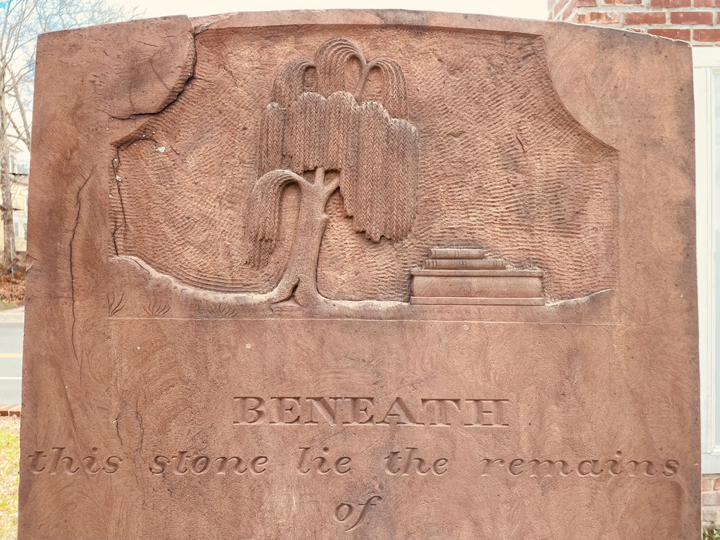
Although there are some marble grave markers scattered along the front and sides of the church, the vast majority (literally hundreds) of markers here are of the brownish-red sandstone variety, commonly found from central New Jersey north throughout New England. Most are adorned with either the winged death’s head skull, or the angel head with wings. Inscribed death dates range from the early 1700s to the early 1800s. 

According to the Atlas Preservation article (ref.), Gravestone Evolution in America From the First Settlers to the Early Victorian Era, this locally quarried sandstone has “a very fine grain, and was relatively high in silicates. It tends to weather minimally and … concise lettering on stones dating back to as early as the middle to late 1600s can be easily read today…. “

This material is commonly known as “brownstone,” the slang term for sandstone that is brown in color. In the Atlas Preservation article, the author states that the reason sandstone was used was because “Stones needed to be soft enough to split and carved with hand tools, but durable enough to resist erosion.” It seems odd that it is so durable – you would think the “sands of time” would wear it down easily. The author accurately states, “A historical graveyard, and all that goes into it, is a kind of ancient puzzle, that I hope will intrigue you as it does me.”https://atlaspreservation.com/pages/american-gravestone-evolution-part-1

I’m no aesthete, but what I find most fascinating about these stones is the soul effigy carvings, as my friend Phil refers to them. He been sort of a death’s head divining rod for me lately – I really had no idea where to find them. Phil has explained to our Cemetery photography meetup group that such imagery is quite common in the old church graveyards of central and northern Jersey. 

Side door of First Shiloh Baptist Church, West Orange

This particular church, formerly Presbyterian, established in 1718, is now operated as the First Shiloh Baptist Church. The gargantuan brick and wooden structure has seen better days. It appears to be abandoned, but it is hard to say. Partially eaten food and canned goods rest near the entrances, trash surrounds the front grounds of the church, the woodwork is cracked and peeling. Although I saw no homeless people or vagrants in the area, it did appear to be a rest stop of sorts. 

Food at the front door.


Why such an equal mix of death’s head and angel head grave markers? Perhaps a hundred of each? I should have paid more attention to the death dates to see if they validated the following statement from Archeology.org:

“…the death's-head motif accompanied the harsh beliefs of orthodox Puritanism. Its replacement by the cherub reflected eighteenth century religious liberalization during the "Great Awakening," a period when some scholars believe orthodox Puritan views were being replaced by a more liberal perspective.” - https://archive.archaeology.org/8309/etc/gravestones.html


It would be interesting to see if the death’s head stones were generally older than the angel head ones. Maybe on my next trip - I guess that’s why they make tomorrows. 

My Next Adventure

Statue at First Shiloh
My next adventure turned out not to be Mount Pleasant Cemetery. After walking the grounds and photographing the headstones at First Shiloh for an hour, I jumped into the car to warm up, find a coffee shop, then zoom off to Mt. Pleasant Cemetery (about five miles away). As soon as I started my car, that pesky “Low Air in Tire” light came on my dashboard again. Rats! Obviously, I’ve got a slow leak. Where to find a tire repair place?!


Luckily, it was only 9 a.m. and I was scheduled to meet up with my friends at 11 a.m. So I had two hours. With my usual sangfroid, I typed “Tire Repair Near Me” into Google Maps on my cellphone instead of my typical message, “Cemetery Near Me.” Most places were closed, Firestone, gas stations, etc. However, there was a Mavis Discount Tire that opened at 9 am about five miles in the direction opposite my preferred direction. Beggars can’t be choosers, so off I went, tout de suite.

Took about half hour to get there, through lots of congested traffic areas, but I arrived about 9:30, and pulled into a large suburban retail resort. Drove past a Whole Foods in a strip mall to the Mavis at the bottom of the parking lot. Many cars in the parking lot. Ouch. Docked the Pequod and went into the customer area. At the counter I asked the fellow if they could fix a slow leak quickly. 

The guy started filling out the work order and asked me how far away I was visiting from, as he took the info from my Pennsylvania auto registration card. I told him a hundred miles away, and I need to get to a cemetery in an hour. He quickly looked up and a bit startled, said, “We’ll get you on the road as quickly as possible, sir.” I didn’t think I needed to explain that I was not heading for a funeral.

First Shiloh (Presbyterian) Church
I left my keys with him and told him I would walk up to the Whole Foods and be back soon. Feeling way more comfortable with the situation, I walked over to the Food Hole for coffee and a breakfast sammie. When I walked in I noticed they had potted gardenias on sale. I like having one in front of my house, so I figured I would buy one before I left. So after downing some breakfast, I bought a gardenia and headed down the parking lot toward Mavis Tire.

When I was about a hundred yards away, my cell phone rang. My car was ready. Thirty-two dollars to fix the nail hole in my tire and off I headed toward Holy Sepulchre Cemetery. For anyone’s reference, I give a five-star rating to the Mavis Tire Supply, LLC, at 235 Prospect Avenue in West Orange, New Jersey!

I ended up putting in a full day with my meetup friends at Holy Sepulchre and Fairmount Cemeteries, experiencing zero lassitude given the fact that I was running on about three hours’ sleep from the night before! But more on that excursion another time. The preprandial at Dunkin Donuts across from Holy Sepulchre helped me begin my day a third time - like a new angel getting its wings.


Monday, August 29, 2016

Ebeneezer Price, Colonial-era Gravestone Carver

My knowledge of eighteenth-century American headstone carvers is rather limited. What I do know has been gleaned from my relationship with the Association for Gravestone Studies. This organization publishes such scholarly information in their quarterly journal (see link at end). So when I personally happened upon evidence of such a headstone carver right before my eyes, I became immediately interested.

Pennington Presbyterian Church, Pennington, New Jersey.

Walking through the Presbyterian Church graveyard in Pennington, New Jersey, I noticed seven red sandstone grave markers all in a row – six large (standard-sized), and one small. Recognizing them as the oldest on the site, I thought perhaps they might have the old “angel-head” carving at top (I initially spotted them from behind). I walked around the thick (three inch) slabs with the roughly carved backs and, lo and behold, three of the large stones had angel heads carved at top, while two had a sunrise! I get rather excited to find these as they are quite uncommon outside New England. New Jersey cemeteries seems to be the southern cutoff point. Why is this?

Rear view of red sandstone grave markers

Well, New England was one of the first areas of the north American continent to be settled by Europeans and the first to become densely populated. Therefore, the oldest graveyards are there. The Puritanical flair of the headstone artisans and craftsmen is evident on early headstone carvings throughout that region. As time went on, populations grew and spread out from New England. Belief systems changed, different materials were used for grave markers, and this particular type of angel head was replaced with other symbolism (or none at all).

"Sunrise" symbolism

White marble became a popular choice as a replacement for red and brown sandstone, as Vermont and Philadelphia quarries boomed in the late 1700s. Angel heads appear on old marble stones too, but marble wears easily and detail is quickly lost. Sandstone retains detail better, but cracks more easily. Central and northern New Jersey’s sandstone quarries supplied the need for grave marker material from the end of the seventeenth century until the beginning of the nineteenth century.

Small headstone, perhaps a child's
While red sandstone grave markers can be found geographically south of central New Jersey, they are usually devoid of ornamentation (i.e., angel heads, flowers, and other designs). The reason is that Philadelphia-area stone carvers (from 1785 onward) usually did not exhibit the artistic flair, or skill, of their northern counterparts. Still, fanciful headstones from the northern and central New Jersey carvers found their way to cemeteries all over the east coast.

"E. Price" signature engraved at bottom of 1775 headstone

Ebeneezer Price

As I photographed the seven red sandstone markers in Pennington’s Presbyterian Church graveyard, I realized two things: one, they all marked graves of members of the same family, the Muirheids; and two, the markers were all signed by the same stone carver! This latter point is rather unusual in my experience.

“E. Price,” as you can see in this photo, stands for Ebeneezer Price, “New Jersey’s most prolific eighteenth century gravestone carver” (so described by Nonesteid and Veit in their fascinating 2011 publication, Carrying On the Stone Cutting Business.) FindaGrave.com describes Price as a “Master Craftsman, Folk Artist. One of the most skilled and prolific gravestone carvers in colonial America, Price's work began to appear in the burial grounds of northern New Jersey in 1757… 

Ebeneezer Price, this engraver from Elizabeth, New Jersey, was born in 1728 and created masterpieces such as those you see here from 1744 through 1787. These intricate soul effigy engravings, lettering, and other designs were amazingly done by his own hand and chisel. His style influenced many other stone carvers of his time.

Note "E. Price" engraving at bottom right

It happens to be well-documented that Price signed, or initialed his work, which was unusual in that industry, or craft. I found it interesting that during the Revolutionary War-era that Price was in business, he would barter for payment of a carved headstone. Barbara Schaffer’s 2013 Quilts, Gravestones, and Elusive Ancestors blog post, “Signed by Carvers,” reproduces a 1786 newspaper advertisement for Price’s engraving business. He would accept any of the following in exchange for an engraving job: “timber, stone, brick, boards, window-frames, doors, sashes, shutters, hinges, carting, labor.” The article shows further examples of Price’s intricate carvings of angels, flowers, and letters.

Seven Ebeneezer Price-engraved sandstone grave markers, Pennington, New Jersey

Ebeneezer Price’s workshop was in Elizabeth, New Jersey, but his engraved headstones – wonderful examples of early American folk art - traveled to such places as New York City, Long Island, the Carolinas, Georgia, and the Caribbean (ref.)


Price died in 1788 and is buried at the First Presbyterian Churchyard in Elizabeth, New Jersey.

References and Further Reading: