Thursday, January 21, 2016

Police Patrols at Mount Moriah Cemetery

This was back in the summer of 2015, when I was exploring some of the more heavily forested regions of Philadelphia's Mount Moriah Cemetery. I was with one of my usual cemetery traveler companions, Robert Reinhardt, and we were back in Section 149 on the Yeadon, PA side of the cemetery. (See map link for reference.)

That's my car parked against the trees in the photo above. You might think this was the border of the cemetery, since the grass is cut in the foreground. However, one step into the woods would show that the grave markers continue on for quite some distance. Here's a photo of Rob (at right) in one of the mildly overgrown areas.


John McCullough monument in Section 149
For those of you who are unfamiliar with the current state of this massive, formerly abandoned cemetery, only about 35% of the grounds of Mount Moriah have been rescued from nature's wild abandon. The Friends of Mount Moriah Cemetery, Inc. stepped into the picture in 2011 when the cemetery was officially abandoned. While most of its hundreds of sprawling acres are currently uncut and unmaintained, the all-volunteer Friends group (along with thousands of volunteers and contributors) manage to keep (as of this writing) about 35% of the grounds cut and maintained. This leaves an immense area open to exploration.

Forested area of Mount Moriah Cemetery
For a map showing the state of restoration efforts, click here.
For a current status report (as of Dec. 18, 2015) of Mount Moriah Cemetery, click here.
See daily progress at the cemetery on The Friends of Mount Moriah Cemetery, Inc. Facebook Group Page.

Cut and maintained area of Mount Moriah Cemetery

After about an hour climbing through the heavy undergrowth, knocking through tall stands of Japanese knotweed, and photographing monuments and other grave markers deep in the woods, we heard the distinctive and somewhat close "Bwoop! Bwoop!" of a police car. You know that sound - its the one they use to get you to pull over. I wasn't too concerned because this is one of the few times that I've been caught exploring an abandoned site where I actually had a legitimate reason to be there! I just tell people I'm on the Board of Directors of the The Friends of Mount Moriah Cemetery, Inc. About every thirty seconds, another "Bwoop! Bwoop!" This guy is serious - police are obviously trying to get our attention, and the sound is coming from where my car was parked.

Japanese knotweed encroaching upon a grave

Navigating the terrain at Mount Moriah
Rob is about thirty paces ahead of me moving toward the clearing near section 142 – another "Bwoop! Bwoop!" I lose sight of him as I stop to make photographs. As I enter the clearing, a police cruiser is parked near my car, and Rob is standing next to the officer. Officer looks at me and says, "Ed Snyder?" I say, “Yes.” He says, "Just checking. Have a good day.” Gets into his car and drives away though the cemetery.

That was odd – I assumed Rob told him who we were and what we were doing there. Later, I come to find out that this Yeadon, PA. police officer had asked Rob if he was Ed Snyder! He had already run my plates and knew whose name under which my car was registered! To see me, he had no idea who I was – he just wanted to make sure my car hadn’t been stolen and/or that I was up to no good there in the woods!

Kudos to the Yeadon Police Department for patrolling the back areas of the cemetery looking for evildoers! I have encountered them on a few occasions – the Yeadon police on the Yeadon side of Mount Moriah and the Philadelphia police on the Philadelphia side (photo above). Routine patrols send the message to people that the cemetery is safe and if you are considering committing a crime here, you will be caught.

Tuesday, January 5, 2016

The Death Salon

Yes, that's right, the Death Salon. Wonder what that’s all about? Back at the beginning of October, 2015, my daughter Julie texted me and asked if I was attending the “Death Salon” at Philadelphia’s Mütter museum. I had heard of the Death Salon, but its big conference in Philadelphia slipped by me. Grateful as ever to Julie, I jumped at the opportunity.

What is the “Death Salon,” you may ask? Allow me to quote from their website:
“Welcome to Death Salon. We hold events that bring together intellectuals and independent thinkers engaged in the exploration of our shared mortality by sharing knowledge and art. Death is sanitized and hidden in contemporary culture to the point of becoming a taboo subject. We aim to subvert this death denial by opening up conversations with the public about death and its anthropological, historical, and artistic contributions to culture. In the spirit of the 18th-century salon, our curated intellectual gatherings hosted in cities worldwide.”
After some preliminary calls and Web searches, I saw that I had already missed the first day of the conference. Would I be able to attend just the second day? I drove over to the Mütter at 8 a.m. on Monday, October 6, and bumbled my way to the conference area on the second floor.

The Mütter is a fine place to hold a Death conference. The place is all about death – or rather medical research that has been advanced through the study of dead bodies. The Mütter is the museum (open to the public) of The College of Physicians of Philadelphia. The best way to describe it is via this quote from their website:
"America's finest museum of medical history, the Mütter Museum displays its beautifully preserved collections of anatomical specimens, models, and medical instruments in a nineteenth-century "cabinet museum" setting. The goal of the Museum is to help visitors understand the mysteries and beauty of the human body and appreciate the history of diagnosis and treatment of disease."
Sounds rather tame, but, trust me – the Mütter is not for the faint of heart (nor is finding the umlaut key on your standard keyboard!). So after a discussion with the ticket desk, it turned out they would not give me half price admission even though I missed the first day. The full $150 price tag seemed a bit steep for me to listen to speakers go on and on about death – God knows, I can understand how people want to flee after I’ve gone on about it for twenty minutes.

The program (view online) did seem fascinating; however, what I hoped I could do was somehow cajole or finagle my way in to the exhibitors’ area, the so-called “Dark Artisans’ Bazaar.” While death-related ephemera interests me, I noticed as I perused the vendor lineup (click to view) that my friend Greg Cristiano from TearDrop Memories would be there.

Greg Cristiano of "TearDrop Memories" at the Death Salon's Dark Artisans’ Bazaar

Teardrop Memories is a New Hope, Pennsylvania storefront business (and Internet retailer) specializing in Victorian mourning memorabilia (among other things). It would be nice to at least peek in and say hi to Greg. As it turned out, they would not even let me in to the Bazaar if I didn’t pay full admission! Kind of weird. You would think the organizers would have allowed the vendors to sell to anyone visiting the Mütter, not just those who paid for attendance to the conference. The crowd in the lecture hall that morning didn’t look that big – maybe a hundred people.

Lecture Hall at Mütter Museum, Philadelphia, for The Death Salon, Oct. 6, 2015

I asked if I could at least pop my head in and say hi to Greg. After checking with his higher-ups, the young gentleman at the registration table led me to the huge conservatory where maybe twenty-five vendors were set up on the periphery of the room. Greg was just inside the door and we both said our enthusiastic hellos (I have written about Greg Cristiano’s "TearDrop Memories” on the Cemetery Traveler in the past) then without thinking, dove into a mourning arts discussion as only true believers can.

Example of framed Victorian artwork made from hair of the deceased (ref)

We just went on and on about death things to the degree that the young fellow must have given up on me and returned to his post. This left me alone to roam around the Dark Artisans’ Bazaar for a bit. There were no other customers, as all the attendees were in the lecture hall next door. I poked my head in to see what aspect of death was being discussed at that moment. I got the idea that I might not actually want to sit through two solid days of death lectures.

Luxurious Victorian library in which Dark Artisans' Bazaar was held (Mütter Museum)

Terry Skovronck, "Death Midwife
I may have stayed for an hour, roaming from one exhibitor's table to the next. TearDrop Memories had many examples of antique Victorian-era mourning  jewelry (many unique and fabulous pieces), hair wall hangings (see photo above), coffins, and other memento mori items. Greg's neighbor was Terry Skovronck, a self-proclaimed "Death Midwife."  

Obscura Antiques and Oddities from New York City had a variety of interesting faux 3-D, Fresnel artwork - death-related, of course. Some people (whose business cards are in the selection in my opening photo at top) were selling such truly bizarre goods and services that I simply did not know what to say to them! "IWantAFunFuneral.com?" "Urns by Artists?" There were various types of death-related art, including Caitlin McCormack's crocheted (cotton string) skeletal specimens, as well as the typical t-shirts, buttons, and books.

One of the more interesting books I saw was called Beyond the Dark Veil: Post Mortem and Mourning Photography from The Thanatos Archive, by Jack Mord - a "compilation of more than 120 extraordinary and haunting photographs and related ephemera documenting the practice of death and mourning photography in the Victorian Era and early twentieth century." The book is available on Amazon.com for $20 – which is quite a steal. Jack Mord has a large Facebook presence with his vintage postmortem photography.         

Note my antique white gold "wizard" wedding ring!

Then I came to the conference table, of sorts. Here I purchased my "Death Salon" enameled pin (see above), and a copy of the decidedly atypical book, Smoke Gets in Your Eyes: And Other Lessons from the Crematory (also available from Amazon.com). Now, I'm a sucker for just about any death book, but with a title and cover graphic like this, who could possibly resist? The author, Caitlin Doughty, seemed to have something to do with the Death Salon; the woman at the table said she was one of the organizers. Well, after purchasing and reading the book, it seems Caitlin is pretty much the driving force behind Death Salon (as well as its sister organization, The Order of the Good Death.

Death tables in the exhibit hall
Caitlin Doughty is on a mission to get us to face the reality of our eventual demise. Many people ride this bandwagon, but to Caitlin’s credit, she’s got the street cred to back it up. In her twenties, she took a job burning people in a crematorium, partly to come to terms with her life-long curiosity about death. Not satisfied that her interests and understanding of death had been rounded out, she went to school and became a mortician. In 2011,with her founding of The Order of the Good Death, her goal has been to bring “the realistic discussion of death back into popular culture.” (All the more reason to hold the Death Salon at the Mütter Museum!)


So while I barely touched the coffin handle of the Death Salon in Philadelphia, I got a taste of what the organization is all about. Through Smoke Gets in Your Eyes, I learned a great deal. The book is a fabulous read, and, I might add, a New York Times bestseller. I do hope to attend a Death Salon in the future, this time as a registered, paid attendee. I have a great deal of respect for what Caitlin Doughty and friends are doing and I sincerely hope the young man whose grip I eluded to get into the Dark Artisans’ Bazaar will not be too severely punished.

References and Further Reading:
Death Salon website
The Mütter Museum website
TearDrop Memories website

Sunday, December 27, 2015

Pottstown, Pennsylvania Cemeteries

Edgewood Cemetery, Pottstown, Pennsylvania
If you travel from one geographic region to another in America, you’re likely to notice subtle differences in architecture. You’ll see differences not just in bridges and buildings, but in cemetery monuments, mausoleums, and grave markers. Headstones themselves vary by shape, inscription lettering styles, and other aspects of design. When I say this varies by geographic region, this may entail areas only fifty miles apart. Different stone carvers, different quarries, different religious sects are but a few of the variables that contribute to differences in stone memorials. This was certainly the case in three cemeteries I visited recently in Pottstown, Pennsylvania – a rural town about forty miles northwest of Philadelphia.

Edgewood Cemetery, Pottstown, Pennsylvania
The main objective of my trip was to see Edgewood Cemetery (on High Street, see map), a twelve-acre property that had been abandoned and recently adopted by a group of concerned citizens, a Friends group. I arrived in Pottstown a bit early so I decided to try out my new Apple iPhone 6 by using it to find other local cemeteries. There were several. The closest one to me was Saint Aloysius Parish’s “Old” Cemetery on High Street on the east side of town. (The Parish has a “New” cemetery in another section of Pottstown.)

Saint Aloysius is wonderfully quaint and wonderfully old – I would guess it was established around the same year the parish was established – 1856. Marvelous decorative iron gates hang from massive stone entrance pillars, giving the impression of total security. However, even with no fence whatsoever at the residential end of the property, I saw no evidence of vandalism or disarray. This was in fact the case in all three cemeteries I visited.

Gold painted marble headstone, St. Aloysius
Saint Aloysius Cemetery is only a few acres, and you can get an appreciation for the cemetery by simply driving around its well-maintained roads. I did get out of my car a number of times, however, to examine more closely some of the grave stones. It became evident to me that simply forty miles from Philadelphia (where I live), there were marked differences in the styles of headstones here compared to what I am used to seeing in the Greater Philadelphia area. For instance, I think I’ve only ever seen one headstone painted like this gold one.

Marble headstone, St. Aloysius Cemetery, Pottstown, PA

Local artisans left their unique and indelible mark on many shapes and styles of headstones. Also, the vicinity may be less susceptible to acid rain as many examples of white marble sculpture seemed oddly well-preserved. Lettering and other engraved designs were clearly recognizable, something I’m not used to seeing in this part of the country.

Rock of Ages headstone with cut sheaves of wheat (symbolizing death)

After a half hour or so in Saint Aloysius, I drove about ten minutes west on High Street to meet my friend at Edgewood Cemetery. He’s one of the volunteers who helps keep the place maintained and getting groups of volunteers to cut grass, clear trees, etc. Edgewood doesn’t have the quaintness quotient of Saint Aloysius, but it is well-maintained and boasts some rather unique memorial sculpture. I don’t remember ever seeing “Rock of Ages” inscribed on a memorial ANYWHERE. The stone is rather old, so I don’t think it refers to the Def Leppard song of that name. More likely the 1763 Christian hymn that refers to the rock that shelters Christians from the storm.

I was surprised to see, as I walked around, a small headstone with a carved angel atop, about six inches wide. Such detail, along with most lettering, is usually eroded away. Established in 1862, the Edgewood Cemetery was abandoned in the 1930s. Local volunteers keep it tidy, and there seem to be occasional burials. There is some damage, apparently from ground subsidence. Some headstones have eroded off their bases, some have fallen due to groundhogs burrowing beneath them. A few have been uprighted and repaired.


Recent burial, Edgewood Cemetery
In the 2014 article, "Pottstown council ponders the future of Edgewood Cemetery," “Todd Dawson of Todd’s Tree Service, became so upset about the overgrown conditions at the cemetery, that he volunteered over the course of several days to cut the grass.” In addition, “Some citizens, who have asked to remain anonymous for now, have expressed an interest in forming a non-profit organization to take possession and responsibility for the cemetery ….”

Whatever its future, Edgewood seems stable for now. Enough people are devoted to keeping it maintained and intact until a more formal arrangement can be made. If the local government can declare it abandoned, progress would have greater potential. Walking through the cemetery is a lesson in stone carving, monument craftsmanship, and history. Maintaining the history of these stones, along with that of the people beneath them, is of great importance to the volunteer group (see the Facebook Group page, “Edgewood Historic Cemetery”).


This amazing white marble arch, which stands about six feet high and spans about ten feet marking the entry to a family plot, is inscribed with the words, “In Death They Are Not Divided.” I thought this to be a good motto for the Friends group – in death, the deceased should not be divided from, or forgotten by, the living.


Elks Club, Pottstown, Pennsylvania

My third and final stop in the area was Pottstown Cemetery, after grabbing a coffee at the lovely “Potts and Penn Family Diner” nearby, across High Street from the Elks Club (there are a lot of Victorian structures like this in the vicinity). I got the feeling that the Pottstown Cemetery was a factory cemetery, as there is an old factory next to it. Similar to cemeteries next to coal breakers, one can only assume that many who had toiled in the factory in the late 1800s and early 1900s ended up dead and buried next to it. This angel on a high pedestal next to the factory seemed to bear witness to such difficult lives.


Factory Angel, Pottstown Cemetery
The “old” cemetery (next to the factory) is on a hill directly across N. Hanover Street from the “new” Pottstown Cemetery. The old one has quite a bit more character. The sun was low on the horizon when I got there as it was just around noon and close to the winter solstice. I have a thing for silhouettes and driving up the hill into the cemetery I was presented with this lovely silhouette (below) directly in front of me.

Pottstown Cemetery, Pottstown, Pennsylvania

The simple fact that such fine detail remains on these soft marble grave markers is uncommon in this geographic area – an area of harsh winters and dramatic seasonal climate swings. I was surprised to see, as I walked around, a headstone with this little carved cherub, about four inches in diameter. Such detail, along with most lettering, is usually eroded away.  In the base of the factory angel was the three-dimensional marble scene below, about fourteen inches long and eight inches high. Tree symbolism – the weeping willow, along with a burial crypt with cover removed – the symbol for resurrection, and a heavenly afterlife.


The headstones in these Pottstown cemeteries are much more ornate and interesting than most headstones made in the past hundred years. Check out this marble tree stump memorial from 1892, for instance. I saw several examples of this – with the roots of the stump carved out very plainly. The symbolism is intense – not only has the life been cut short (a severed tree), but the stump itself has been torn away, uprooted, from the mortal earth. Reminds me of the Emily Dickinson quote,“To be remembered is next to being loved, and to be loved is Heaven.”

Saturday, December 19, 2015

Death at Christmas

Here I am writing a blog about death on my own birthday. Polar opposites on one hand, yet part of the same package. It’s also a week before Christmas, December 19 – thanks again for that, Mom and Dad. I always felt gypped having the two days so close, as their typical line would be, “This is for your birthday AND Christmas!” So boo-hoo; anyway, here’s a real hardship – a friend of mine is spending his first Christmas without his wife.

She died this past summer. Unexpected and aggressive cancer killed her at 56. I went to the funeral. When it comes to the list of things that remind us of our own mortality, attending a funeral must be Numero Uno. Having a clear view of the cemetery out your fourth floor hotel window may run a close second.


Not only was having the cemetery right next to the hotel convenient for out-of-town visitors, but the church itself, where the service was held, was just on the other side of the cemetery! Everything within walking distance, including the restaurant for lunch afterward. Good planning on my buddy's part. I didn’t realize how close things were to each other and the morning of the funeral I drove past the cemetery looking for the church. I noticed a sign that said, “Mausoleum Sale! $15,000.”

The funeral was solemn (more so than my biker friend’s funeral that I attended a few months later). It was also quite boring, thanks to the Catholic priest in attendance. He had all his lines memorized, no doubt having done this countless times. This was, however, a blessing in disguise. When they get all emotional and start referring to the deceased as if they actually knew them, I get all teary-eyed.
The only personal comments made at the service were made, surprisingly, by my friend, the widower. He shared a couple pages of memories of his late wife, such as, “She loved to plant flowers, but she didn’t love to water them. That always ended up being my job.” Have to give him credit – I could never have uttered a word had I been in his shoes.

Later, back at his house, the doorbell kept ringing with flower deliveries. He was totally weary by that point but got up to answer the door. When he came back to the gathering of friends and relatives, someone asked, “More flowers?” He said, “No. Some guy trying to sell me windows. I said, look buddy – I just buried my wife today. It’s not a good time.”

Sunday, December 13, 2015

Union Cemetery Has Gone Missing ...

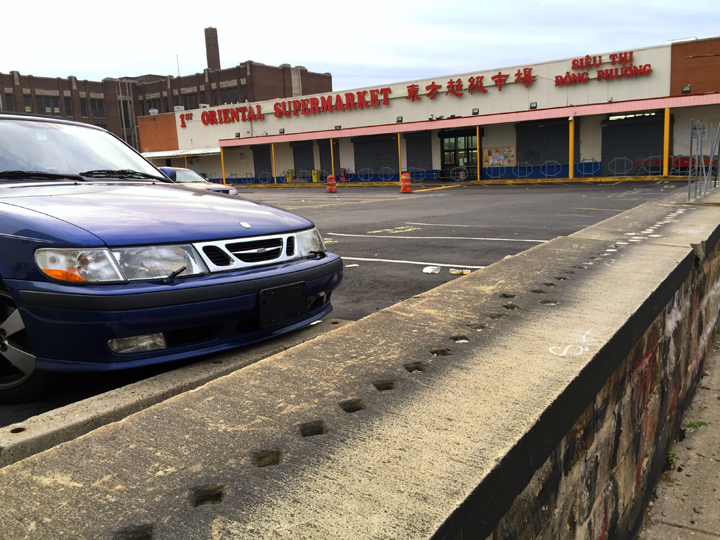
Here’s a short blog on an odd little situation I just discovered. I live in South Philadelphia near Third Street and Washington Avenue. At Sixth Street and Washington Avenue (running to Federal Street), there used to be a cemetery. It was called the Union Cemetery. The City of Philadelphia “removed” the cemetery around 1970 to further develop the commercial business corridor along Washington Avenue.

I have driven past the particular Asian supermarket you see in the photo above, which is at Sixth and Washington (Federal Street is behind it). I have driven past it hundreds of times since moving to the neighborhood in 2008. Until a few weeks ago, I had no idea that the stone wall along Sixth Street (on the south side of Washington) is the ACTUAL stone retaining wall of the Union Cemetery! Complete with holes in the granite top where the iron fence was anchored!

It is no wonder they would they destroy a cemetery to build a parking lot, but why KEEP the original retaining wall? If you’re expecting to find the answer here, you may as well stop reading – I don’t have it. There is quite a bit of information (and photos, as bizarre as that is!) on the cemetery’s demise all over the Internet, but I could not find out much about the wall. I suppose it will remain just one of those odd little cemetery facts.

Union Cemetery wall with fallen fencing, c. 1970 (Ref. 1)

I will quote a few of these sources and you can see more of the historic photos at the link to the Temple University Archives (at end). Temple, by the way, is no stranger to cemetery destruction. They conned the City of Philadelphia into condemning the city’s second Victorian cemetery in 1956 so the university could build a – you guessed it – a parking lot. (Read more about that on my blog post, "How Monument Cemetery Was Destroyed," at the link at the end.)

Picking through human bones during excavation of Union Cemetery, c. 1970 (Ref. 2)

Historic map of South Philadelphia's Union Cemetery (Ref. 4)
But back to the little ol’ Union Cemetery, the graveyard in the Southwark section of Philadelphia which occupied land about the size of half a city block. The name "Union," perhaps, may have sprung from the fact that a union, or association, of people established it in 1841. Ironically, 100 Civil War soldiers - mostly Union Army veterans, I suppose - were later buried here. Where are they now? Under the parking lot of the Asian supermarket? Supposedly not. Above you see a photo of a young man picking through the bones in 1970 so they could be reinterred, in a mass grave, I expect, in Frazer, PA – a distant suburb of Philadelphia . Get those dead as far away from the living as possible! Make way for progress!

Original entrance gate from Union Cemetery resides at Philadelphia Memorial Park in Frazer, PA. (Ref. 1)

From the Find A Grave website (Ref. 1):

"The Union Burial Ground was located at the NE corner of 6th and Washington; Federal Streets in South Philly, was incorporated in 1841 as an "association" cemetery, catered to the poorer residence who as association members could obtain a decent family plot for $10.00. This cemetery was called Sixth Street Union to differentiate it from another Union Burial Ground at 10th and Washington Avenue. In 1970 the cemetery which contained the graves of over 100 Civil War Soldiers and Sailors and their families was neglected and vandalized. That same year the site was sold for use as a supermarket. About 2,000 graves were dug up, the remains boxed and then reburied in Philadelphia Memorial Park in Frazer, Chester County."
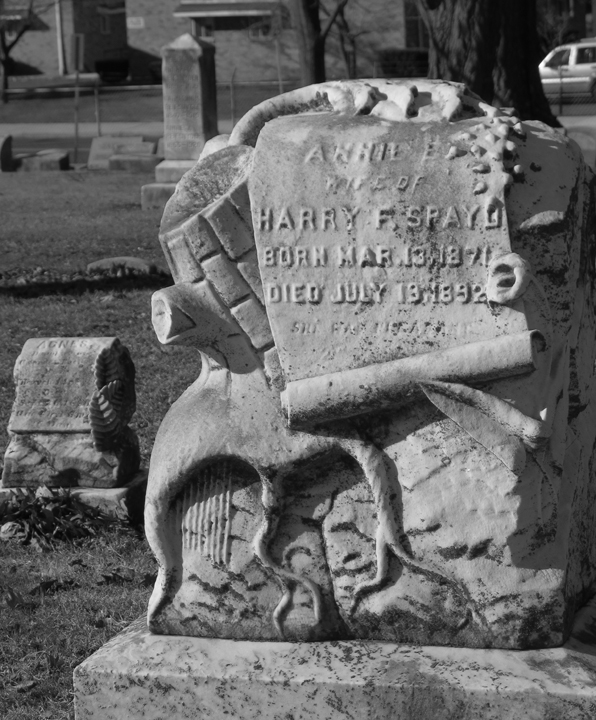
Casual onlookers during the demise of Union Cemetery, c. 1970 (Ref. 3)
 

Union Cemetery's decline began at the end of the nineteenth century, as the area's residents began to move away, edged out by commercialization. With no close relatives living nearby to care for the graves, the cemetery went to ruin (Ref. 4). As I said, by 1970, it was gone - gone, that is, except for one of it's retaining walls. Perhaps it was left intentionally as a reminder to future generations - a reminder of the ground's sacred past, or perhaps our callous handling of the dead.