Showing posts with label meetup. Show all posts

Friday, January 10, 2025

Some Cemeteries of Trenton, New Jersey


Okay, so when you think of interesting cemeteries to explore, Trenton, New Jersey may not immediately (or ever) come to mind. However, your opinion may change. For our 2024 end-of-the-year meetup, the cemetery photography group I hang with decided on Trenton. It was a midway spot between Philadelphia and north Jersey (the general areas where most of us live), so about ten of us agreed to meet at Riverview Cemetery in Trenton, then continue on to the chain-link graveyard cluster in Hamilton, ending with the State Prison cemetery (whatever that is). All of a sudden, you’re interested, right?

It was a cold morning in December, with rain forecast the following day. Hopefully the rain gods would take pity on us and delay the downpours. I got to Trenton a bit early and was dismayed to find Riverview’s gates closed. I’d been here before – it is a wonderful, sprawling Victorian garden cemetery, full of unique statuary, grand monuments, interesting epitaphs, and the mausoleum of John Taylor, the creator and founder of Taylor Ham! 

You may not realize this, but from Trenton north in the Garden State, this breakfast meat is known as Taylor Ham. South of Trenton, it is merely pork roll. Mick Jagger famously told the audience at a Rolling Stones concert in August, 2019 at the MetLife Stadium that “he and his band mates grabbed Taylor ham sandwiches at the Tick Tock Diner on Route 3 in Clifton earlier that day.” Clifton, New Jersey is near the MetLife Stadium, in East Rutherford, where the Stones were playing. 

Word of Jagger's comments spread like wildfire and so fans would go to the Tick Tock and order “the Mick Jagger special” – Taylor ham, egg and cheese with disco fries.” I think if I ordered one at the diner for breakfast, I’d want the Stones’ song “Start Me Up” blasting from the sound system! However, this morning I had to content myself with a Wake-Up wrap at the Dunkin Donuts in Trenton, near Riverview, while I killed time waiting to see if the gates would be opened at ten. I sat in the parking lot munching away, watching the panhandler at the corner go from car to car. He was a largish guy, dressed all in white, looking like either Elvis or porn actor Ron Jeremy. 

I drove over to St. John's Cemetery down the road from Riverview, and shot the zinc Jesus, then thought there might be another entrance to Riverview. Found that and it was closed too. I texted my graver pals to apprise them of the gate situation and was promptly told about the third entrance, which was open. Three of my friends were already there. How I ever get into these places on my own is puzzling, lol.

This grave marker bears the inscription, "Nevermore."
The light snow on the ground lent a nice contrast to the landscape, and did not totally cover up the chicken eggs laying about. Offerings, of some sort. The group fragmented and visited some familiar spots, like the “Nevermore” door and the receiving vault. I wanted to shoot a short video in John Taylor’s plot, since the poison ivy around its low fence had been cut away. As I approached it, I realized I had forgotten my empty box from Taylor Ham! As I said this, my friend Phil, who was walking with me, said, “You can borrow mine,” as he pulled a neatly folded box from his coat pocket! Cemetery nerds, aren’t we hysterical?

You can see my video at this Instagram link on my @mourningarts page. And while you’re there, check out this awesome “Long Live John Taylor” page! 

Not the first time I've seen the word "cemetery" misspelled!

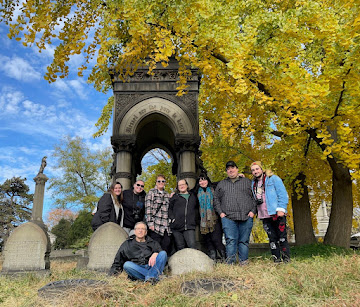
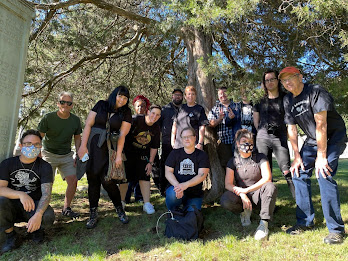
After about two hours at Riverview and our standard group photo shoot (that's us in the first photo of this piece, with me in the orange cap) we jumped into our respective vehicles and headed off to the Hamilton cluster, as one of our group members has dubbed it. I’d been there once before, but it did not seem all that interesting. Just shows to go you - hang out with other artists and you see things you normally might not. And that happened to me today - note one of the many cemetery signs in the cluster (above).

The cluster is near Hamilton, NJ, but might actually be in East Trenton. It’s not unusual to see a couple of cemeteries next to each other, separated by fencing. What is unusual about the Hamilton cluster is that there are so many separate cemeteries in this one area that it is difficult to even count them! Maybe ten? Fifteen? Not sure. Acres and acres of Christian and Jewish burial grounds, side by side. St. Mary’s, Our Lady of Lourdes, People of Truth Hebrew Cemetery, Congregation Brothers of Israel, Knights of Pythias (I think its cool that there’s a fraternal organization based on math – this group follows the philosophy of Pythagoras, he of the Pythagorean Theorem that you learned in high school. The Masons are based on math as well, come to think of it….) 

Anyway, you didn’t actually need to read the cemetery signs to know which ones were Christian and which were Jewish at this time of year. All the Christian cemeteries had Christmas decorations on many of the graves. The Jewish cemeteries did not. 

The cluster is all on level ground, and each cemetery is bordered with four-foot-high chain link fence. It very much reminded me of the cluster of cemeteries in Old San Antonio, Texas, where there are 31 cemeteries across 103 contiguous acres! (read about that visit here). Very much the same layout. Efficient use of space, but not very picturesque. Zero landscaping, no arboretums, these are “lawn” cemeteries, as opposed to the more picturesque Victorian sculpture garden cemeteries. Beginning in the mid-1800s along with the American rural (Victorian) cemetery movement, there was also an effort to establish more modest cemeteries which were basic, more frugal places to bury loved ones. Hence, what came to be known as a "lawn" cemetery - almost uniform grave markers in neat rows, with little ornamentation. You can read more about lawn cemeteries here


The only things that make such a cemetery interesting, or would call attention to any specific grave, are the occasional unique monuments and other memories that 
punctuate the gravescape here and there. Note the bottle of booze (I hope that's booze) left with a few roses at a gravesite. 

The American Institute of Commemorative Art opines that:

“Sculpture should be used only when it is true art, such as we see in the famed cemeteries of Europe. The dignity of all too many American cemeteries is spoiled by the use of commercial statuary such as no trained memorialist would tolerate.”

A bit highfalutin, those words. Certainly, anyone who wants an angel statue on their grave would prefer a hand-sculpted marble piece, versus a factory-cut angel bought at a 
roadside memorial business. But not everyone has the money for that. So we tend to see a mix of statuary and monuments of varying quality and design, spanning generations - some new, some aged, produced by various carvers. One thing is certain - someone wanted to mark that grave and this is the best they could do. A bronze Jesus plaque set into a home-cast concrete stone may have more character that a weeping marble angel bought from a roadside stone vendor. 

The light snow on the grass gave the grounds a bit more character, but the chain link fencing was rather annoying. Most people are visiting a specific grave in a specific cemetery here, so they can just drive around the border of the cemetery, look for the gate, park and walk in. But if you’re there to visit many of the cemeteries, it is tiresome to have to walk a block to the entrance to the next cemetery to get in. The fence is only four feet high, but that’s still a bit much for most people to jump over. When I was in San Antonio, the fencing presented quite a hardship. Not only were there 31 (!) cemeteries all separated by chain-link fence, but that fence was even higher, and it was close to a hundred degrees the day I visited! So, the effort required to walk a block (or more) in the blazing sun just to get to the next gate was exhausting. (You can read more about that visit here.)

Of the cluster cemeteries, Our Lady of Lourdes Cemetery was the most replete with interesting statuary, if that draws you. This is the half of the cemetery north of East Brown Street. The southern half includes the numbered graves of either the New Jersey State Prison or State Hospital burials, not sure which. These are uniform concrete markers in a small plot within the cemetery. There is a bit more landscaping at Lourdes than in any of the other cluster cemeteries. More trees, a columbarium, an interesting angel-flanked family memorial. It is also the largest cemetery in this cluster. There is a sign at the entrance stating that it is “consecrated ground” (i.e., ground that is blessed and made sacred via some religious ceremony).

New Jersey State Prison graves, Our Lady of Lourdes Cemetery, Trenton

The angel-flanked memorial seen above is unusual. Down the road from here is a columbarium, a building to house cremains within individual niches. One of our group said it smelled funny in there. Can't imagine why.

Xmas tree and creche inside the columbarium

Concrete Jesus on a stainless steel cross

Our group fractioned off then rejoined several times, based on our varied interests. Eventually, we all went for a late lunch at a Thai restaurant, traded stories, then went our separate ways. I was done graving for the day, so I went home. With an hour of daylight left, others hit the local pet cemetery and the Presbyterian Church graveyard heading toward Princeton. Hanging with these people is always enjoyable, respectful, educational, and so much better than just appreciating their work on social media. All in all, a grand day out.

So, if you do venture to the Trenton area in search of interesting cemeteries, you will not be disappointed. As I learned, even basic lawn cemeteries offer interesting memories of lives spent, lives that are no more. The dog tags on the urn of cremains stopped me in my tracks.


For your reference and further reading:


Saturday, July 13, 2024

The Cemeteries of Baltimore, Maryland

Chapel, Greenmount Cemetery
No one is ever going to rewrite Led Zeppelin’s, “Going to California” as “Going to Baltimore” (with an achin’ in my heart… ). However, I am quite passionate about Baltimore’s Cemeteries. In this post, I’m going to attempt to tell you why. I was just interviewed by American Cemetery & Cremation magazine for an article they published on “cemetery bloggers,” and the interviewer asked me if I had any favorite cemeteries. I had to say that most of them are in Baltimore, which surprised the author, Alexandra Kathryn Mosca. 

The interview is in the June 2024 issue, if you want to pop down to your local 7-Eleven and pick up a copy. There is a link at the end of this post to view the article electronically, compliments of the publisher, Kates-Boylston Publications. The article is called “Cemetery Bloggers – Blending History and Reverence.” 

American Cemetery & Cremation

Alexandra is from New York and is very passionate about New York City’s many wonderful cemeteries. New York has some glorious Victorian-era sculpture gardens, on the Mount Auburn garden cemetery plan - for example, Green-Wood in Brooklyn and Woodlawn in the Bronx. Mount Auburn, by the way, was the first rural garden cemetery in the U.S. (est. 1831), modeled after Paris’ Pere LeChaise Cemetery (est. 1804), the first garden cemetery. This was followed by Philadelphia’s Laurel Hill in 1836. Garden cemeteries sprang up all over the nation. Baltimore has a lovely “rural” cemetery – as these arboreal sculpture gardens were originally called – Greenmount Cemetery (est. 1838). They were called rural because they were originally built outside the city limits. With the rapid growth of American cities in the mid and late 1800s, these rural cemeteries quickly became inner-city cemeteries. It’s a testament to our culture and society that these wonderful places still exist. And speaking of culture and society, people need to lose any parti pris they may have about Baltimore. There is more to this city than the "Inner Harbor" and John Waters (with all respect to Mr. Waters).

Druid Ridge Cemetery (infrared E4 film image made in 2002)

There are vast burial grounds in Brooklyn, Queens, and the Bronx that rival Baltimore’s magnificent sculpture gardens; however, in my cemetery travels across the U.S., I’ve not seen Baltimore’s equal. My “favorite cemeteries” reply surprises a lot of people who have asked me that question over the twenty-five years I’ve been photographing cemeteries. If you like Victorian garden cemeteries, and you like them densely packed with marble monuments as far as the eye can see, then Baltimore is for you. Loudon Park Cemetery in Baltimore, at 500 acres, is actually larger than either Green-Wood Cemetery in Brooklyn or Woodlawn Cemetery in the Bronx.

New Cathedral Cemetery, Baltimore
If you want star power, sure, New York is the clear winner. Celebrities, business magnates, mobsters – NY’s got the lion’s share. You’d have to go to Chicago or California to find its equal. But if you want to stroll endlessly through grounds densely packed with wonderful Victorian-era marble sculptures, magnificent Gothic mausoleums, and winged bronze angels, Baltimore is the clear winner. Recently, I was so overwhelmed upon entering Baltimore’s New Cathedral Cemetery (photo below), that I just laughed at the sheer sweeping vista of statuary in my field of vision. The deep, broad landscape pans around you like an iMax movie. I was so stunned that I failed to capture the scene photographically – I just walked, wide-eyed and dazed through the labyrinth of monuments. 

New Cathedral Cemetery, Baltimore (Photo by Rachel Bailey)

Luckily, my friend Rachel (IG @photosofcemeteries) was better able to maintain a discerning and objective eye and in so doing, captured the sweeping landscape you see here in a way that I wished I had. Master photographer Robert Capa said, “If your pictures aren't good enough, you're not close enough.” Well, this obviously does not hold true in all cases! My photographs of the statuary and architecture in Baltimore cemeteries suffer from my being too close to my subject! I need to step back, literally. Live and learn. I think this is necessary to capture the full effect of the scene presented to you. One of my photographer heroes, Mary Ellen Mark, said, “It’s not when you press the shutter, but why you press the shutter.”

Calvary Cemetery in Queens, New York

To be fair, Calvary Cemetery (above) in Queens is massively impressive and jam-packed with Victorian monuments – and has an amazing view of Manhattan. It is similar in scope to Holy Redeemer and Loudon Park in Baltimore. One thing that Calvary lacks, however, that Baltimore cemeteries have in abundance, is access. For instance, New York’s cemeteries are so spread out, you could not visit Woodlawn and Calvary on the same day – unless you had a helicopter. In Baltimore, you can easily drive from Druid Ridge Cemetery to Prospect Hill Cemetery (where entertainer Divine is buried) in seventeen minutes (according to Google Maps). Baltimore’s cemeteries are so close, you can’t swing a cat without hitting one (to paraphrase Mark Twain).

Divine's grave, Prospect Hill Cemetery

The main advantage of Baltimore’s cemeteries compared to those of NYC, is that they are easily accessible by car. The Evergreens Cemetery in Brooklyn and Woodlawn in the Bronx are fabulous places, but the traffic and logistical planning one must contend with to access these destinations can be mind-boggling at times. Once, years ago, my brother and I made a trip to NYC to visit Woodlawn Cemetery. At Grand Central, we got on the wrong train and mistakenly headed out to Long Island! By the time we got back to Grand Central, it was too late in the day to get to Woodlawn. Mission aborted. In Baltimore, even the most immense and intense burial grounds are immediately accessible! Baltimore City Cemetery is five minutes from Baltimore Hebrew Cemetery which is five minutes from Holy Redeemer Cemetery – all on the same road! 

Gardens of Faith Memorial Gardens, Baltimore

Now, being from Philadelphia, I would be remiss were I not to mention the grand cemeteries like Laurel Hill, Mount Moriah, and The Woodlands. These are large Victorian-era rural cemeteries like Mount Auburn outside Boston, and like New York’s Green-Wood and Woodlawn cemeteries. All are amazing, serene, finely landscaped and picturesque sculpture gardens, patterned after Père Lachaise. A main difference between all these and Père Lachaise, I now realize, is that the monuments, mausoleums, and other grave markers in Père Lachaise seem to be more densely-packed than what you typically see in American garden cemeteries. It is more like what one finds in the cemeteries of Baltimore, e.g. in Greenmount and Baltimore City Cemetery. 

Holy Redeemer Cemetery, Baltimore (Photo by Rachel Bailey)

Here's another example above of a sweeping Baltimore landscape, Holy Redeemer Cemetery (again, photographed by @photosofcemeteries, not yours truly). Holy Redeemer, by the way, must have the largest abandoned cemetery chapel I’ve ever seen – the green-domed building in this photograph. (Psst …if you look through the keyhole in the red door, you can see inside! But take a real camera with a zoom. Thanks to Teresa @teresacast for pointing this out.)

Greenmount Cemetery
What prompts me to write about Baltimore’s cemeteries at this time, is my friends. I’d been extolling the virtues of these places for twenty years to anyone who asked, but it has only been since 2023 that many of my Philadelphia-area cemetery photography friends began making the hour-and-a-half trip to the Land of the Crab Cake. However, I don’t know that anyone ever went to Baltimore based on my suggestion. Small groups of these cemetery photographers, as well as individuals, have been exploring Baltimore cemeteries over the last year or so. 

Loudon Park Cemetery
One member of our group discovered Baltimore’s treasures years ago on her own. She photographs there on a regular basis. It was at her insistence that many of the others in our group followed suit. It really had nothing to do with my influence. This is really a joy for me to experience, actually – I’m watching others discover their passion for these cemeteries as I had done in the early 2000s. And as I am a part of this group of photographers, this has rekindled my interest and love of these destinations.

I say we ‘discovered” Baltimore’s cemetery gems as if no one knew they were there. While its true that most people may be unaware of their existence, most of these properties – large and small – are well-maintained. It is not the case that any of them are neglected or abandoned. The general public is simply unaware of their existence, or just does not care, and I can appreciate that. I fall into the small category of people who do care. And I appreciate the fact that the city, synagogues, churches, and other organizations maintain these sacred spaces, preserving the dignity of those who are buried within their grounds.

Greif family angel, Baltimore Hebrew Congregation Cemetery

Some of Baltimore’s cemeteries, like Baltimore Hebrew Congregation Cemetery, are walled in, gated and locked – only accessible by checking in at the gatehouse. This keeps the contents, as well as its visitors, safe. By the way, it’s unusual to find an angel in a Jewish cemetery. But this relatively small place has numerous life-sized bronze angels and other effigy sculptures that are simply amazing. Here’s a 2004 photo of me with one. She’s still there if you’d like to stop by for a dance.

Author in Baltimore Hebrew Cemetery, 2004.
I suppose Baltimore’s cemeteries have a deeper meaning for me. I explored these burial grounds back in the early to mid-2000s, when my life was going through an upheaval and I needed alone time with my camera. “All art, like all love, is rooted in heartache,” photographer Alfred Stiegletz said. Walking these many arboreal sculpture gardens alone was therapeutic for me. I saw, touched, and walked amidst exquisite art that I never knew existed. Artwork that most people do not know exists. Sometimes you just have to create your own happiness. 

Greenmount Cemetery
I was happy – actually thrilled – when I happened upon this marble statue (at left) in Greenmount Cemetery, probably around 2004. It confused me, and after photographing it, I spent years researching its meaning. Hercules now graces my business card. From what I’ve determined, this is him as a child, wearing the lion’s skin that he wore as an adult (after killing the monstrous Nemean lion). I surrounded myself with such quiet beauty while the world threw so much ugliness at me. It was a coping mechanism. Maybe some of my current friends can relate to that. Maybe Baltimore’s cemeteries were protection, of sorts, for me, like Hercules’ lion skin that was impervious to attack.

Legend has it that Hercules killed the lion by strangling it with his bare hands, as he could not damage it with arrows or clubs. He then skinned the lion and used it for a protective cloak - ref.)

The group meetups are a relatively new thing for me, which we began as an Instagram meetup of like-minded cemetery photographers during COVID. As of mid-2024, the idea has stood the test of time, with new people joining regularly. Truly lovely people. When I see them become excited about the cemetery adventures we plan, it can be a rather joyous feeling. They inspire me.

Our IG Meetup at Westminster Hall, Baltimore, July 2024

Back when I discovered Baltimore’s cemeteries around Y2K, you had to use paper maps for guidance. Now with GPS camera phones and Google Maps, locating cemeteries has become easier. Locating graves within a cemetery has become easier! One of my friends taught me how to use Google image search, see locations using metadata, and download the Find-A-Grave ap. I’m no Luddite, but technology improves so quickly that its hard to keep up. Its great to have friends who do keep up, and are willing to share! One of my friends seems to be on a personal mission to find all of Baltimore’s cemeteries, and she has found more than I knew existed. This is like a treasure hunt if you are a cemetery photographer. One such gem is Western Cemetery (photo below), which, until the spring of 2024, I was totally unaware of!

Western Cemetery, Baltimore

While Philadelphia, my home town, has a plethora of wonderful cemeteries, it has nothing to compare with the huge burial grounds of New York and Baltimore. But wait, Baltimore itself isn’t that big, right? Smaller than Philly, much smaller than New York. So why does it have so many enormous cemeteries? You know what? I don’t know. Maybe there’s a clue in what Baltimore film maker John Waters said, “So many great people are dead, and so many assholes I know are still alive. Karma's bullshit.”

Sculpture in Baltimore's Greenmount Cemetery

What I do know is that I’ve got more cemetery gems to explore down south with my friends. We’ll revisit my old haunts, plus find new ones thanks to inquisitive minds and Google Maps. Some Baltimore cemeteries, like the music of Pink Floyd, can be scary. Witness the Gothic Revival-style Westminster Hall and Burying Ground with its catacombs and Edgar Allen Poe tomb, and the somewhat overgrown Western Cemetery with its junkyard in the back. Be wary and wise because Baltimore never ceases to amaze ... shine on you crazy diamond.

💎💎💎💎💎💎💎💎💎💎💎💎


Further Reading ....

Alexandra Mosca shared this link on Facebook related to her article on cemetery bloggers. She graciously interviewed me for her article. Link below:

Kates-Boylston Publications is generously offering non-subscribers complimentary digital access to June’s American Cemetery & Cremation magazine. This issue is filled with interesting articles such as ‘Picnic Time Again,’ which delves into the modern revival of 19th-century cemetery outings, a unique blend of grave visits and picnics. The issue also features my article on cemetery bloggers (of which I am one) and the reasons we chronicle the sometimes arcane stories of those who have gone before us. Here’s the link.

https://www.acm-digital.com/acm/library/item/june_2024_/4197300/?fbclid=IwZXh0bgNhZW0CMTAAAR0-ROlGbnG1doZFUPR709o3u3JGxtXEECdnUNDkEjUHoFURbkWbwKog0g0_aem_ZmFrZWR1bW15MTZieXRlcw


Saturday, January 8, 2022

Cemetery Meetups

Cemetery Meetup at The Woodlands Cemetery, Philadelphia

Back in the fall of 2021 (when we were thinking that we were all successfully pulling out of the COVID-19 pandemic, pre-Omicron variant), I got this idea in my head that it would be a cool social exercise to get some Instagram cemetery photographers together for an outing at Mount Moriah Cemetery in Philadelphia. I invited mostly people I’ve never physically met. About ten of us showed up – several whom I invited, and some people who THOSE people invited. The only commonality was that these were seriously good photographers who shared a common interest – posting cemetery photography on Instagram.

Mount Moriah Cemetery, Yeadon, PA side

Our initial outing at Mount Moriah went so well that we all decided to do it again. After some conversation, we all realized that we each had explored many cemeteries that the others had not. Thanks to Jenn O’Donnell (IG link), our member who organized an IG Meetup link, we all stayed in close contact with each other and took a vote on the next cemetery location at which to meet. Three additional meetups have occurred since that initial one, in cemeteries in southeastern PA and central and south Jersey. We number about twenty “members,” if you want to call us that.

A few things I’ve learned from my fellow necrogeeks (kudos to Timothy for that term!):

  • Cemetery nerds have the BEST stories!
  • There are funeral strippers in China.
  • If you ask at the office for the key to the community mausoleum, they might just give it to you.
  • Santeria-type offerings at a gravesite could easily involve live animals.
  • There are FAR MORE deaths-head and angelhead gravemarkers outside of New England than I thought.
  • Zinc monuments are still controversial.
  • Snapseed is a cool, in-phone photo-editing ap - and its free.

Mount Moriah Cemetery, Philadelphia and Yeadon, PA.
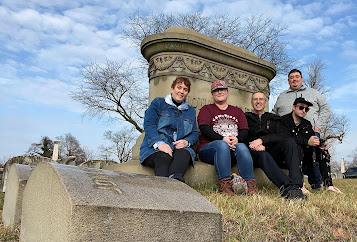
The photo you see directly above was the first group photo we made. Or rather, I made, actually, to sort of document our initial meetup at Mount Moriah. We only began staging the group shots at our second meetup, at Philadelphia’s Laurel Hill Cemetery. We didn’t really know each other well enough, I think, at Mount Moriah, for anyone to suggest a group photo. Plus there was the issue of who was vaccinated and who wasn’t. Also, it might not have occurred to us at the time that we would continue our adventure. I’m not sure who suggested the group photo a month later at Laurel Hill, but it has since become a staple of our gatherings. As more people got vaccinated and boosted, spreading COVID became less of an issue.


Cemeteries need not be places where dreams go to die. As we re-envision what social gatherings should look like in this evolving pandemic, there is one thing that everyone agrees on: outdoor gatherings are safer than indoor ones. So these cemetery meetups appear to be a healthy way to maintain our interactivity as social beings while staying physically safe.

While many cemeteries host official events that draw throngs of people (I realize there might be some of you who are surprised to learn that), such events are carefully planned and quite focused. Our IG meetups are anything but! We just stroll through the cemeteries and graveyards talking, photographing, and perhaps being led to some points of interest by someone who had been there before. We greatly appreciate the hospitality offered by the many open cemetery gates throughout the region, that allow us this opportunity. We also do appreciate the more focused events such as hearse shows, The Market of the Macabre, movie nights, concerts, the Darksome Art and Craft Market, and so on. Such events are all wonderful ways to bring people together, promote small business, and to raise money for the upkeep of the cemeteries.

Evergreen Cemetery, Camden, New Jersey

Victorian-era garden cemeteries of course were designed for large groups of people to visit and enjoy. Before there were parks and museums in the United States, cemeteries were the places you would go to get away from the noise and grit of the cities. They were meant to be calm, contemplative locales, beautifully landscaped in arboreal splendor - a place to revitalize, a place conducive to better physical and mental health. People recognized early in the current pandemic (and especially during lockdown) that cemeteries were in fact the ONLY safe place to congregate. I for one am grateful to all the cemeteries for keeping their gates open and welcoming throughout this time. Hopefully the trend will continue and more people will visit regularly - and I encourage people to donate money to their favorite cemetery to help keep those gates open in the future.

There is, of course, no socially redeeming purpose to cemetery photography itself (or photography in general). As with any art form, it must be shared to offer its greatest value. Interacting with people who share this common interest is exhilarating, at times. Meeting them personally is an added dimension and doing so during the COVID crisis is one of the best things we can do for our mental health. As I write this on the first day of the new year, 2022, the Omicron variant is so widespread that unless we force ourselves into lockdown again, it cannot be avoided. We’ll all get it sooner or later.

COVID has made death more real for many of us (death toll as of January 2, 2022 in the U.S. is 828,732; worldwide it is nearly 5.5 million (ref.)). Probably not since the last pandemic a hundred years ago has death been this concrete. Mentally, this is probably healthier for us – we are now forced to be much more pragmatic about death. Its almost like the present pandemic switched things up: pre-pandemic, death was abstract and society was real (for the most part). During the pandemic, death became more real and society became abstract.

But now with our evolving understanding of COVID-19, we are trying to work our way back to being a society that interacts physically – less screentime and more facetime. Ironically, virtual tools like social media can help us attain this goal. Though Instagram, Facebook, and other social media are quite abstract, we can use these tools to form concrete relationships – to create actual reality from the virtual. Granted, there are situations in which virtual meetings are the only option due to geographic distance, transportation, or the need to reach a larger audience. However, social media can successfully be used as an invitation, an entrée into more fulfilling in-person relationships.

Laurel Hill Cemetery, Philadelphia

Sometimes timing keeps all the members of our IG group from getting together. I’ve missed a couple meetups, but when I see the results others have posted on IG, it makes me wish I had been able to attend. Creatively, for many of us, these meetups will be a seminal influence on what is yet to come (little inside reference to the hooking tree we discovered in Camden).

We share our knowledge of specific cemeteries we have visited, and benefit greatly from the knowledge of others. These people bring a wealth of research and experience to bear in their work and all have their own reasons for doing what they do. It is evident by the joy and camaraderie at our physical meetups that everyone shares a deep interest in those who have gone before us. But why this interest? Perhaps it has something to do with a comment made by Dave Grohl (of Nirvana and The Foo Fighters) in his autobiography, The Storyteller ...

  We all carry traits of people we have never met somewhere deep within our chemistry.”

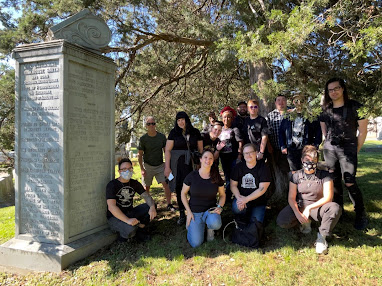
Another view of the photo above in the shade of an immense zinc gravemarker