Showing posts with label cremains. Show all posts

Wednesday, January 15, 2025

The Scattering

This blog post was guest written by my friend George Hofmann. George writes the newsletter "Practicing Mental Illness."

Down the hill just out of reach beyond a black, cast-iron fence still lays a cigarette, dusty, flicked without thought or respect into a pile of ashes, as if someone chain smoked pack after pack and tossed all thoughts of the past onto the heap. Although it has become the same color as the grey fanning over it and out across the hill it stands out, like nagging thoughts of things you should have done that you can’t push away. Guilt over someone else’s carelessness. That one thing you’ll never escape. All that remains among the remains. This is where ghosts come from.

The cemetery is such a well-ordered space that something out of place just glares at you as it breaks the peace, the silence, of the columns of dead. One after another, immobile, but drawing us back into a timeless past upon which we write the history and we choose what to inscribe on the granite that lasts longer than that history, till a time comes when no one cares anymore, and the earth takes it all back.

The scattering garden is different. It sits upon a hill that would overlook the graveyard, but a circle of trees conceals it. Evergreens, so the place is always shaded and always tucked away. There are two tables of granite off to the side, crowded with the names and dates of those scattered there. A third will be added soon, so many lives have ended and rested on that slope. Birds sing in the trees unseen, and the sound of traffic from somewhere off to the left is overtaken by the wind that makes the trees sway, but does not lift any ashes from the ground. Like the lives lived the ashes scattered here are not unform, at least not up close. But the black iron rail keeps you away, and it all looks the same, except for the time when the bag is held and the arms outstretch and empty all that is left onto the charnel on the hill.

Some would say this is just throwing the dead away. It’s not a remembered place like the ocean or a hiking trail or off the last row of the stadium of a favorite sports team. It’s contrived. It’s a built garden reserved for disposal, but with a bit more dignity and a place to come and visit and reflect. A beautiful place. The flowers and shrubs, the trees and the ribbon of sky that peaks through, and yes, the heaps of cremated remains that dive off deeply onto a patch of exposed earth where grass no longer grows.

Others would say here we don’t throw away the dead at all. Instead, we release them into consciousness where all are joined indistinguishable from one another, in the image of some unnamed god, sent back into the fabric from which we all came. This is a sharp contrast to the rest of the cemetery, with its insistent distinction of one plot from another, standing out alone with markers to prove it, and no doubt of who lies there. The scattering garden is a common grave for people secure with being common people. The ashes merge together with the souls risen and the memories swirl and while the culture may scream “me!” the dead know better. The dead are all one. It is the living that makes each stand out.

The living come in groups to the scattering garden. One is chosen, usually the groundskeeper, to open the urn and empty the bag inside. Overt religious services are rare here, but words are always spoken. Most people think they are more profound, more notable, than they truly are. But in these small groups they are notable indeed. Whereas, like the ash, we all kind of blend together into some secure irrelevance to the broader world, to these groups of loved ones, right up to the point of release, we are spectacular. Today, in the bitter cold, a widower stood with his collar raised and his eyes tearing as he leaned into the wind. His wife did routine work but in new, unusual, sometimes remarkable ways. He spoke of an early mentor who saw the way she did things and said, “you can’t do that. It’s not normal.” He said of his wife, “but she was not normal. She was better than that.” 

The groundskeeper held the bag just above the lip of the hill and poured out the remains gently, so that none would take to the air and cling to the widower’s long coat. Tonight, at home, his wife does cling to him. As does a flake or two of ash just beside the left lapel of his coat. By instinct he raises his arm to brush it away, and then realizes what he is doing and stops. He sits on the bed, falls over, and sleeps in the coat. In the morning he rises, first thought of his wife. On the way to make coffee, as he always did for her, he stops in front of the mirror in the hall. His coat is disheveled and the ash is gone.

As the sun rises the groundskeeper scales the fence and moves across the hill of the scattering garden with a rake. The little piles are evened out and a bit of dirt is mixed in to keep it all down. Midday there’ll be another family. The groundskeeper notices the cigarette and moves to rake it under, then stops. He picks it up and puts it in his pocket to take very far from here. We will be judged by the way we treat our dead and the places we leave them. What we learn from them, and how we bring them back.


Friday, January 10, 2025

Some Cemeteries of Trenton, New Jersey


Okay, so when you think of interesting cemeteries to explore, Trenton, New Jersey may not immediately (or ever) come to mind. However, your opinion may change. For our 2024 end-of-the-year meetup, the cemetery photography group I hang with decided on Trenton. It was a midway spot between Philadelphia and north Jersey (the general areas where most of us live), so about ten of us agreed to meet at Riverview Cemetery in Trenton, then continue on to the chain-link graveyard cluster in Hamilton, ending with the State Prison cemetery (whatever that is). All of a sudden, you’re interested, right?

It was a cold morning in December, with rain forecast the following day. Hopefully the rain gods would take pity on us and delay the downpours. I got to Trenton a bit early and was dismayed to find Riverview’s gates closed. I’d been here before – it is a wonderful, sprawling Victorian garden cemetery, full of unique statuary, grand monuments, interesting epitaphs, and the mausoleum of John Taylor, the creator and founder of Taylor Ham! 

You may not realize this, but from Trenton north in the Garden State, this breakfast meat is known as Taylor Ham. South of Trenton, it is merely pork roll. Mick Jagger famously told the audience at a Rolling Stones concert in August, 2019 at the MetLife Stadium that “he and his band mates grabbed Taylor ham sandwiches at the Tick Tock Diner on Route 3 in Clifton earlier that day.” Clifton, New Jersey is near the MetLife Stadium, in East Rutherford, where the Stones were playing. 

Word of Jagger's comments spread like wildfire and so fans would go to the Tick Tock and order “the Mick Jagger special” – Taylor ham, egg and cheese with disco fries.” I think if I ordered one at the diner for breakfast, I’d want the Stones’ song “Start Me Up” blasting from the sound system! However, this morning I had to content myself with a Wake-Up wrap at the Dunkin Donuts in Trenton, near Riverview, while I killed time waiting to see if the gates would be opened at ten. I sat in the parking lot munching away, watching the panhandler at the corner go from car to car. He was a largish guy, dressed all in white, looking like either Elvis or porn actor Ron Jeremy. 

I drove over to St. John's Cemetery down the road from Riverview, and shot the zinc Jesus, then thought there might be another entrance to Riverview. Found that and it was closed too. I texted my graver pals to apprise them of the gate situation and was promptly told about the third entrance, which was open. Three of my friends were already there. How I ever get into these places on my own is puzzling, lol.

This grave marker bears the inscription, "Nevermore."
The light snow on the ground lent a nice contrast to the landscape, and did not totally cover up the chicken eggs laying about. Offerings, of some sort. The group fragmented and visited some familiar spots, like the “Nevermore” door and the receiving vault. I wanted to shoot a short video in John Taylor’s plot, since the poison ivy around its low fence had been cut away. As I approached it, I realized I had forgotten my empty box from Taylor Ham! As I said this, my friend Phil, who was walking with me, said, “You can borrow mine,” as he pulled a neatly folded box from his coat pocket! Cemetery nerds, aren’t we hysterical?

You can see my video at this Instagram link on my @mourningarts page. And while you’re there, check out this awesome “Long Live John Taylor” page! 

Not the first time I've seen the word "cemetery" misspelled!

After about two hours at Riverview and our standard group photo shoot (that's us in the first photo of this piece, with me in the orange cap) we jumped into our respective vehicles and headed off to the Hamilton cluster, as one of our group members has dubbed it. I’d been there once before, but it did not seem all that interesting. Just shows to go you - hang out with other artists and you see things you normally might not. And that happened to me today - note one of the many cemetery signs in the cluster (above).

The cluster is near Hamilton, NJ, but might actually be in East Trenton. It’s not unusual to see a couple of cemeteries next to each other, separated by fencing. What is unusual about the Hamilton cluster is that there are so many separate cemeteries in this one area that it is difficult to even count them! Maybe ten? Fifteen? Not sure. Acres and acres of Christian and Jewish burial grounds, side by side. St. Mary’s, Our Lady of Lourdes, People of Truth Hebrew Cemetery, Congregation Brothers of Israel, Knights of Pythias (I think its cool that there’s a fraternal organization based on math – this group follows the philosophy of Pythagoras, he of the Pythagorean Theorem that you learned in high school. The Masons are based on math as well, come to think of it….) 

Anyway, you didn’t actually need to read the cemetery signs to know which ones were Christian and which were Jewish at this time of year. All the Christian cemeteries had Christmas decorations on many of the graves. The Jewish cemeteries did not. 

The cluster is all on level ground, and each cemetery is bordered with four-foot-high chain link fence. It very much reminded me of the cluster of cemeteries in Old San Antonio, Texas, where there are 31 cemeteries across 103 contiguous acres! (read about that visit here). Very much the same layout. Efficient use of space, but not very picturesque. Zero landscaping, no arboretums, these are “lawn” cemeteries, as opposed to the more picturesque Victorian sculpture garden cemeteries. Beginning in the mid-1800s along with the American rural (Victorian) cemetery movement, there was also an effort to establish more modest cemeteries which were basic, more frugal places to bury loved ones. Hence, what came to be known as a "lawn" cemetery - almost uniform grave markers in neat rows, with little ornamentation. You can read more about lawn cemeteries here


The only things that make such a cemetery interesting, or would call attention to any specific grave, are the occasional unique monuments and other memories that 
punctuate the gravescape here and there. Note the bottle of booze (I hope that's booze) left with a few roses at a gravesite. 

The American Institute of Commemorative Art opines that:

“Sculpture should be used only when it is true art, such as we see in the famed cemeteries of Europe. The dignity of all too many American cemeteries is spoiled by the use of commercial statuary such as no trained memorialist would tolerate.”

A bit highfalutin, those words. Certainly, anyone who wants an angel statue on their grave would prefer a hand-sculpted marble piece, versus a factory-cut angel bought at a 
roadside memorial business. But not everyone has the money for that. So we tend to see a mix of statuary and monuments of varying quality and design, spanning generations - some new, some aged, produced by various carvers. One thing is certain - someone wanted to mark that grave and this is the best they could do. A bronze Jesus plaque set into a home-cast concrete stone may have more character that a weeping marble angel bought from a roadside stone vendor. 

The light snow on the grass gave the grounds a bit more character, but the chain link fencing was rather annoying. Most people are visiting a specific grave in a specific cemetery here, so they can just drive around the border of the cemetery, look for the gate, park and walk in. But if you’re there to visit many of the cemeteries, it is tiresome to have to walk a block to the entrance to the next cemetery to get in. The fence is only four feet high, but that’s still a bit much for most people to jump over. When I was in San Antonio, the fencing presented quite a hardship. Not only were there 31 (!) cemeteries all separated by chain-link fence, but that fence was even higher, and it was close to a hundred degrees the day I visited! So, the effort required to walk a block (or more) in the blazing sun just to get to the next gate was exhausting. (You can read more about that visit here.)

Of the cluster cemeteries, Our Lady of Lourdes Cemetery was the most replete with interesting statuary, if that draws you. This is the half of the cemetery north of East Brown Street. The southern half includes the numbered graves of either the New Jersey State Prison or State Hospital burials, not sure which. These are uniform concrete markers in a small plot within the cemetery. There is a bit more landscaping at Lourdes than in any of the other cluster cemeteries. More trees, a columbarium, an interesting angel-flanked family memorial. It is also the largest cemetery in this cluster. There is a sign at the entrance stating that it is “consecrated ground” (i.e., ground that is blessed and made sacred via some religious ceremony).

New Jersey State Prison graves, Our Lady of Lourdes Cemetery, Trenton

The angel-flanked memorial seen above is unusual. Down the road from here is a columbarium, a building to house cremains within individual niches. One of our group said it smelled funny in there. Can't imagine why.

Xmas tree and creche inside the columbarium

Concrete Jesus on a stainless steel cross

Our group fractioned off then rejoined several times, based on our varied interests. Eventually, we all went for a late lunch at a Thai restaurant, traded stories, then went our separate ways. I was done graving for the day, so I went home. With an hour of daylight left, others hit the local pet cemetery and the Presbyterian Church graveyard heading toward Princeton. Hanging with these people is always enjoyable, respectful, educational, and so much better than just appreciating their work on social media. All in all, a grand day out.

So, if you do venture to the Trenton area in search of interesting cemeteries, you will not be disappointed. As I learned, even basic lawn cemeteries offer interesting memories of lives spent, lives that are no more. The dog tags on the urn of cremains stopped me in my tracks.


For your reference and further reading:


Saturday, February 20, 2016

Architectural Cemetery Treasure In Danger of Collapse

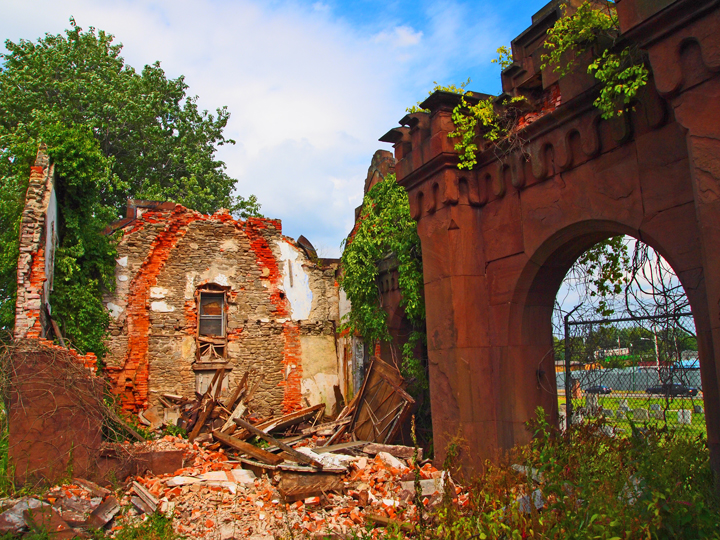
The Friends of Mount Moriah Cemetery, Inc. (FOMMCI) in Philadelphia currently has a “Go Fund Me” page up on the Internet. The goal is to raise $10,500 to stabilize the façade of the historic 1855 gatehouse facing Kingsessing Avenue at Cemetery Avenue

The page was posted on February 15, 2016, and by Saturday, February 20, $11,630 was raised! At that point, 157 people had donated. Here is the link to the page, which is headed by my February 2016 photograph of the gatehouse (the one in the snow, shown above):

Mount Moriah Cemetery gatehouse, Philadelphia, c. 1855.

I spread the call on February 15, all over my own social media sites and those of all my cemetery-lover friends. People on the FOMMCI Facebookpage shared the invitation multiple times. The result is an unqualified success!

Rather than reiterate the purpose of the fundraising program, I will quote the FOMMCI Go Fund Me page. I have included more of my gatehouse photos throughout. Please consider donating to this worthy cause – we greatly appreciate your help!


Architectural Treasure In Danger of Collapse


Historic brownstone Gatehouse designed by Stephen Decatur Button, the architectural designer of the Gettysburg Gatehouse is in imminent danger of collapse. This iconic structure built in 1855 was the grand entryway to the 200 acre Mount Moriah Cemetery located in Pennsylvania's Philadelphia and Delaware Counties. The cemetery was privately owned but it was abandoned in 2011. The Friends of Mount Moriah Cemetery, a nonprofit grassroots organization of determined volunteers immediately stepped in to honor those who are buried in the cemetery's hallowed ground, including over 5,000 veterans.

Inside of gatehouse, showing collapsed internal building (Sept. 2014)

Our goal is to stabilize the facade of the brownstone so that a columbarium for cremains can be built behind it in the future. It will cost $35,000 to stabilize this magnificent structure and we now have $24,500 from a grant and donations. We need $10,500 to keep this treasure from becoming a pile of rubble. We need your help!

Author leading tour in front of gatehouse, 2013.

If our fundraising goal is exceeded, donations will be used for additional Mount Moriah Cemetery capital improvements. Your donation is tax deductible. To learn more about the Mount Moriah Cemetery and the work of the Friends of Mount Moriah Cemetery, visit our website.

Wednesday, May 14, 2014

Friends of Mount Moriah Cemetery - "Urning" Our Respect

Whenever I’m looking for something to write about, I’ll take a drive out to Mount Moriah Cemetery in southwest Philadelphia to see what’s up. Something always is. Since the weather broke and the insanely snowy winter loosened its grip on the region, The Friends of Mount Moriah Cemetery, Inc. has been hosting restoration events every weekend. There are so many volunteer organizations wanting to participate in this effort, that every time I visit, a new previously-forested area seems to be cleared!

The obvious large-scale cleanup has been the inner “Circle of Saint John,” the Masonic plot which can actually now be seen and easily accessed for the first time in ten years. (The lead photo in this article was made in May 2014, after substantial clearing had occurred.) Various groups of people have participated in the restoration of this particular area of the cemetery, including local Masonic lodge members and students from Drexel University. I had seen photos of the cleared area but until you see it in person, you cannot appreciate the magnitude of the job. The photo below shows the same area in 2011.

Circle of St. John at Mount Moriah Cemetery, Philadelphia, winter 2011

My focus of this article, however, is less on the magnitude of this work than on the meticulous CARE involved. Obviously, the people involved are focused on more than just the brute force work of clearing the area of invasive trees, vines, and knotweed. They’re doing this because they’re interested in what’s under the brush – the graves of our ancestors. This is about respect for the dead and keeping their memory alive.

On walking through the Circle, this granite draped urn (at left) caught my eye. It was placed at the foot of a large memorial, the one it had fallen from. It seems a rather small detail, but it exemplifies the great care that the volunteers take to ensure this statuary continues to exist, and the memories remain strong. The urn can be viewed as a simple design accent on a grand Victorian memorial, but in past times, it was viewed as much more than that.

This particular urn was found embedded in the ground, having fallen about ten feet from the top of the monument behind it, god knows how many years ago. The Friends (Bill Warwick, Bill McDowell, and Ken Smith) dug it out and carefully placed it where you see it in the photo. My estimate of the weight of this thing is three hundred pounds. No small feat. To give you an idea of the size of this objet d’art, take a look at the photo below of me crouched behind a similar urn a few plots away. I weight two hundred pounds and am six foot two.
 
Author Ed Snyder with fallen granite urn

The urn was a very common piece of Victorian funerary art. However, designers did not use the urn as a literal symbol of a cinerary urn (which holds ashes, or cremated remains), simply because cremation was far less common then.They meant for it to symbolize a container of sorts, like the human body, which holds inside it, the soul.

Douglas Keister, in his book, Stories in Stone,” says:
“The draped cinerary urn is probably the most common nineteenth-century funerary symbol." The drape may symbolize the veil between earth and heaven. Since cremation was seldom practiced in the 1800s, the urn likely does not signify a literal vessel for ashes (or cremains). More likely it symbolizes the human body, a simple vessel for the spirit. Keister goes on to state that the urn and the willow tree “were two of the first funerary motifs to replace death’s head …. effigies when funerary symbolism started to take on a softer air after the [American] Revolutionary War.

Keister tells us that the phrase “gone to pot” may have originated as a reference to a cinerary urn.

Cleared section of the Circle of St. John


Friends' treasurer Ken Smith, with chain saw
So the fallen urns are not just adornments on the larger monuments – they very personally signify the bodies of the deceased. The care with which they are handled and treated by the volunteers who are restoring Mount Moriah Cemetery should not go unnoticed. Another thing that should not go unnoticed is the fact that these incredibly heavy objects are not even attached to the monuments! You can see that the base of the urn I am crouched near is smooth! It was just sitting up there, ten feet off the ground! This one may have fallen 50 years ago when the monument tilted off level due to ground subsidence. I wonder if such things are more securely attached in earthquake-intensive areas like California?

Visit the Friends of Mount Moriah Cemetery, Inc. website to learn more and find out how you can help! (Click here!)

Wednesday, July 3, 2013

Burial at Sea

When it comes to the idea of “burial at sea,” I’m probably influenced more by the romanticism of the idea than anything else. My guess is that most of my readers are too. When it comes to the cold, hard facts of how someone gets buried at sea, I’m in a rather wobbly boat. So it was with great interest and fascination that I phoned Captain Johnnie Lee, the proprietor of Long Beach, California’s “Burials at Sea” service.

Queen Mary in background
Amidst the pleasure cruise docks, tourist traps, and the Queen Mary in Long Beach, California, is an interesting sign on Pine Street’s Dock 5: “Burials at Sea, by Captain Johnnie Lee (310) 387-0587.” I was in Long Beach a couple weeks ago, so I went down to the docks and phoned Captain Lee. Unfortunately, he was not at his boat at the time, so I only conducted a phone interview with him. He was very forthcoming with his information, and after I told him I’d like to interview him for my Cemetery Traveler blog, he invited me to the boat the next day. Unfortunately, I was in the midst of a teaching engagement at the Convention Center and so had very limited time.

The idea of burial at sea is intriguing to me, so I had many questions about it. What you see below is as close as I can get to a transcript of our conversation. I took notes while sitting on the pier across from his boat on a sunny Saturday afternoon in June, 2013.

Dock 5, Long Beach, California: location of Captain Lee's vessel
After I returned home to Philadelphia and read up on the subject, I found this excerpt from Captain Lee’s website. I’ll let it set the stage for the interview:

Capt. Lee, alongside his vessel, "The Great Faith" (ref.)
Image above and text below are from the website, “Burials at Sea by Captain Johnnie Lee:”

Scattering of ashes and a Sea Burial Ceremony is a time honored tradition. Widely accepted throughout the world, and becoming even more so considering factors such as cost, land use and environmental concerns, and acknowledged in the Book of Revelations, Chapter 20, Verse 13:
"And the Sea gave up her dead that were in it...."


Interview with Captain Johnnie Lee of “Burials at Sea”

CT: How many burials do you do?
JL: Three or four families per day on the weekend, and maybe one or two during the week. I’ve been doing this for about fifteen years. My business has grown to approximately 400 services annually.

CT: I assume we’re talking about ashes, not whole bodies?
JL: Correct. I do not do full body burials, just cremains. For full body burial, you have to go further out and you must be in at least 600 feet of water. You must also weigh the body down.

CT: How far out to sea do you go?
JL: Two to three miles – the law requires a minimum of five hundred yards.

CT: I hadn’t thought of that - there are laws and regulations …
JL: I am certified and licensed, as well as registered with the state [California Cemetery and Funeral Bureau] Cemetery Bureau.

I should note that my interview was done right off the top of my head. I called Captain Lee spur-of-the-moment, and I truly appreciate his graciousness and patience with me. So my questions kind of jumped all over the place, often being spurred in a new direction based on unexpected information imparted to me by Captain Lee.

CT: I assume your burials are somber events?
JL: Not really, it’s not sad. It’s peaceful, tranquil. The ocean helps a lot.

Image from the brochure shown above.

CT: How do you actually drop the ashes into the sea?
JL: I lower them into the ocean in a basket covered with red rose petals. When the last of the petals have floated away, I bring the basket back up.

CT: Sort of analogous to lowering a casket into the ground.
JL: Not really. It’s a scattering at sea.

CT: It seems romantic, something I don’t remember seeing anywhere on the East Coast.
JL: It’s not so much romantic – scattering at sea is part of the Asian, Indian, Hindu, and Buddhist culture, but is becoming widely accepted by all people.

CT: For others, whose religion does not dictate a water burial, it seems like there is no actual closure, no tangible memory left of the deceased – no grave to visit.
JL: The event is one of release and tranquility; each one is unique. I give each family an 8 1/2" X 11" certificate that has a seascape in the background, with their loved one's name, date the service was performed, GPS coordinates of the exact burial site, and my signature.

Image from the website "Burials at Sea by Captain Johnnie Lee"
[Captain Lee added, in a later conversation, "One of the advantages of a burial at sea service vs. the traditional, is you don't have to wait for business hours to go visit your loved ones.  Just go to the ocean, anywhere near the ocean, and you can have that closeness."]

CT: Do you get repeat business?
JL: Oh, yes many people who go out with me decide right then, that they want this type of service for themselves.

CT: Do you have any extraordinary recollections from your years of providing this service?
JL: Weather conditions. Choppy seas. On my first service, I let the surviving family member release the ashes overboard and the wind blew them back at us. Since then, I designed the basket approach.

End of Interview

I have to say that Captain Lee in no way thought this final comment humorous – he was very serious and treated the matter with the utmost respect. The honor and dignity afforded to the process and people involved by Captain Lee was quite obvious. My interview ended there with his invitation to meet me at his boat the next day. Unfortunately I could not do this.

One of the intriguing questions regarding a burial at sea service would be, “How much does it cost?” I have copied the full fee schedule from the Captain Lee's Burials at Sea website:

Fee Schedule

Witnessed Burials at Sea: $450.00 for 1 to 6 people on board when departing from Long Beach or Alamitos Bay*, $500.00 for 1 to 6 people on board when departing from Huntington Harbor. An affiliate vessel that carries up to 149 people on board is available. Please call Capt. John for pricing of this vessel. Fees are payable by Personal Check, Cash or Major Credit Card. Payments by Credit Card must be made two days before the planned departure date. Payments with Cash or Check may be made when we return to shore.

Permits: Client families are required to obtain the Burial At Sea Permit from their Mortuary, Crematory or local Department of Health, and bring it with them on the day that we depart. I will execute and file the Department of Health Permit with the appropriate agencies, with copies to my client family and Mortuary.
Non-Witnessed Burials, where I scatter the cremated remains without the family on board: $100.00 per scattering, payable upon receipt of cremated remains, and Permit.

Extended cruises and special requests may be accommodated.

* Note: An additional fee of $100.00 applies to Alamitos Bay departures only, payable directly to the Alamitos Bay Harbor Master.

Further Reading and References:

Burials at Sea by Captain Johnnie Lee website
Burial at sea, Wikipedia