Showing posts with label Graceland Cemetery. Show all posts

Monday, July 18, 2016

"Visitations" - by Comic Book Creator Scott Larson

Comic book creator Scott Larsen has a unique and interesting idea. It is one I would like to share with my Cemetery Traveler readers.

Back in the winter of 2015-16, I saw a few of Scott's posts on Instagram. They involved graphic art drawings of cemeteries, so I became intrigued. Scott’s comic book project, Visitations, was created and drawn by him, the writing shared with Len Strazewski. It is set in crime-ridden Victorian-era Chicago. Gracehill Cemetery, a fictitious Victorian graveyard in that city, plays a central role in Visitations. Scott has drawn his versions of actual monuments in actual Chicago cemeteries. Some of them come to life! It’s a fabulous idea. Other real Chicago locations are drawn into the story.

Issue #1 opens with a crime committed in Gracehill, Chicago’s oldest cemetery.

Scott tells me:
"Gracehill is a fictional cemetery based on Graceland and Rosehill cemeteries in Chicago. Both are resting places for many of the city of Chicago founders. Rosehill is in the neighborhood I grew up in and my Great Grandfather is buried there. I recently learned that my Great Great grandparents, who were immigrants from Sweden are buried in Graceland. Working on a genealogy project for my family I went to see their graves and was astounded by the monuments that were in the cemetery. Around this same time I was looking for a new project to work on. The characters, some of whom are based on the monuments, and the plot for the first issue came to me in a dream after I had visited and the story progressed from there."

Scott was gracious enough to send me some photos of himself with some of the monuments he has drawn for Visitations. Maybe my readers recognize some of them? For a good introduction to Visitations, let me quote from Scott’s Indiegogo fundraiser site:

What is Visitations?
"Visitations is a story of Chicago, as witnessed through the eyes of characters residing in the city's oldest cemetery. It's part historical fact, part fantasy horror, and part adventure. As the narrative unfolds, the history of Chicago unfolds as well. From the Great Fire of 1871 to the election of President Barack Obama, Visitations tells a tale of rebirth and the growth of a modern metropolis.

Meet Clayton Blackwood, magician and adventurer living in Chicago at the turn of the century. Blackwood and his ghostly group of friends believe they have successfully robbed crime boss Diamond Jim Colosimo of a cursed object. Little do they know they have the wrong talisman. When a mysterious stranger from Blackwood's past unleashes the horror they were trying to prevent throughout the city, this group of apparitions must leave the safe confines of the cemetery in which they reside and face their worst nightmares."

Scott Larson with one of the monuments he drew into his story

Earlier I mentioned Scott’s fundraising site on Indiegogo. What’s that all about? Issue #1 of Visitations was, for a limited time, available as a free download. A hard copy was also available (for $6, including shipping). However, Issue #2, due out at Halloween 2016, will be a bit more elusive. It’s creation was dependent upon Scott raising $3500 to cover the cost of publishing.

Crowdfunding websites like GoFundMe and Indiegogo may not be such a novel concept in this day and age, but I have to give Scott Larson credit for making this work. People are typically not willing to give you money to fund a project unless they believe in what you’re doing. Scott successfully funded Issue #2 of Visitations this way. He met his $3500 goal.

Gothic architecture never looked so good!
Scott sent me a copy of Issue #1 and it was great fun reading. Its basically to introduce us to all the characters (check out the links at the end to learn more). Now, how would you cemetery enthusiasts out there like to be drawn into Scott’s next comic?! Scott offered, in his Indiegogo campaign, that for contributions over a certain amount (see link for details), he would draw you in as your choice of a cemetery monument or ghost in Issue #2! I donated some money to fund it, so with any luck, I’ll end up a ghost so that I may forever haunt my enemies (one of my secret desires).

Some of Scott's artwork from his Google+ site

Visitations Comic Book Issue 2 “The Great Balloon Disaster”
BE A CEMETERY RESIDENT THIS GOTHIC STEAMPUNK COMIC BOOK SERIES!

I ran a few questions by Scott for Cemetery Traveler readers:

How can someone purchase or download a copy of Issue #1 at this point?
"Anyone who would like to read a digital copy can contact me by email at visitationscomicbook@gmail.com. I'll send that person a PDF of the issue for FREE.
Print copies are currently SOLD OUT. There will be a second printing coming soon. A first print can still be found in 2 Chicago comic shops:
Graham Crackers Comics ( Chicago Loop location) 312-629-1810
Chicago Comics 773-528-1983
Supplies are limited and once they are gone there are no more."

How do you share the writing with Len Strazewski?
"Len is acting as a creative consultant so far. I'm doing the writing and he's helping with the dialogue. He has really helped with the development of the characters. When I took the story to him to get his opinion and he developed the backgrounds and origins for each on the spot (I had no clue what the histories were since the first story came from my unconsciousness). His favorite character is The Entertainer (the headless man) and Len has a story that he will be writing for him that has ties to present day Chicago."

Visitations comic book creator Scott Larson

I hope you will join Scott Larson in his Visitations adventure! Please follow Scott at these links:

Monday, May 27, 2013

Forgotten on Memorial Day

On this Memorial Day, I cannot help but think about the trademarked slogan of the Wounded Warrior Project (see link at end), “The greatest casualty is being forgotten,” and how the phrase is so descriptive of Graceland Cemetery.


Entrance to Graceland Cemetery, Yeadon, Pennsylvania

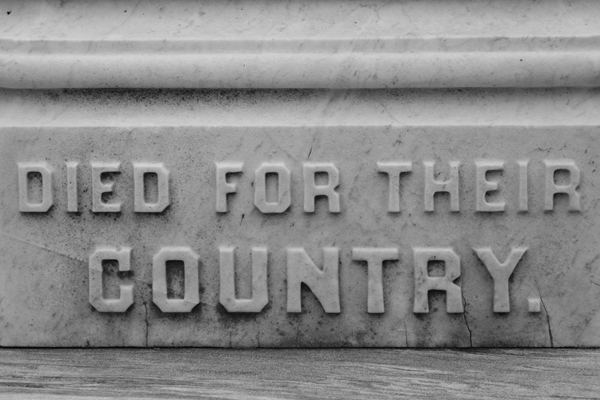
Graceland, that full city block-sized, um, field in Yeadon, Pennsylvania supposedly has thousands of United States veterans of many wars buried beneath its grass. The place looks like one of those memorial parks with the flush-to-the-ground grave markers – except there very few grave markers of any kind. On this Memorial Day in 2013, the bare flag poles behind the entrance sign stare at you in mute witness to what had been and what might have been. Honestly, if it were not for the oddly striking white marble monuments scattered here and there across the field, you would think it was just a park.


There’s a community athletic field alongside Graceland Cemetery, and housing on the other two sides. An industrial company sits near the entrance to the grounds, at Ruskin Lane and Bailey Road (Map). The cemetery is off the beaten path, a few blocks from the center of town. Yeadon, by the way, is a small town in Delaware County, which borders Philadelphia on Philly’s southwest side. I used to live nearby, and I never knew the cemetery was there.

Graceland, which was established in 1774, has been referred to as North Mount Moriah Cemetery since around 1895. This was due mainly to its geographic proximity to the much larger Mount Moriah Cemetery (established in 1855), which is about a half mile away. Graceland was not, and is not part of Mount Moriah Cemetery. It has, however, been known by other names, e.g. Buren Hill Cemetery and Sylvan Memorial Park.


Civil War headstone lying in Graceland Cemetery
The sign at the entrance to “Graceland Memorial Burial Ground” (as it is called on the Delaware County History website) says that 1600 Civil War veterans are buried here. So why no fanfare? Why the bare flagpoles? Did they move the bodies as some websites indicate? My question is this: if all the bodies were removed, why is it still called a ‘cemetery” on the sign?


Some burial records exist, but not all. As the entrance sign indicates, Graceland is home to an “unknown number of civilian burials.” On the Delaware County History website, a few hundred names are listed. Among them, eleven veterans. If the records exist, the federal government can be petitioned to have new grave markers made to be placed on these veterans’ graves. If worn stones exist, they will be replaced for free. Why the town of Yeadon has not requisitioned the federal government for new stones for the veterans’ graves is beyond me. According to these records, the locations of eleven veterans’ graves are known, based on a 1936 survey of the remaining headstones. 

This 1938 account of the burial situation indicates that the body count of veteran “soldiers” is closer to 5600. It goes on to state “Many of the old stones have been damaged and carried away and broken by the boys who frequent the cemetery as a play-field. Others have been used to form a wall at the rear of the cemetery. I should judge about fifty of the old fashioned marble, three inches thick type, made up the wall.” According to court documents, the Borough of Yeadon condemned the cemetery in 1964 because it was a “public nuisance.” It was closed to future burials and most of the head stones were removed. I assume the handful of large marble and granite monuments still on the grounds were left there simply because they were too large to move.

One of a handful of lone monuments left in Graceland Cemetery
I cannot help but wonder if one of the reasons for building the athletic field - Kerr Field - next door (a basketball game was in progress during my visit), was to discourage continued use of the graveyard as a playing field. At least the sacredness of the ground has is being observed – there appears to be no ball-playing of any kind in Graceland. Even though there are no gates or fencing, the locals obviously avoid walking through the cemetery to reach the basketball courts. There are also no paths worn in the grass. Signs warn of a $300 fine for dumping.

On my first journey out to this place where the journey of so many others ended, I instinctively began walking toward the distant corner of the cemetery field, toward a lone eight-foot marble obelisk. Too preoccupied with the surrounding rowhomes (and their quaint graffiti), I hadn’t noticed the stubs of white marble sticking out of the grass here, there, everywhere. You can see that the grounds were at one time densely populated with headstones and other grave markers. White marble nubs, headstone bases, and an occasional section marker are scattered all over the field, flush with the ground. The stones that stick up more than an inch have been clipped and worn by the blades of riding mowers. The grass is cut routinely here, I assume by the town. At least this form of respect continues to be afforded the dead.  

Graceland is supposedly the home of reinterred bodies from various condemned cemeteries in Philadelphia (Macpelah in South Philly and Hanover Cemetery in Kensington, to name two). By 1938, Graceland still had an owner, but the property was not taken care of. Headstones were stolen and smashed. “By the time Yeadon took over the care of the cemetery, many of the stones had already been stolen or broken throughout years of neglect and were piled to the side or were decorating neighborhood gardens.

Lone monument on the edge of Graceland Cemetery
According to this Ancestry.com reference, the town of Yeadon cleared the derelict cemetery in the 1960, dumped all the headstones somewhere, and [maybe] moved the bodies to Rockledge. Lawnview Cemetery in the Rockledge section of northeast Philadelphia had reportedly been the recipient of various cemetery reinterments, with mass graves being the burial method of choice. So much for a "blissful immortality." 

Whether there are 5600 veterans buried at Graceland, or even 1600, or just eleven, can we at least mark the eleven known graves of our war veterans? Flush-to-the-ground memorial plaques would not impede the grass-cutting. 

Naval Plot, Mount Moriah Cemetery, Philadelphia
So on this Memorial Day, 2013 – one hundred and fifty years after the Battle of Gettysburg – the lives of so many veterans have been forgotten. These were not unknown soldiers – the grave markers were originally there – we just, as a people, allowed them and their memory to be destroyed. Ironic that the original purpose of Memorial Day was to commemorate the lives of Union and Confederate soldiers who died in the American Civil War. It was originally known as Decoration Day, a day on which veterans’ graves would be decorated with flowers. The veterans’ graves in this particular cemetery will not be decorated as long as the locations of the graves remain unmarked. This disrespect to the veterans rests with us as the nation that created this memorial cemetery in the first place.

References and Acknowledgements:
Wounded Warrior Project
Thanks to Robert Hobdell for historical information.