Showing posts with label killed in cemetery. Show all posts

Thursday, April 16, 2015

Danger in Our Cemeteries!

This is kind of a follow-up blog to the one I posted last week, entitled, “Man Killed by Falling Headstone” (http://thecemeterytraveler.blogspot.com/2015/04/man-killed-by-falling-headstone.html). That was about a poor unfortunate fellow who was killed on Easter (2015) in northeastern Pennsylvania when the family grave marker that he was decorating fell on him.
Perhaps every cemetery should have these sort of signs throughout the property. Perhaps also something should be done to prevent headstones and monuments from falling. The sign is offered by the state board charged with identifying and preserving Oregon's historic cemeteries.

According to the KVAL.com story, (Aug. 21, 2013) “Warning: Historic cemetery ahead:”

The safety signs are intended to warn visitors that historic gravestones can be unstable. If the heavy stone monoliths fall, injuries or even deaths can occur, the Oregon Commission on Historic Cemeteries said. "The Commission tries to focus on practical services and programs for historic cemeteries." noted Commissioner Dirk Siedlecki. "This simple sign will remind people to use caution both for safety and for preservation of the markers."

Signage is important, obviously, but is simply the first step toward a lasting solution. I got to thinking about how to rile up the public enough so that money would be spent shoring up our cemetery monuments so they wouldn’t fall on people and kill them. Normally, if enough people die, something gets done. However, no one seems to be jumping up and down about the safety issues in our cemeteries. Maybe Ralph Nader needs to get involved.

1971 - "Danger in Our Hospitals"
Mr. Nader, as some of my readers may recall, is the famous consumer advocate who published the book, Unsafe at Any Speed, in 1965, which was a critique of the safety record of American automobiles and their manufacturers.

Oddly, I owe my livelihood to Ralph Nader. Currently I am a Clinical Engineer in an academic medical center in Philadelphia, but I began my career as a “Biomedical Equipment Technician.” This job classification was a direct result of something that Nader brought to the public’s attention. One of Nader’s alarming consumer alerts was published in the March 1971 edition of the highly-respected technical magazine, Ladies' Home Journal. To this I owe my livelihood. The issue carried the article, "Ralph Nader's Most Shocking Expose," in which he claimed, "At least 1,200 people a year are electrocuted and many more are killed or injured in needless electrical accidents in hospitals."(Ref.)

Who knows how many people were actually being accidentally electrocuted in U.S. hospitals, but it was a big enough scare that it birthed an entire new career, that of the “Biomedical Equipment Technician.” This person’s role was to keep all the electrical devices (everything from infusion pumps to heart monitors) safe for staff, visitors, and patients in U.S. hospitals. These technicians, who were usually electricians or electronics technicians, were not specifically trained for this new role– colleges and universities had no biomedical electronics degree programs at the time. The people hired for this technical role in hospitals were concerned primarily with keeping the existing inventory of equipment safe (for example, ensuring that every electrical device had a three-prong power plug to keep the chassis grounded). They were not initially involved in the design and manufacture of those devices, only in the ongoing safe use and maintenance of them.

A fallen, thousand-pound headstone

See the analogy to the falling headstones yet? To warn unsuspecting citizens of the potential hazards in cemeteries is one thing, but shoring up the monuments and headstones to ensure stability should be the next step. Not only that, but the manufacturers of these grave markers should be required to design them with a greater emphasis on safety. As I said in the “Man Killed by Falling Headstone” blog, our forefathers may not have expected that the ground would shift, that vandals would push headstones off their bases, or that earth tremors would happen – but we know that now! So why would we not secure new monuments with new technologies? One of the more obvious techniques - pinning headstones to their bases with metal rods - has proven to not be a viable long-term solution, for reasons that my Facebook Friend, David Gurmai points out:

Pin holes in the base of a fallen marble headstone
”The metal pin method causes the stones to degrade sooner. Metal expands/contracts faster than rock (cracking the stone), plus moisture still seeps in at the joint and corrodes the metal. You can tell the pinned stones in a cemetery immediately because their joints are rust stained and they are all cracking/cracked where the pins are. It only takes a few decades for the damage to begin showing.
In the late 19th century they "restored" the Parthenon with the metal pin method. By the 1960's (when the current conservation/restoration effort began) it was in worse condition than if they had done nothing at all."

It turns out that if the 1898 restoration effort had followed the method of the ancient Greeks, the Parthenon project might have been successful. Read more about that here.

So, can our cemeteries be made safer? Of course. All it takes is money, research, and perhaps, Ralph Nader. After all, Nader got the entire country so scared with his hospital electrocutions article that the problem was solved in ten years’ time. It all began with a bit of sensationalism – the opening line in Nader’s Ladies' Home Journal article was, “Too many hospitals are hazardous electrical horror chambers, says America’s leading safety crusader.” In the period between 1971 and 1981, the biomedical technicians (and later, biomedical engineers) along with hospital administrators, demanded safer designs from the manufacturers of electrical and electronic medical equipment. Eventually, medical products became very safe and therefore presented little of no risk to the patient or user.
 
A fallen, thousand-pound stone that nearly claimed a woman's leg.

The thousand-pound headstone pictured above nearly claimed a woman's leg when it fell on her. Unprovoked, it simply fell over as she walked by. Notice the off-level base. It took six men to lever the stone off her leg. Luckily, the ground was soft and gave a bit, so she did not lose her leg. She has internal pins keeping it together. I witnessed this calamity. You only have to see such a thing once to become a believer in cemetery safety.

So while it pays to be cautious around cemetery monuments, perhaps the monument manufacturers and stone carvers can incorporate new (or even ancient Greek) safety methods in their future designs. The Greeks used iron clamps to hold the Parthenon marble pieces together, but sealed the joints against moisture with molten lead. Molten lead being rather toxic, maybe non-metallic rods can be used to hold headstones to their bases? As an analogy, automobile manufacturers not only strive to make vehicles pleasing to the eye, but they also constantly improve the safety of the vehicles. True, certain aspects of this industry are government-regulated, but hey, if that’s what it takes to design safer cemeteries, so be it. Now if you will excuse me, I must go and see if Ladies' Home Journal is still in publication ...

References and Further Reading:
Read the entire article here: Nader, Ralph (March 1971). "Ralph Nader's Most Shocking Expose;"
Ladies Home Journal 3: 176–179.
Wikipedia article on Biomedical Equipment Technicians

Tuesday, April 7, 2015

Man Killed by Falling Headstone


No, that's not him above being killed by a falling headstone. That's a photo of me (taken by my friend Karen Schlechter) in an abandoned cemetery lowering a temporarily uprighted headstone. Some numbskull had raised it (probably to read the face-down inscription) and propped it up with a stick! I swear to you, this was right next to a playground in Norristown, PA. That stone must have weighed three hundred pounds. Horrific accident waiting to happen, don't you agree?

The title of this blog refers to an article on the WNEP-TV website that reads, “Man Killed by Falling Headstone While Decorating Family Grave … THROOP [near Scranton, in northeast Pennsylvania] — A man decorating a gravesite for Easter [2015] died Monday morning when a headstone fell on him in Lackawanna County.”


Getting past the irony of being killed by a falling headstone, most people who have read this tragic account probably had one of two reactions, either:“Oh my god that’s horrible!” or Tsk, what a shame.” I would venture to guess that very few people read it and think, “How can we prevent such tragedies in the future?

In reference to this accidental death, is it enough that the caretaker of the cemetery says (according to the article) that “each spring when the ground begins to thaw, some of the bases tilt and the stones on top can slip?” If you’re the owner of this (St. Joseph’s in Throop or any other) cemetery, that’s a plausible excuse to give the police. However, the next step should be taken – implementing a method of securing the stones so this does not happen again. Ever. Anywhere.

Accidental c
emetery deaths are not an unusual occurrence. A child recently died while playing in a churchyard cemetery in North Carolina. While attending Vacation Bible School, this WCYB.com story (click for link) states, “the children were running around when a massive cross fell off a tombstone and struck the girl.” 
 
A child died in Glenwood Cemetery in Park City, Utah in 2012, when a four-inch-thick, several hundred pound tombstone fell on him. According to Fox News, his father was taking pictures at the time (click for link). 

My daughter
That struck a painful chord. I’ve taken my five-year-old daughter into cemeteries quite a few times. For the past year or so, I have been extremely selective and careful about bringing her. I cringed when I found this photo I took of her in 2012.

There is a very subtle phrase in the recent Throop, PA story that I would like to clarify for you. When the caretaker says “some of the bases tilt and the stones on top can slip” what he means is this: When a headstone is installed, a stone base is placed in the ground and then the headstone is placed on this base. It has been done like this in the United States probably since the 1890s. You can see an example of such a n installation in this YouTube video, “How to Install a monument in a cemetery.” Also, if you look at my photo below of a vandalized grave marker, you can see that the headstone is typically not attached to the base.

Fallen headstone, unattached to base
When this practice of setting a headstone first began, it was probably not foreseen that the ground would erode, that the stones may sink and tilt, that there would be earthquakes, vandals, and groundhogs. So now that we KNOW that over the course of a few decades the ground will shift, there is NO GOOD REASON not to pin headstones to their bases as a standard practice! This will also deter vandals from pushing the stones off their bases.

When I say to “pin” a headstones to it’s base, I refer to the practice of setting steel rods into the base so that they protrude up and can fit into holes in the bottom of the headstone. This secures the headstone to the base (which is only a few inches wider that the footprint of the headstone, by the way). This is not done all the time, though I have seen it used for both marble and granite headstones (this is hardly ever done with slate, as the stone is too brittle).

U.S. Government-issues grave markers
An older, alternative method – and one used by the United States Government since the Civil War – is to make what is known as a single tablet slab headstone, installed with no base. Veterens' upright markers, shown at left, are basically a slab of marble or granite with the bottom third buried to keep the stone upright (read more at this link). Obviously, excavating the earth this far down (several feet) involves more work than placing a simple stone foundation, but it does make the stone safe and secure. For additional photos of standing stone grave markers, please see this informative website, Standing Stone.
 
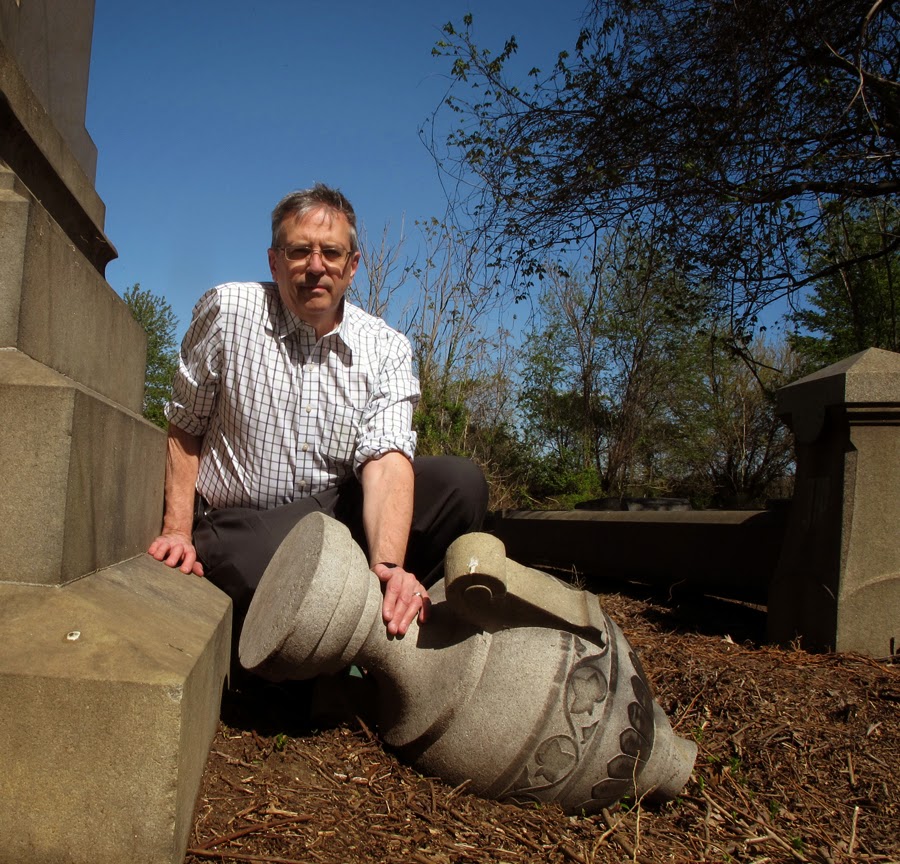
Ed Snyder with fallen decorative granite urn

Monument off which urn had fallen
One of the most shocking things I’ve seen in cemeteries is decorative granite pieces which have fallen off their monuments. Look at this granite urn I’m kneeling behind. This thing probably weighs four hundred pounds. At some point, it fell off its perch on the monument shown in the photo. Note there are no pins or holes in the base of the urn. It is smooth and flat. It was just sitting up there! Perhaps the monument sank a bit and is off level. So much for terra firma.
  
To summarize, this is a call to cemetery stone cutters – please suggest to your customers that they pay the extra few dollars for pins to be installed in their headstones and monuments! As for all those millions of unsecured and off-level grave markers out there in our thousands of U.S. cemeteries, I would suggest something on the order of what is happening currently in Scotland. “Considering the delicate balance between safety and compassion, … every council in Scotland is having to respond to the Health and Safety Executive (HSE) which has asked them to conduct safety inspections of all cemeteries within their jurisdiction, in the light of three fatal accidents of children from falling memorials.” While a number of methods of insuring safety have been implemented, probably the most dramatic is that of laying the stone down on the ground, with its inscriptions facing up (read more at this link).

 
Memorial Park

If all this sounds too complicated and expensive, safety may be the only good reason for the “memorial park” cemetery design: with all the grave markers being flush to the ground rectangular plates, there is nothing to fall on people. The old Victorian "sculpture garden" cemeteries are wonderfully picturesque, however, do exercise caution when visiting.
________________________________________________________
Follow up story on the gentleman in northeast Pennsylvania who was killed on Easter by a falling headstone: