Showing posts with label West Philadelphia. Show all posts

Wednesday, February 27, 2013

A “Stranger’s Guide” to Philadelphia’s Woodlands Cemetery

This winter in Philadelphia we’ve had an unusually high number of “snow events,” as the weathernauts have come to call them. Luckily, none of them dropped more than a few inches of snow. I’ve long been a proponent of photographing cemeteries under duress (mine, as well as theirs), so when weather hits, it becomes a “graveyard event” for me. One weekend in late January was a prime example. A small amount of snow was predicted for Friday night, and although it was expected to be colder than a well-digger’s butt on Saturday morning, I planned to head out to West Philly’s Woodlands Cemetery.

On the morning in question as I was getting ready to leave my house in South Philly, I checked the conditions and saw that about an inch had fallen and it was not actively snowing. There would be a light coating on the tombstones and I didn’t have to shoot through falling snow. Decent conditions - light dry snow, not enough to shovel or even sweep from around my house. I threw some chemical hand warmers in with my camera gear and got ready to make the twenty-minute drive to the Woodlands.

Looking out my back door, I was reminded of my stolen snow shovel from a few years back.  One wintery Friday evening it was snowing like a mother, so our friend Tom asked to stay the night. As we sat inside holed up and ordering Chinese food, Tom thought he saw someone through the glass at our back door. I figured since there really wasn’t anything worth stealing back there I didn’t even get up to look. Next morning, I was chagrined to find my snow shovel gone – with fourteen inches of snow to shovel! I closely scrutinized the hardware toted by the vagrants who came to my front door over the next few hours asking for twenty dollars to shovel my walks. Could anyone possibly have the nerve to steal my shovel and then try to charge me to shovel my walk with it? I ended up paying two neighbor kids to do the work.
 
Headstone, Woodlands Cemetery, Philadelphia

But to the subject at hand: I have not spent a lot of time at the Woodlands in recent years, but I figured I should reacquaint myself with its charms as it will be one of three subjects this fall in a photography exhibit in which I will be a participant. In September and October of 2013, I along with two photographer friends will be exhibiting work at the Philadelphia Free Library (Benjamin Franklin Parkway) on “Historic Cemeteries of Philadelphia.” The exhibit will feature predominantly Laurel Hill, Woodlands, and Mount Moriah cemeteries.

As it happens, each of us had long ago and for various reasons chosen one of these cemeteries on which to concentrate, so we each have many images of these institutions spanning a ten-year period. Frank Rausch (who literally lives in Laurel Hill Cemetery), Robert Reinhardt (who has done extensive photography and research in the cemeteries of Scotland), and Ed Snyder (starring as himself), will be presenting their photography of Laurel Hill, Woodlands, and Mount Moriah, respectively.

From the photos I’ve sprinkled throughout this article, you can see that I was rather taken with the light covering of snow on everything. Rather than cover up, it seemed to accentuate small details, which I have in the past, missed. Of course, the last two times I was here it was actively snowing, so I didn’t walk around as much. From the lettering on headstones to small carvings such as the boat propeller above, the eye is drawn more to the shapes of things than their intended meaning. The geometric lines of crosses and crypt covers jump out at you, begging to be photographed. A dusting of snow on the cold shoulders of these Victorian mourning statues make them appear far more alone in their grief.

Runners at the Woodlands
It’s odd that the first things you see at the Woodlands after passing through its ornate hourglass gates are joggers, runners, dog walkers, dog runners, and track teams working out. It’s a good thing there are so many well-kept paved roads here, otherwise paths would be worn into the grass! Of the three cemeteries I mentioned, Woodlands is by far the most visited for the purpose of maintaining people's health! Due to its location in Philadelphia’s University City district, and the fact that it is very safe and well-maintained, people treat it as a getaway from the city - a park, a place to play. Oddly, this was exactly the intent of the designers and architects of the Victorian rural or “garden” cemetery, that it be a bucolic getaway from the noisy city, a place for people to enjoy themselves.
The trees that adorn the cemetery are some of them of majestic growth, leading to the scenery and the grounds the most impressive effect.  The vistas beneath the foliage, or between the separated groves, conduct the eye to distant prospects, varied on every hand, and by every change of position,; there, the spires and public buildings of the city are beheld; here, the windings of the Schuylkill [River]; and more distant, the bright surface of the Delaware [River] and the blue hills of New Jersey skirt the horizon; while flowers and shrubs are scattered plenteously around, shedding a cheery influence in shaded lawns, or among the tombs. All that taste can suggest or science demand, consistently with the solemn purpose of the place, has been added to the superior advantages already possessed.
– From "The Stranger’s Guide in Philadelphia …," 1852.

Woodlands' entrance gate
The above description of the Woodlands is excerpted from an odd 1852 travel guide of sorts, “The Stranger’s Guide in Philadelphia and its Environs: Including Laurel Hill, Woodlands, Monument, Odd Fellows, and GlenwoodCemeteries: with Illustrations.” I say odd because it’s  author is “anonymous” and various cemeteries are actually named in the title. Truly, in Victorian times, a city’s garden cemeteries were gems worth boasting about. While you really can’t see the rivers anymore due to the train tracks and power plants, nor the distant “blue hills of New Jersey,” the passage above makes you wonder what lovely Woodlands Cemetery looked like in 1854. No doubt the grounds themselves were at least as beautiful as they are today.

References and Further Investigation:
The Woodlands Cemetery website
Buy from Amazon.com

Thursday, December 6, 2012

A Monumental Challenge

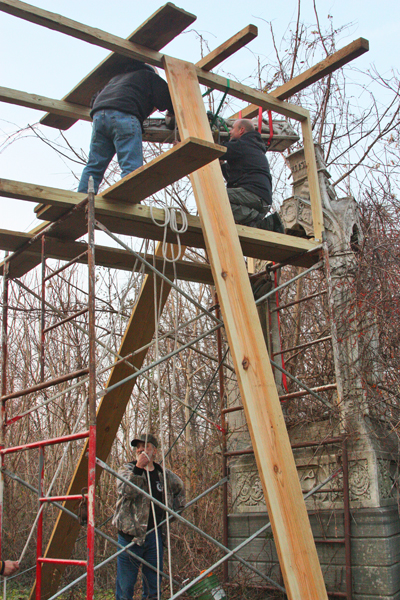
I have to say, I really walked into it this past weekend. I was out at the (formerly abandoned) B’nai Israel Cemetery in West Philly (see links at end), photographing the headstones as part of a research project, when I was invited to the takedown of the broken Keystone monument at nearby (also formerly abandoned) Mount Moriah Cemetery.  Donna, along with her husband, who both take care of B’nai Israel and as much of Mount Moriah as they can handle, had organized a rigging crew to remove the broken spire from atop the large Masonic Keystone monument. Hurricane Sandy toppled the spire a few weeks back so the only thing holding it up above the roadway was a tangle of vines.

Keystone monument with toppled spire


You can see the broken piece in this photo I took a couple weeks prior to this visit. At right is what the spire looked like a few years ago. I was invited to take pictures of the disassembly, but it was obvious they really needed another pair of hands. As I walked the short distance into Mount Moriah (B’nai Israel is essentially on the same piece of land), I saw that a scaffold had already been built around the monument. I would estimate the base of the broken spire to have been about twenty feet off the ground, the spire itself adding another six feet.

It was mid-afternoon when I got there, and nightfall when I left. Over the course of about three hours, we managed to get the 500-pound marble spire down to the ground in one piece, to await its reattachment at some point in the future. About eight people were involved in the project, though one lead guy provided most of the brainpower and muscle.

Sawing the marble spire loose from the steel rebar
The spire was actually attached to the main structure of the monument with steel rebar, a rod that went through the center of the spire, and continued down into the arch of the monument. The rebar had bent and pulled out of the spire somewhat when the spire fell, but was still attached to the inside of the spire. To get the spire down, the rebar had to be cut.

That’s where the generator and electric Sawzall® came into play. Three guys set all this up and the lead guy up on the scaffold spent twenty minutes sawing through the steel. When it finally broke loose, the spire looked quite precarious hanging up there with ropes and nylon straps. How to get it down? The old green coffin-lowering straps had no winching mechanism so another fellow provided some pulleys and rope. Hopefully things could be rigged up so we could ease the spire down to the ground.

Marble miter from atop monument
The marble miter, or flame, was actually loose on the rebar protruding from the top of the spire. This just slid off and was gently lowered to the ground in a padded moving blanket. I set the twenty-pound decoration in the nearby weeds out of harm’s way.

Spire cut loose from steel rebar
At one point, there were as many as three men on the upper deck of the scaffold, balancing the spire in mid-air, attempting to lower it down to the next level. Did I mention that it was slowly getting dark? And that one of the men had only one arm? I was holding onto the pulley rope from the ground, adding some upward force to the hanging spire, while they guided it through the center gap in the platform. Some other folks were keeping the generator running and connecting lights. My wife called my cell phone at this point wondering where I was. I told her I was helping disassemble a broken marble monument in an old cemetery at night – that’s plausible, right?

Spire being lowered thru decking
Nothing short of amazing to me was the fact that this group of guys kept their cool even when things began to look impossible. When lowering the spire all the way to the ground began to look unlikely, they ended up propping one of the 2x10 planks against the box of the pickup truck so we could gradually slide the spire into the back of the truck!

I was surprised to find out later that these guys were not a professional rigging crew, but just regular people who happened to have way more common sense and practical know-how than you could possibly imagine! And they had the right tools. Why were they here? Maybe the same reason I was there. Just to have the honor of doing something good.

Fund-raising will be put into place in the near future to reattach the spire, through the Friends of Mount Moriah Cemetery. This would obviously involve a crane and people skilled in statuary restoration.

Spire safely in truck bed

Further Reading:
West Philadelphia's B'nai Israel Cemetery

Saturday, September 4, 2010

Trapped in a Cemetery!


Whenever I photograph in a cemetery, I pay attention to an important sign at the entrance--the one that tells me when "Closing Time" is. Minor detail, but neglecting this has gotten me into some tough scrapes. Not that I'm scared of being locked in a cemetery--walking by a dialysis clinic should be more frightening, you know? All those people on the other side of that wall will probably be dead in a month.

Ignoring the possibility of being attacked by the living dead, getting yourself locked in a cemetery poses a certain inconvenience--especially if you're locked in with your car. At least as a pedestrian, you can climb over the wall...before they release the dogs, that is. Who am I kidding? I don't want to be locked in a cemetery under any circumstances!

Back around 2005, I was photographing in the Woodlands Cemetery in West Philadelphia. This is an oasis of 250 wooded acres surrounded by city, The University of Pennsylvania, mostly. Its a quietly creepy kind of place, with the sculpted hills blocking out  most of the city noise. In his book, "Philadelphia Graveyards and Cemeteries," author Tom Keels quotes an early advertisement for the Woodlands:

"...the decaying bodies of the dead may securely moulder into kindred dust, with an abundant vegetation and free winds to absorb and dissipate all noxious effluvia."

Poetic, don't you think? Certainly not a place you want to get locked up in. Anyway, I vaguely glanced at the closing time sign on the entrance gate when I drove in--4:30 p.m. I spent a few hours shooting, when I noticed an old pickup truck drive by, heading toward the maintenance garage. I glanced at my watch. Hmmm. 4:20 p.m.. Best pack up my gear. I drove to the entrance and, to my horror, the gate was chained shut! My first inclination was to panic. Which I did, quite effortlessly, as I recall, but then remembered the pickup truck. I drove at amazing speed toward the maintenance garage and found a man sitting in the driver's seat of the idling truck. I drove up alongside him and asked as casually as I could if he could let me out. He looked at me and with the few teeth he had, laughed and said, "That's the only way to get you people out of here!" He did let me out.

As I quickly exited the cemetery, I noticed this decoration on the main gate--an hourglass with wings! Time flies, get it? What better symbol to remind one of closing time! Needless to say, I now pay closer attention to closing times.

Obviously its more than inconvenience that makes us prefer to not be locked in a cemetery. We're taught at a young age that there are no such thing as monsters. It can't simply be fear of mortality. What then strikes fear in our hearts? The possibilities are only limited by our imagination....

A friend of mine once worked in a cemetery and told me that she didn't believe there were any 'bad' spirits haunting cemeteries. If a person happened to die a horrible death, the person's ghost would hang around the place where the death occurred, not the body's final resting place. We laugh at comments like this with much bravado sometimes, either due to ignorance or because we're secretly afraid. Sometimes we think we're above all that "superstitious nonsense." I often recall something I heard a mother tell her 3-year-old daughter at a gallery opening in Manhattan for an exhibit of nineteenth century "spiritualist" photography. It was a telling comment on how our views and beliefs change over time. She gestured around the room at all the hanging photographs and said, "This was all before people knew any better."