Showing posts with label PA cemeteries. Show all posts

Tuesday, October 2, 2012

Dearly Departing for the Dunmore Cemetery

I’m quite looking forward to October 7, 2012, when I’ll be attending the Dunmore Cemetery Tour, in Dunmore, Pennsylvania, hosted and presented by the Dearly Departed Players theatrical group. Thousands of people attended this annual event over a two-weekend period in the fall of 2011!


From the Dunmore Cemetery Tour Facebook page:

    Sunday, October 7  and 14, 2012
    2:00pm until 4:00pm
    Dunmore Cemetery,  400 Church Street,  Dunmore, PA 18512

    Join the Dearly Departed Players on their annual historical walking tour through the Dunmore Cemetery. With all new "stops" the "Players" will be joined by the students of Scranton Civic Ballet and the Genealogical Research Society.    No reservations are required, admission is free. For more information regarding the tour call 570-344-3819.

    Don't forget "Dinner with The Dearly Departed"on October 7th. This dinner is sponsored by the Dunmore Historical Society and will take place immediately following the tour at the Dunmore Civic Center on Monroe Avenue. Reservations are required, tickets are $8 and can be obtained by calling the Dunmore Historical Society at 558-1060. All proceeds from the dinner benefit the Dunmore Historical Society.

Dunmore Cemetery, Dunmore, Pennsylvania
From what I’ve read and heard, the performers, sponsors, and coordinators do an incredible job with this program so I’m just DYING to see it! I was graciously invited by the coordinators to exhibit my artwork in the cemetery the first day of the tour (October 7), so I will be set up at the entrance at noon. I do hope to take in some of the tour, however!

For the occasion, I made cards and prints from images in the Dunmore Cemetery itself, and will exhibit these along with my cemetery photography from all over the United States (and Italy as well). I spent a few hours in the Dunmore Cemetery last fall and photographed many of the wonderful monuments, mausoleums, and headstones. I used about twenty of these photographs for the new work, examples of which you see in this article.

The Dunmore Cemetery is a wonderful Victorian masterpiece, meticulously cared for and interesting in so many ways. From the iron scrollwork on the mausoleum doors to the unusual monuments,  to the rolling hills that lead you back to the old section (1838) of the cemetery, there is something here for everyone − taphophiles, historians, nature-lovers, and those who just want a quiet place to think.

Headstones in the old section of the cemetery

Click to buy Julie Snell-Esty's book
No doubt some of the trees up there in northeast Pennsylvania will soon be donning their fall attire. Such will add to the pageantry of the Dearly Departed Players, as they (in Victorian dress) lead the audience through a two-hour tour of the lives of some of the cemetery’s residents, re-enacting interesting events in their lives. These “Stories in Stone,” as Players’ director Julie Snell-Esty calls them in her book of the same name, provide the script through which her cast fleshes out the lives of people who lived in the region.

Today, people “yearn to learn of their past” and to preserve their heritage, Esty says. The region’s ancestors include miners, soldiers, housewives, clerks, laborers, merchants, and artists – who “all played a significant role in the making of our history.” These people are no different than those of your own ancestors, wherever you live. While you might not recognize any of the personages addressed in the tour as celebrities or national heroes, they give one a sense of how everyone contributes in their own way to the “fabric of our history.” So even if you cannot attend either of the October 7 and 14 cemetery performances, I hope I’ve stirred up enough interest in you to at least visit the Dunmore Cemetery.

As a side note, Dearly Departed Players Julie Snell-Esty and Wendy Belaski’s “Grave Matters Funeral Exhibit” affords us a look at the history of mourning in the United States:
Grave Matters Funeral Exhibit 
    Saturday, October 27, 2012
    10:00am until 5:00pm
Mall at Steamtown, Second Floor, Scranton, Pennsylvania 18503
                Local historians and Dearly Departed Palyers Wendy Belaski and Julie Snell-Esty bring their curious collection of funeral and mourning memorabilia to Library Express! Players will be on hand and in historic costume to help explain photos and histories of mausoleum stained glass, vintage funeral fashion, and a whole collection of ephemera related to funerals and cemeteries. This is not to be missed! Schedule, 2-4 pm, dinner afterwards.

References:

The Dunmore Cemetery Tour on Facebook
Scranton PA chamber of Commerce link to the Dunmore CemeteryTour

Thursday, September 20, 2012

Time for a Little Football?


Over the years, I’d driven past a few small roadside graveyards in Conshohocken, PA. This is northeast of Philadelphia, outside the city limits. As soon as you get off the PA Turnpike and head south on Germantown Pike, you start seeing them, quaint little spots that history forgot.  You look at these forlorn little cemeteries and you know for certain that whatever needs to happen next isn’t going to happen here.

Cemetery entrance gate on Butler Pike

One such graveyard sits calmly on busy Butler Pike, nestled between an insurance agency and a car dealership (at Twelfth Avenue). No name is evident, but it’s two-hundred –foot frontage is dressed with a low stone wall and an old iron gate – hardly a deterrent to a vandal or a teenage tryst.  There’s a wonderfully unique miniature castle-sort-of-looking granite monument front and center facing the road. Its bare pedestals once hosted statues or urns, perhaps.


The old cemetery seems very typical of the geographic area, until you walk the length of the narrow, deep cemetery toward its back half. There’s a large grassy gap – maybe a third the size of the entire cemetery − between where the headstones end and two large white marble monuments stand. In this space stood the football tackle practice sled you see in the photo at left.

As I walked out to toward these monuments, I noticed traces of marble headstone bases here and there in the grass. A glance to the right side stone wall of the cemetery confirmed my suspicion − most of the headstones on the back half of the grounds had been removed and were repurposed as building stones for the wall! (You can see these in the top photo beyond the blue pads.)

I suppose that decades ago, this was an old derelict cemetery and the townspeople got together and “cleaned it up.” In so doing, they (intentionally or not) created an athletic field for the Conshohocken Youth Football organization to use for practice. (I assume the blocking sled belongs to them, as they have a facility behind the cemetery.) The young boys must dodge the old marble Celtic Cross and large obelisk as they run around.

As the blocking sled was one of the more unusual items I’ve seen to date in any cemetery, I posted the image (below) on Facebook, and received many cries of dismay. Most were based on the disrespect to the dead, but one posting was quite thought-provoking:
"Probably was done decades ago, but still the students are going to see this and think that it is ok. It's not - we need to find and build respect in our country again …"


While I agree wholeheartedly that we should set an example of respect for our dead, I assume as well that this "repurposing" of the graveyard happened decades ago. The cemetery was probably let go and derelict. As I've said about other forlorn cemeteries in the past, it appears that up until the 1950s, we just didn't care. And I include all our ancestors - we, collectively, just didn't care as much as we do now. Something happened to our sensibilities around the 1950s and we stopped plowing over old moldering graveyards to make parks. Obviously, this sort of thing would not happen as easily today, even if the land was extremely valuable.

So while I find it difficult to be judgmental about what the people of Conshohocken did to a derelict graveyard, I shudder to think what might have been their Plan B.  My knowledge of such things is inadequate and explosive, so I’ll just change the subject.

I probably wouldn’t have bothered to write a blog about this place if one of my readers (Michael T. Dolan) hadn’t directed me to an article he wrote, which is about growing up near a cemetery and playing football in it with his friends. It really is a wonderful story, having nothing to do with organized sports − in general, it’s about growing up, with the cemetery as the focal point. I highly recommend the reading his essay, “Learning to live in a graveyard.To quote Mr. Dolan, "October’s spirits fill the air, calling us to revisit the cemeteries of our lives, so that we may remember what it is like to live."


As for the little Conshy cemetery in question, it looks like there hasn’t been a burial here since maybe the 1920s, with most of the still-standing stones being much older than that. After a bit of Internet digging, I’ve decided this must be “Old St. Matthews Cemetery,” Just a few blocks away from the newer St. Matthews Cemetery (at Butler Pike and North Lane). Since St. Matthews Parish was founded in 1851, I assume this was the original parish cemetery. The other one seems to have been established later.

Wednesday, October 19, 2011

Cemetery Exploring: Scranton PA and its Environs

It seems I’ll be allowed to go on being Ed Snyder for a while longer. Just got home from having surgery on my inner ear and am waiting for the power headaches to kick in. Pass the Darvocet, please. As I write this, I’m flying higher than angels.

When you go under general anesthesia, you’re never a hundred percent sure you’ll wake up, you know? (That is, unless you checked the appropriate box on the “Advanced Directive” form.) But hey, aren’t these the best conditions under which to write a cemetery blog? I certainly can’t go exploring in a local graveyard– my equilibrium is off and I might fall over a cliff or something. Boneyards around here are like that. Of the literally scores of them in the Philadelphia area, many are not kept up that well. There are the ones with sunken graves, open crypts, tombstones spilling into the river, the ones with dealers and hookers and burned out cars, voodoo offerings and long rusty saws and knives hidden in weeds. As for this last one, I’m not referring to the self-defense weaponry with which I typically arm myself when I explore such places. I’m referring to the giant carving knife I found stuck inside a child’s grave monument (shown above) in an abandoned Philadelphia cemetery. Intertwined with the memorial ’s faded and soggy stuffed animals was a melon vine. So I’m sure some homeless guy was using the knife only for good. The only thing worse than abandoned cemeteries is abandoned people.

Too bad you don’t dream under anesthesia. You have no brain capacity for that − they basically kill you, while keeping you alive. Thanks to Tommy for that comforting thought, and for driving me to the hospital this morn − Whoops – I was listing to port for a moment there, felt a bit of my brains leaking out my ear. Better right myself and prop up with some pillows. There. Any “Distance Reiki” practitioners out there willing to send some positive energy my way?

I need to recuperate well, you see, and not lose any white matter. The Cemetery Traveler will be heading up to Scranton, PA in a few weeks and he needs all his faculties. He also plans to stop talking in the third person, as it gets on his nerves. I was offered a spot at St. Luke’s Church as an exhibitor during Scranton’s First Friday Art Walk for November. I will be showing my photography (prints framed and unframed), greeting cards, and books – all for sale. As it will be in a church, I may need to go easy with my usual tongue-in-cheek banner ads, like “Death Images – Just in Time for Xmas!

I don’t have a lot of work from the Scranton area (even though I grew up around there), but I do intend to show some of the images sprinkled throughout this article from the nearby towns of Wilkes-Barre and associated environs. In fact, my signature image, “Folded Hands” (which you see at the beginning of this article, on my Facebook page, business cards, and the cover of my “Stone Angels” book) was made in the Exeter Cemetery, across the Susquehanna River from Wilkes-Barre. I shot it some years ago around seven o’clock one misty morning, roughly twenty minutes after I left a sleeping woman in bed to zip back to Philadelphia. As I closed her locked front door behind me, I realized I left four pounds of fresh Polish kielbasa in her freezer. Damn!


Slovak Cemetery, Exeter, PA
Occasionally I post images on the Facebook page, “Cemetery Iron,” like this gate from the Exeter cemetery. (“Cintorin” is Slovak for ‘cemetery.’) The wrought iron fencing reminds me that for the next few months, all my food will have a metallic taste. Side-effect of the stapedctomy (ear surgery). My doting wife Jill just allowed me to devour a hot dog, which tasted much like one would expect a piece of cemetery iron to taste, were it served up on a bun. Maybe later, I’ll try a metallic Nutella sandwich.
Oww! Sorry − just tore off an errant ECG electrode they left on my right leg. Funny how when they were monitoring my vital signs, they complimented me on how “normal” I was! Hah! Me! Normal! If only they were to read this blog! Anyway, I’m glad I had the bionic ear installed (my hearing acuity will be so amazing I’ll be able to hear what people are thinking! Imagine that.). A benefit of hearing well is that when I do shows now and meet people face-to-face, I’ll actually be able to hear what you’re saying (instead of faking it, as I’ve been doing.  No that’s not true – I’ve learned to read lips. Again, not true. I can kind of hear, but I do sometimes allow my imagination to fill in the gaps. Much like how I write, since my memory is less than perfect. I’ve had considerable hearing loss since I was twenty years old, when I spent way too much time next to the PA speakers at several KISS concerts. I’ve also come to suspect that my parents may have dropped me on the head as a small child.

So anyway, while in Scranton for the Art Event, I intend to spend some time in the nearby Dunmore Cemetery, as recommended by my Facebook Friend,Wendy Conrad Belaski, who is a member of  The Dearly Departed Players (who give tours of the cemetery while reenacting the personalities buried there).

Angel, Hollenback Cemetery
Another favorite graveyard of mine in the area is the Hollenback Cemetery, which is across the street from the Wilkes-Barre General Hospital (click here for a view of its rather unique entryway). My Dad died there in 2004 (the hospital, not the cemetery). Hollenback is a quaint old hilly Victorian cemetery along the river, which is where I shot this angel. As for the cemetery where my Dad‘s ashes reside, that’s an unassuming little back-mountain graveyard in an area north of Wilkes-Barre that is so “out there” it’s just called the “Back Mountain.” I don’t believe there’s even a town associated with it, just a sand pit.

"Damaged Woman with Dog"
Here’s a photo a little statue near my Dad’s grave. Looks like the woman had some surgery done to her head. Which prompts me to break here and apologize since I, your favorite content provider, seem to be jumping around a bit, ah, content-wise. It’s the drugs. But hey, if it worked for Hunter Thompson (Fear and Loathing in Las Vegas, etc.), should work for me, right? Gee, I wonder if Microsoft Word has a plug-in for correcting dyslexic text? (Try to say that quickly three times! .. or just ONCE, actually…) It’s taking me much longer than usual to type this article since the effector neurons sending impulses from my brain to my fingers seem to be regularly misfiring. Have to keep going back to make corrections. Maybe I’ll lighten up on the next load of painnkilerz.

"Old Man"
You look at pictures like this “Old Man”  (double-exposed and cross-processed Ektachrome) from the Hollenback Cemetery, and you wonder if this guy had anything to live for when he reached the stage in his life when the sculpture was made.  Me, I certainly do have a lot to live for and to be thankful for – a wonderful wife, four lovely children. Oh, and the ability to go on being Ed Snyder for a while longer, until my peep-hole into the world is finally closed, as Kurt Vonnegut would say (or said, rather, as he’s dead). Vonnugut’s work, by the way, is one of the few things you can read when you’re drugged up and loopy, and still have it all make sense! This last image is for him:

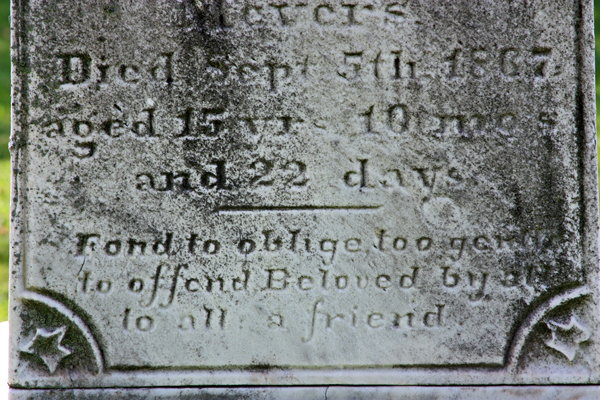
Epitaph, Hollenback Cemetery, Wilkes-Barre, Pennsylvania