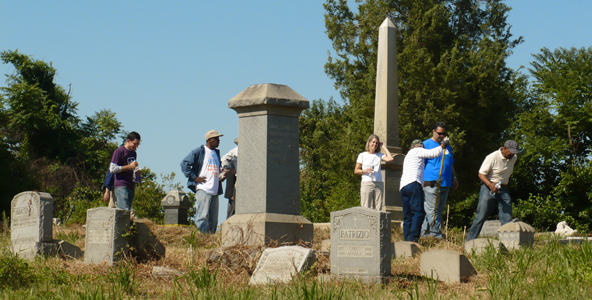
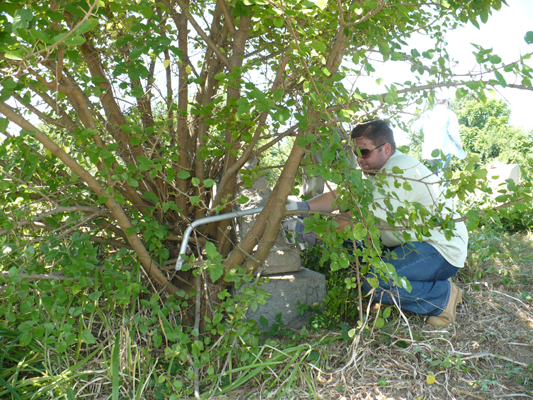
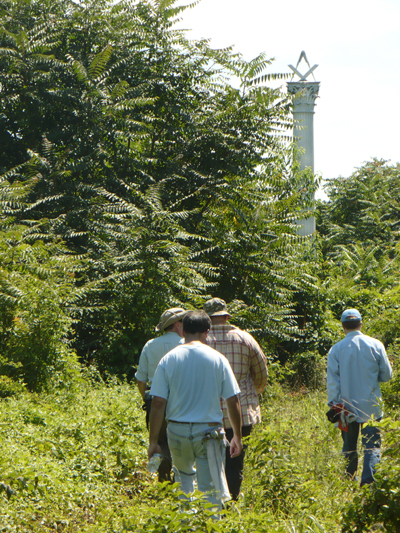
! Folks digging out family plots, clearing brush from obscuring the veterans' burial ground, hauling rocks away that had been dumped, and weed-whacking with a vengeance. Chains saws tore away at the trees that had been overtaking graves, and machetes hacked away at the vines and other invasive growth. ABC News was there and Philadelphia mayor Michael Nutter stopped by to give everyone a T-Shirt and a "Thank you" from the city.
 |
| Veteran's Grave |
Even though Park Day is mainly about saving locations historically linked to the Civil War, there were very few Civil War buffs at Mt. Moriah today. There were a few guys with period kepi caps, but there were also groups of high school and college kids, neighbors, and people who have family buried here. Some of the latter used the opportunity to clear their own ancestors’ graves, but most just helped with the mass cleaning of the overgrown areas in front of and around the Soldiers’ Plot (Section 200). This is where the bulk of the work was concentrated. Local Veterans’ organizations care for these actual grave sites, but not the overgrown plots that keep you from accessing (or even seeing) the section. The rake trucks, police cars, food trailer, and an assortment of other city vehicles were parked here, near the barricaded Cobb’s Creek entrance.
 |
| Groups of Volunteers working at Mt. Moriah Cemetery |
 |
| Weed whacking |
The work began at 8 am, and mercifully ended at 1 pm. Everyone had to register and sign waivers to the effect that it was their own responsibility if they got hurt. Good plan, given all the chainsaws ripping through trees and machetes swinging at the underbrush. (I thought it rather comical that one guy was distributing brand new machetes to any takers this morning. "
Where do you actually BUY a machete?" I asked. He said, "
Home Depot! I was actually surprised at the quantity they had available!" Hey, this IS Philadelphia, after all.)
It's a strange feeling to pull a wet flag out from under the weeds and drape it on a stone, stranger yet to discover a hidden flush-to-the-ground veteran's marker, and weedwhack it back from obscurity into the light of day.
Between trysts with Japanese knot weed and tearing through the tall grass with a gas-powered weed whacker, I chatted with some of the other volunteers.
I was surprised to learn that about ninety-five percent of the 400−person membership of the Friends of Mount Moriah are descendants of those interred at the cemetery! I wondered if they came out en masse because they felt it was safer here with so many other people around.
I felt WAY in the minority, just being someone who cares about the cemetery, the neighborhood, and the memory of the thousands buried here.
 |
| Rakers taking a break (note mausoleum and monuments in background) |
There was a college-aged guy making a video of the day’s work, who was surprised when I told him about the dangers of being in here alone. I had just been told that the city pound rounded up the latest pack of resident wild dogs and hauled them away. They seem to form in the overgrown wilderness areas of this cemetery every few months. In the photos here you see relatively low grass around the tombstones. The woods in the background actually delineate the major portions of the cemetery – probably eighty percent of its 380 acres. If you look closely at the trees in the photo above, you can see a mausoleum in the center and a red granite obelisk sticking out of the trees.
 |
| Philadelphia Mayor Nutter (second from right) |
I caught bits and pieces of some on-camera interviews with people throughout the day. Many of the volunteers were in their sixties, had grown up nearby, then moved away. The 1960s were fine here, so they said, with things going downhill in the 1970s. One woman’s husband worked here as a groundskeeper in the 1970s-80s. He told her, “
A place this size would take a crew of ten people seven days to just cut all the grass. Then you’d have to start over.” Another woman and her friends learned to ride their two-wheeled bicycles on the hilly roads of the cemetery when they were children.Two volunteers, both equipped with site
maps and print-outs of burial records, found they both had ancestors buried in the same section of the cemetery. This place is more than a graveyard – it’s really a web of relationships.
Every hour or so, I would take a break and hit the Potty Queen or grab a bottle of water from the free supply. Once, on my return to the work site, I came upon a woman shoveling turf off a buried sidewalk that crossed the section in which her ancestors were buried. She was working in front of four large granite stones, one of which was knocked off its pedestal. She and her husband were dismayed that the base was unlevel, so righting the stone would not be a permanent fix. This is the sort of thing “Perpetual Care” was supposed to encompass, and what people paid for as part of the original burial fee. Unfortunately, the cemetery owners didn’t live up to their end of the bargain.

At one point, I laid down the weed-whacker to help load a truck with chainsaw-cut logs, and then helped load chunks of busted-up concrete from an illegally-dumped pile. One of the local residents had a four-wheeler and a large hauling wagon which she used to cart off the concrete to dump into sink holes in other parts of the cemetery. While we were loading the concrete, a fellow volunteer – who came from the other side of Lancaster to be here today – told me he has relatives buried on the Cobb’s Creek side of the cemetery. When he was visiting and tending to these graves about five years ago, two trucks appeared, dumping building materials in the weeds nearby. Imagine the BALLS that takes! Especially when the dumper SEES a person there tending a grave! Luckily, this has stopped, mainly due to the city having barricaded the entrance with concrete highway dividers.
 |
| Food Tent |
Around noon, I headed over to the food cart for a Philly soft pretzel and was thrilled to find piles of hot dogs on buns! Don’t know if these were voluntarily provided or paid for by the city, but after all that work, these things tasted great.
The section in which we were working looked great with all the grass cut, so then people began hacking away at the periphery, felling trees growing on the hillside. College students swarmed over the area bagging the grass clippings, and some of the people more knowledgeable about the cemetery led small groups of interested parties on quick tours here and there. I called my wife to tell her how great the place looks. She said, "
If you clean it all up, what will you take pictures of?" Then I told her that we probably only cleared a few acres.While that small area does look much better, the place is almost
400 acres of mess, most of which is a forest. Everything's relative - where will the hawks and vultures roost then?
 |
| Mt. Moriah Hawk |
I was surprised at the number of people who routinely visit Mt. Moriah (aside from myself, of course). There’s the guy who rides his bike through the place every midnight, the woman who lives nearby and cuts grass here with her riding mower, and the guy with the chainsaw who cuts down the invading trees in his spare time. I felt better about the place knowing that there are several (sort of) normal people who “haunt” Mt. Moriah Cemetery!
At the end of the day, the city will hopefully find a "receiver" to manage the cemetery. A Pennsylvania State Representative introduced legislation last year that would protect an entity willing to take over operation of the abandoned cemetery from current and past outstanding liabilities. Expecting descendants or other volunteer organizations to keep the place up is just not re
alistic. One fellow I spoke with used to live nearby as a child, and he and his cousins used to come here to tend to his great-grandparents' graves. Cemeteries used to count on this sort of thing, before people became more mobile and began moving all over the country. This particular gentleman moved away to the other side of Lancaster, PA. in the 1970s. He brought his mother back in the early 1980s and they were greeted by "about thirty guys hanging out in the cemetery, shouting threatening things" at them. He said his mother never returned. Hopefully, now that more and more people are actively involved with Mount Moriah Cemetery, those days are gone for good. 
As I finish writing this two days after the cleanup, my biceps are aching. I earned a new appreciation for the backbreaking work done by cemetery groundskeepers. I don’t REALLY look forward to the next cleanup day (which will be published
here), but there’s always Dr. Seuss' Lorax nagging:
“
Unless someone like you
Cares a whole awful lot, nothing is going to get better.
It’s not.” – The Lorax, Dr. Seuss
References and Further Reading:
Park Day 2012


 At one point, I laid down the weed-whacker to help load a truck with chainsaw-cut logs, and then helped load chunks of busted-up concrete from an illegally-dumped pile. One of the local residents had a four-wheeler and a large hauling wagon which she used to cart off the concrete to dump into sink holes in other parts of the cemetery. While we were loading the concrete, a fellow volunteer – who came from the other side of Lancaster to be here today – told me he has relatives buried on the Cobb’s Creek side of the cemetery. When he was visiting and tending to these graves about five years ago, two trucks appeared, dumping building materials in the weeds nearby. Imagine the BALLS that takes! Especially when the dumper SEES a person there tending a grave! Luckily, this has stopped, mainly due to the city having barricaded the entrance with concrete highway dividers.