Showing posts with label Jewish Cemetery. Show all posts

Friday, June 12, 2026

Philadelphia Cemeteries that Mark Our Nation's 250th Birthday - Part 2

Two hundred and fifty years ago, the Declaration of Independence was signed. Two hundred and eighty-six years ago (in 1740), Congregation Mikveh Israel was established – and with it, the first Jewish cemetery in Philadelphia. The small burial ground is one of about twenty colonial-era cemeteries in Philadelphia that exist as they did when America’s founders walked this land.
As you peer through the black iron gate onto the small, quarter-acre property, you get a more visceral sense of history than if you were walking past, say, the Liberty Bell. This is the actual ground that America’s founders walked on, actual headstones that thousands of Philadelphians have touched over the centuries. Unlike some other “historic” landmarks in this city (like the fake Betsy Ross grave in front of the fake Betsy Ross House), these cemeteries have intense historic significance as tangible artifacts of our proud past.

There are in fact three Mikveh Israel cemeteries, the oldest being on Spruce Street, between Seventh and Eighth streets, directly across from the oldest hospital in America, Pennsylvania Hospital (which has a newly opened museum, by the way!). How this cemetery came to be established is an interesting story. Nathan Levy (who is buried here) was a Philadelphia merchant who petitioned the William Penn Family (Royal Proprietors of Pennsylvania) for a piece of ground to bury one of Levy’s children (in 1738). In 1740, Levy established the space as a cemetery for Jews. This was not unusual at the time. There were no public cemeteries then – they were either private family burial grounds, potters' fields, or the graveyards of churches of various denominations (Protestant and Quaker, mostly, and a few Catholic).

Eli Gabay, Parnas (an ancient term used amongst Sephardic Jews) of Mikveh Israel, points out that the cemetery was declared by Congress as a national shrine [in 1956].  He adds that amongst those buried in the cemetery are the Jewish soldiers who fought shoulder to shoulder with General George Washington.  "Let us not forget that the Jewish community of Philadelphia through this 'Synagogue of the American Revolution' fought bravely for the establishment of these United States from the very beginning."

The cemetery is part of Independence National Historical Park and is within easy walking distance of the Liberty Bell and Independence Hall. The cemetery will be part of the Interfaith Philadelphia Religious Freedom Walk that has been organized for this summer, so do stop by to see it as you walk through the area (ref.).

Mikveh Israel Synagogue, 44 N. Fourth Street, Philadelphia

The people buried in Mikveh Israel were members of Mikveh Israel Congregation, the “Congregation of the American Revolution.” The congregation was formed in 1740 by Jewish Spanish and Portuguese immigrants when Nathan Levy began to hold services in his home. He was a merchant whose ship the Myrtilla, was thought to have brought the Liberty Bell to America from England in 1752 (but they probably didn’t call it “The Liberty Bell” at the time, so as not to tip off the Brits!).

One wishes that photographs existed to show what these monuments and gravestones looked like when new – or at least the ones that were carved and set after photography was invented (around 1830). Sadly, it didn’t occur to many photographers back then to photograph gravestones. Of course it was only black and white photography back then, right? So any such early photos would never have captured the beauty of these azaleas in the springtime. But wait, were there azaleas in America back then? Turns out there were! They were first brought to America from China around 1840, so it is possible that azaleas were planted here when the cemetery was established that same year!

The landscaping is well tended at Mikveh Israel Cemetery and I must pause here just to say that we all benefit from the efforts of people who work to maintain and preserve our historic cemeteries in Philadelphia. Of the 200 graveyards and cemeteries that were moved, destroyed, and buried throughout Philadelphia’s history, some still exist. Whenever one disappears, that chapter in the city’s history disappears. So it is truly a marvel and a testament to the tenacity of visionary people that twenty cemeteries actually exist that were here prior to 1776, with Mikveh Israel (the “Hope of Israel”) being one of them.

 “Send for Haym Salomon” – George Washington


A permanent resident of Mikveh Israel Cemetery is American patriot Haym Salomon, a financier who helped George Washington meet payroll for the soldiers under Washington’s command, so they would not desert. Because of this one action, Washington won the battle of Yorktown - the final battle of the Revolutionary War. This singular instance 
is but one example of the 250 years of Jewish contributions to our American story.

Salomon worked with Washington and Robert Morris, Superintendent of Finance of the United States, from 1781 to 1784 to finance the war effort. In 1781, Washington determined that he needed at least $20,000 for continued financing of the campaign. Washington wanted to lead his army from the Hudson Highlands (in New York) to Yorktown, Virginia to engage the trapped British army (led by Cornwallis). When Morris told him there were no funds and no credit available, Washington said, "Send for Haym Salomon." Salomon raised $20,000 through the sale of bills of exchange. With that contribution, Washington conducted the Yorktown campaign, which proved to be the final battle of the Revolution. Hence, Haym Salomon, patriot.

With regard to historically famous residents of the Mikveh Israel Burial Ground, the Gratz family may be a name more familiar to Philadelphians. Gratz College, the Gratz Building (Fifth and Spruce), Gratz Street, and so on.  – Hyman Gratz is buried here, the founder of Philadelphia’s Gratz College (which places its focus on Biblical and Talmudical study)

Hyman’s sister Rebecca is of course, the cemetery’s most esteemed resident. Perhaps you’ve not heard of her? Let’s change that, then.

Rebecca Gratz 

Rebecca Gratz portrait at the Rosenbach
I took a special interest in Rebecca Gratz’ grave, as I was quite the fan of Sir Walter Scott’s novel, Ivanhoe (1819). The heroine in this novel, Rebecca, is patterned after Rebecca Gratz (1781 – 1869). “The leading American Jewish woman of the nineteenth century, Rebecca Gratz founded several organizations that poignantly defined American Jewish public life for years to come and helped move women to the center of that life” (Ref.). 

Rebecca Gratz exhibit at the Rosenbach Museum and Library

A friend of the Gratz family, author Washington Irving, extolled Rebecca’s virtues to fellow author Walter Scott, who created the character “Rebecca” for his novel around 1817. By that time, Rebecca (who was the first Jewish female college student in the United States, having attended Franklin and Marshall College in Lancaster, Pennsylvania) was seen as “gentle, benevolent, and accomplished … she soon became the centre of a brilliant circle of men and women of all denominations.” As a philanthropist, Rebecca Gratz established the Philadelphia Orphans Asylum (1815) and co-founded the Female Association for Relief of Women and Children in Reduced Circumstances (1800). The latter provided assistance to women whose families had suffered economically during the American Revolution - one of the first of its kind in America.

Daughter Olivia, back in 2018
My daughter Olivia owes her Sunday mornings spent in Hebrew School to Rebecca Gratz, as Gratz was the person who instituted the practice of religious education for Jewish children. In 1838 she founded the Hebrew Sunday School Society of Philadelphia (at Mikveh Israel), “based on the pedagogy of Isaac Leeser” (the pioneering champion of written Jewish Orthodoxy, who is buried in Mikveh Israel’s West Philadelphia cemetery, at 55th and Market Streets). Leeser and Gratz supported each others’ work in Jewish education, starting the Jewish Sunday school movement within the Mikveh Israel Congregation (ref.). This became the first such organization in America and served as the model for others like it, such as the school my daughter has attended for years at Congregation Rodeph Shalom in Philadelphia.

Rebecca Gratz' stone, before cleaning
In 1906, Mary M. Cohen wrote in the City History Society of Philadelphia:

 “I stood the other day by her forgotten grave in the little grass-grown Jewish cemetery on Spruce Steet and read the simple inscription on the tomb – ‘Rebecca Gratz, born March 4, 1781, Died August 29, 1869.’ … ‘Forgotten’ grave? Oh no! Far from it! Never would the grave of one of the noblest and most distinguished of Hebrew women of the land be forgotten by her kindred or her grateful fellow believers!”

You can still read the inscription, barely. The marble has eroded to the point where it can no longer really be cleaned. In 1959, on the 90th anniversary of Gratz’ death, a bronze memorial plaque was attached to the brick wall at the head of her burial plot. 

My friend Robert Reinhardt's hand, assisting in the cleaning

Rebecca’s large marble crypt cover is weathered but the more recently placed marker of polished granite lent itself to gentle cleaning with a soft brush, soap, and water. Since plans are for Mikveh Israel Cemetery to be open to the public around the July Fourth holiday this year, I thought it would be a good idea to clean this newer gravemarker. It was barely readable in April of 2026 when I visited. A few weeks later, I returned to clean the stone.

Rebecca Gratz at Rosenbach
The artist Thomas Sully painted this remarkable portrait of Gratz, which was recently on loan to the National Portrait Gallery in Washington, D.C., and is now back with its owner, the Rosenbach Library and Museum in Philadelphia. It hangs in the Gratz family parlor at the Rosenbach, along with other portraits and pieces of the family’s furniture. And if period furniture interests you, Congregation Mikveh Israel is preparing a “Gratz Room” that will be open to visitors this summer at the Synagogue (44 N 4th Street). This is on Independence Mall, so if you are strolling by Ben Franklin’s post office on Market Street, do stop by the synagogue to see the portraits and other artifacts from the Gratz estate. History is so much more interesting when it is tangible, you know? Like when you can see yourself reflected in said history, as I’m reflected in this actual mirror in which Rebecca saw herself.

Our Shared American History

Gratz' mirror at the Rosenbach
Having a tangible link to our shared past is a strong catalyst to understanding our history, ourselves, and the role we play in creating that history. For 250 years, we’ve struggled with that line in the Declaration of Independence, the one about all men being created equal. Our forefathers espoused the ideals of freedom, liberty, and equality while owning slaves and engaging in religious persecution. Today, we tear down the historic reminders of slavery from the site of George Washington’s former home in Philadelphia, within Independence National Historic Park.

Gratz room at the Rosenbach
The nation’s 250th birthday comes at a rather inconvenient time, when respect for human life does not seem to be a popular notion in America. As a result, I am reminded of a quote related to the current restoration of Har Hasetim Burial Ground, the formerly abandoned Jewish cemetery in the woods of Gladwyne, PA.  Rabbi Beth Kalisch (of Beth David Reform Congregation, the new owners of the cemetery) said, “Restoring the cemetery is a way of affirming that each person buried there matters, even if we don’t know their name… we live in a world that so desperately needs the reminder of how valuable every single human life is.” - Beth David Rabbi Beth Kalisch, Philadelphia Inquirer, Dec. 28, 2022

So as you stroll past Mikveh Israel Cemetery this summer, pause. Look inside. Consider how this 250th birthday may be an opportunity to put into action what our forefathers wrote on paper. They were somewhat hypocritical, so perhaps we should consider the Declaration of Independence as a goal, one that we’ve not fully attained, or lived up to yet. Alexander Hamilton called us (in 1787), “The American Experiment.” Why? Because the founders really did not know if a democracy on this scale would work. It does seem that it has worked reasonably well for nearly 250 years --- the goal being, as Hamilton stated, to be able to govern ourselves without a king.  


Click here for Parts 1 and 3 in this series!

https://thecemeterytraveler.blogspot.com/2026/02/philadelphia-cemeteries-that-mark-our.html

https://thecemeterytraveler.blogspot.com/2026/06/philadelphia-cemeteries-that-mark-our_01700527249.html

Further general information:

https://www.mikvehisrael.org/

https://philadelphiaencyclopedia.org/essays/roman-catholic-church-and-catholics/

https://legalclarity.org/what-was-the-american-experiment-and-is-it-over/

https://www.hmdb.org/m.asp?m=81984

https://jewishaction.com/cover-story/isaac-leeser-1806-1868-champion-of-orthodoxy/

https://www.gratz.edu/

https://en.wikipedia.org/wiki/Haym_Salomon

https://reformjudaism.org/learning/torah-study/torah-commentary/liberty-and-freedom-religion-america


For a more detailed account of Rebecca Gratz’ life, please see:

https://jwa.org/encyclopedia/article/gratz-rebecca

https://books.google.com/books?id=9sHVsA2dfHkC&printsec=frontcover&source=gbs_ge_summary_r&cad=0#v=onepage&q&f=false

https://www.britannica.com/biography/Rebecca-Gratz

Also, my friend Joe Lex created a wonderful podcast entitled, “Mary S. Costanza: Finding a Glimmer of Light in the Darkness,” in which he covers the Gratz family history.

https://www.aojd-online.net/tng/getperson.php?personID=I1839&tree=tree1


Saturday, March 4, 2017

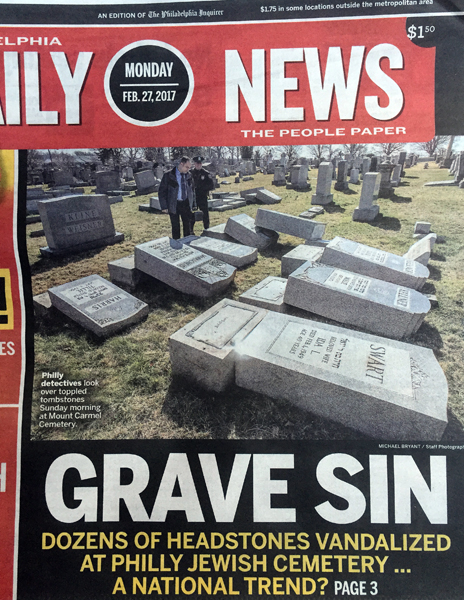
Jewish Cemetery Vandalized in Philadelphia

This has been a busy week for the small (Jewish) Mount Carmel Cemetery in Philadelphia. You’ve no doubt heard of the desecration - it became national news: 75 to 100 headstones were knocked over sometime Saturday evening, February 25, 2017. This follows on the heels of similar vandalism in Missouri, from February 20, when over 100 headstones were toppled in the Jewish Chesed Shel Emeth Society cemetery in University City, Missouri (see story at this link: https://www.youtube.com/watch?v=yO2QXjwYtg0).

Philadelphia Daily News
To fuel the fear of a “hate wave” spreading across America, about thirty bomb threats were made at the end of February to Jewish schools and community centers in eighteen states (see link). As of this writing, the case has been solved and seems to have been the work of one person, not related to the incident at Mount Carmel Cemetery.
A portion of the damage in Philadelphia's Mount Carmel Cemetery

Bad stuff, any way you look at it. However, I’m not going to jump on the hate crime bandwagon just yet, even though the FBI is investigating the vandalism. Why? Well, for one thing, thirty-three headstones were toppled last month in the Holy Redeemer Catholic Cemetery in the Bridesburg section of Philadelphia (see link), less than two miles from Mount Carmel. So it may not be antisemitism, just cowardly aggression toward those who cannot defend themselves – the dead. In both Philadelphia situations, communities have come together to repair the damage.

Volunteer registration at Mt. Carmel coordinated by the Jewish Federation of Greater Philadelphia

I’m still (perhaps naively) thinking it was a small group of drunken kids with beer muscles, at least in Philadelphia. Should the people responsible be caught and punished? Damned right. A $69,000 reward (it increases each day, see link) is being offered through a variety of sources for the apprehension of those responsible. 

Headstone fallen and broken in half
Looking at the situation from a vandal’s perspective, Mount Carmel was, unfortunately, an easy target. And that may simply be the main reason it WAS targeted. If you wanted to topple headstones, Mount Carmel would be a better choice than any of the cemeteries on the other three sides at this intersection (Cedar Hill and North Cedar Hill) of East Cheltenham Avenue and Frankford Avenue in north Philadelphia. At Mount Carmel, you are hidden from the road by the densely-packed headstones, making it easy to do your dirty work without being seen.

Mount Carmel Cemetery also has no road inside it so neither police, nor any other cars, can drive through it. Besides, the gates are left open at night, unlike the other, better cared for and more secure cemeteries. The rear gate opens up onto a parking lot and there is quite a bit of tree cover. These many drawbacks will be remedied, however, through the generosity of many donors - significant improvements will be made to the cemetery going forward. 

Wide open rear gate at Philadelphia's Mount Carmel Cemetery

Throughout this past week, hundreds of people have volunteered their time to help repair the damage done at Mount Carmel Cemetery. 

On March 1, 2017, I visited and spoke with members of the Jewish Federation of Greater Philadelphia, who were organizing the volunteer effort. A registration table was set up at the cemetery’s entrance, bottled water and bags for trash, branches, and weed clippings were provided. Dozens of volunteers (all races and religions) spent the day cleaning up debris, raking leaves and dead branches, and marking and cataloging the damaged grave stones. The Federation has been receiving calls from individuals asking if their ancestors’ headstones had been knocked over. They took it upon themselves to gather this information. Someone had placed cut flowers on all the damaged headstones and monuments. People are upset, but have joined together to correct the situation.

Philadelphia Inquirer, www.philly.com

I’ve seen damage in cemeteries, but I was not prepared for this. You can't really grasp the magnitude of the damage through on-the-ground newspaper photos. A hundred headstones does not seem like a lot, but Mount Carmel is not a large property. This may amount to a tenth of all the stones in the cemetery. The swath taken by the vandals is obvious, as you walk the length of the property. Stones are toppled throughout the center portion of the rectangular cemetery (east to west). The aerial photographs published by the newspapers give the best depiction of the extent of the damage. Seeing this atrocity in person is jaw-dropping – cracked stones, large monuments pushed off their pedestals, grave markers of all shapes and sizes knocked over.

From the Philadelphia Police Department
Anyone with information on the suspect(s) involved in this crime, please contact either:

·         Northeast Detective Division – 215-686-3153/3154
·         Philadelphia Police Tip Line – 215-686-TIPS (8477)
·         Tips via email – tips@phillypolice.com
·         Citizens Crime Commission – 215-546-TIPS (8477)

Jewish Federation of Greater Philadelphia Donation page for Mount Carmel Cemetery:


Preventing Future Damage
There is a clear message being sent to the criminals responsible for the Mount Carmel damage – the greater community will repair the damage and will prevent such damage in the future. Police will patrol the property 24x7 until the criminals are caught. Fencing will be improved.

“… the Philadelphia Building and Construction Trades Council offered to replace the toppled headstones and … the International Brotherhood of Electrical Workers Union Local 98 offered to install additional lighting and security cameras." -  http://www.jta.org/2017/02/28/news-opinion/united-states/philadelphia-labor-unions-offer-to-repair-secure-vandalized-jewish-cemetery

Mount Carmel is apparently an active cemetery, as I was told of a relatively recent burial here, 2015. There is a bit of pre-existing damage (a few fallen headstones), a bit of overgrowth, and some areas where the ground has subsided, causing a handful of grave markers to tilt. Clearly, work needs to be done here, especially if families have paid for “perpetual care.”
Volunteers bagging debris at Mount Carmel Cemetery

The lopsided headstones made me realize that before members of local labor unions are allowed to reset the fallen headstones, someone needs to consult a professional about a safe and secure way of doing that. Even if the stone base of the headstone is level, the headstone should be pinned to its base with steel or fiberglass rebar to prevent future damage. Believe it or not, many extremely heavy granite headstones simply sit on their bases! They are not fastened in any way, which is why people are injured or killed when headstones fall on them! If the base is not level, it needs to be leveled first, as shown in this video:


Pinning a headstone to its base is not an unusual practice, but it does cost more money, which is probably part of the reason it is not always done. Two holes are drilled in the base and the underside of the headstone, ... rebar is used to attach the stone to the base, then the joint is sealed to keep water from seeping into the joint between the stones.

“Blind Pinning is exactly what it implies, pins you do not see once the stone is installed. The concept is very simple. Holes are drilled in both the [headstone] and base at exactly the same locations so they match up when joined. Then metal [or other material] pins are placed in the holes, and usually mortared in place. The basic thinking was that if the monument was knocked or began to lean the pins would prevent a complete failure, and the damage this may cause.”International Southern Cemetery Gravestones Association, “HOW TO INSTALL A GRAVESTONE”


References and further reading:

Mount Carmel Cemetery 5722 Frankford Avenue Philadelphia, PA 19135. Phone: 215-535-1530. Fax: 215-535-5192 

Friday, May 15, 2015

A New Era for Abandoned Jewish Cemetery

A newspaper columnist phoned me a couple months ago and asked, “Mr. Snyder, just how many abandoned cemeteries are there in the United States?” I felt like saying “Twelve thousand, eight hundred, and thirty-six.” Obviously, no one knows the answer to that question. What I actually said to him is that there are degrees of abandonment, sort of. A cemetery can be unmaintained, yet still have an owner. So it may appear to be abandoned, but in reality, it is not - it is simply unmaintained. How can this happen? Why is this even allowed to happen? There are no simple answers.

May 2015 image of lower portion of cemetery, cleared of weeds

The good news, however, is that yet another (in my fifteen-years’ experience as a cemetery traveler) abandoned cemetery has been reclaimed! The cemetery in question is the 18-acre (by some estimates) abandoned Jewish cemetery in the woods of Gladwyne, Pennsylvania (a suburb of Philadelphia).

You may have read one or both of the blogs I’ve posted about this cemetery, known variously as Mount of Olives, Har Zetim, and Har Hasetim Cemetery. One blog documented my maiden voyage to this "Abandoned Jewish Cemetery in Gladwyne" (as it is also known), "Passover and Gladwyne's Abandoned Jewish Cemetery" (click link to go to that blog). A second blog documented a winter visit, "Graves Beneath the Snow." One of this cemetery's challenges is access - it is surrounded by very expensive private residential properties. In fact, you would never find it unless someone physically showed you where it is.

Brick crypt in Har Hasetim Cemetery

Any information available on the cemetery via the Internet is sparse, and in some cases inaccurate. I must confess that I added to the wealth of misinformation with the title of my first blog on the cemetery, "Passover and Gladwyne's Abandoned Jewish Cemetery." As I mentioned above, although a graveyard may appear unkempt, it does not necessarily mean it has been abandoned. Har Hasetim actually became the property of Gladwyne's Beth David Reformed Congregation in 1999. The most complete history of Har Hasetim has just been published in the Spring 2015 issue of "Chronicles," the Journal of the Jewish Genealogical Society of Greater Philadelphia (Vol. 32 - 1). The article, written by Philadelphia's LandHealth Institute member Rachael Griffith and Beth David Executive Director Jill Cooper, is entitled, A New Era for an Abandoned Jewish Cemetery (past issues are available at this link online). 

Back in 1999, the courts ruled that nearby Beth David Reformed Congregation be granted ownership of Har Hasetim, as the cemetery was facing a land development threat. Since its inception in 1895, Har Hasetim changed ownership a few times, and has faced a number of challenges. Since 1999, Beth David has kept the cemetery intact, and has reached the point where a master plan for the property will soon be adopted. The plan is being created with the help of LandHealth Institute. Details of the plan will be made public in the near future. The people directly involved with the care of the cemetery are members of Beth David's "Friends of Gladwyne Jewish Memorial Cemetery," a non-profit company (click here to go to the Friends website).


Wineberry thicket photographed in 2014

Keeping the sacred ground intact, maintained, and eventually restored is the main goal of the Friends group. I sat in on a recent meeting of the Friends and was taken by their knowledge and enthusiasm. The group has already had several cleanup days this spring, with a major goal of removing the wineberry (a relative of the raspberry) vines that tangle the grave sites at the lower end of the grounds. They've done wonderful work. Much of the thorny wineberry plants have been uprooted and removed. This allows access to individual graves. Another cleanup day is scheduled for this Sunday, May 17, 2015. Their volunteer efforts have certainly been evident. I visited Har Hasetim at the beginning of May, 2015, and was struck by how walkable the grounds are. Vines and weeds had been cut back and the walking trails are clear of woodland debris.  


Since forming in 2012, the
Friends of Gladwyne Jewish Memorial Cemetery has done much genealogical research (a list of a thousand names from the burial records appears on their new website). Working to publish these names as well as publishing the concise and accurate history of the cemetery (Spring 2015 "Chronicles" article) satisfies the curiosity of many and fills in some of the gaps of Jewish history in the Greater Philadelphia region. I, for one, did not know that Philadelphia had many Jewish burial associations, which owned plots at Har Hasetim for the purpose of providing "poor Jewish immigrants with a proper burial according to Jewish law" (1). This explains all of the pieces of rusting iron fencing throughout the property. Also shocking are the documented attempts by land developers over the years to build on the cemetery grounds. In 1912, when Har Hasetim had fallen on hard financial times, a Narberth, PA, contractor purchased a majority of the land at sheriff's sale and disinterred an estimated half of the bodies before he was stopped.

Har Hasetim Cemetery currently has clear paths on which to walk its grounds (you can see the tree branches in the photos above and below, which bound the walking path). This is just the beginning. The future of Har Hasetim, "its continued survival and success," as Griffith and Cooper put it in the Chronicles article (1), "is in the hands of those who care about it. Themes of survival emerge from many parts of the cemetery's story. [It's] existence has been tenuous since its establishment, but there have always been people who cared enough to save it from obliteration." The Friends, along with the LandHealth Institute, are developing a master plan to ensure this will continue.

So if you have wondered about this formerly abandoned cemetery, tucked in the woods, totally off the beaten path – as I had please consider stopping by for at least a tour this coming Sunday. The Friends group welcomes all volunteers and would be happy to show you around. If you’d like to help clear some weeds, the formal invitation from the Beth David Reform Congregation is reprinted below:


We Need Your Help!

Sunday, May 17th

Calling All Gardeners and Horticulturists

Tucked among the homes and estates of Gladwyne is a gem of an historic cemetery, as well as a hidden haven for nature, the Gladwyne Jewish Memorial Cemetery. Beth David Reform Congregation of Gladwyne has been tasked to maintain it, and the Friends of the Gladwyne Jewish Memorial Cemetery has plans to restore it. This Sunday, May 17th, we will be cleaning up the cemetery by removing the dead wood, overgrown weeds, and invasive plants. Meet at Beth David at 12:30pm, 1130 Vaughan Lane, Gladwyne PA 19035 (proceed to the very end of the lane). Wear appropriate clothing including stable footwear, jeans, and work or gardening gloves. Bring hand tools for weeding and clearing such as rakes and clippers. Additional tools will be available for those who need them.

Questions? contact Jill Cooper, Executive Director, jcooper@bdavid.org, 610-896-7485 x104

References
1. Jewish Genealogical Society of Greater Philadelphia, Vol. 32 - 1, Spring 2015 (http://jgsgp.org/Pages/chronicles.html)