Showing posts with label Box Spring Gallery. Show all posts

Sunday, March 30, 2025

A Hearse of a Different Color

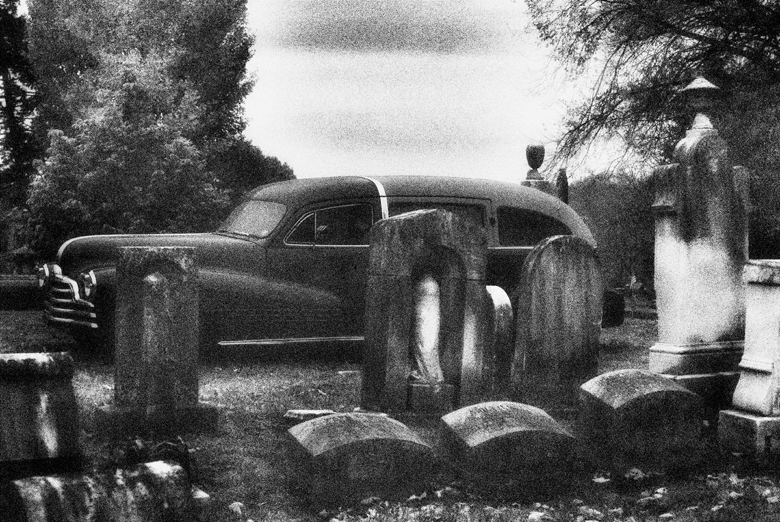
Hot on the heels of my interview with Shawn Koenig, hearse collector (last blog I posted on March 15, 2025), I thought I’d be writing about this image. Its a photograph I submitted for consideration in a curated art exhibition. The show is called “Chrome,” and is being held at  Box Spring Gallery in Philadelphia. 

Box Spring Gallery: “Chrome,” April 2025 Exhibition

The visual elements and design of the automobile as encountered on the street, in motion, or as imagined.

Here was my artist’s statement about the piece:

The smooth rounded curves of this ghostly antique hearse contrast with the rigid tombstones in this dream-like scene. The roof's banded chrome and the vehicle's grill serve to accent its gently arched back. However, this offers little solace as even at a glance, the viewer knows this 1947 Pontiac Superior hearse gave many their last ride. Since Victorian times, hearses have been regally designed with only a few chrome flourishes (usually the decorative "S" shaped landeau bars on their sides). This particular model is banded with an unusually aggressive chrome strip across its roof, which seems to symbolically separate the driver from the driven, the living from the dead.

I shot the image on expired 35mm film with a Nikon F3 camera – if that means anything to anyone anymore. An expired hearse in an expired graveyard shot on expired film with an expired camera. The film was Fujicolor, maybe ten years out of date (hence the reticulation, or severe graininess of the image). Here’s the original image below, which I desaturated digitally to make the monochrome version. The black and white submission was turned down.

Maybe there wasn’t enough chrome. Maybe the color version would have appealed more to the jury. Maybe the jury thought the subject matter too morbid. Maybe it did not blend well with all the other chosen entries. These would be all on the wall next to each other. Curators have an amazing ability to create a flow, a collection of work that complements each other. Perhaps the hearse just didn’t add anything to the overall body of work. Were there too many hearse submissions?

Maybe, just maybe, my photograph simply wasn’t good enough. As an artist, you need to consider such a preposterous idea. The curator is expecting to sell the artwork on display (and they always get a commission), so they need to consider the salability of the piece.

My photograph below is what they chose to be in the exhibition, a digital photograph of a non-hearse, for which I am immensely grateful. Public hangings are an experience unto themselves, especially group shows. You get to see other artists’ interpretations of the same theme and usually meet them to talk shop if there is an opening reception. Always inspirational.

I had submitted both photographs, in case the hearse was deemed inappropriate for the exhibition. And so it was. I love all these images, I love the design of both automobiles. So if you want to see my non-hearse photograph in all it’s 11x14 matted and framed glory, details for Box Spring Gallery’s opening reception at the Crane Arts Building are shown below. Crane Arts in Philadelphia’s Fishtown neighborhood is home to several galleries, all of which host opening receptions for new shows on the same night. So it’s a lot of fun - wine and cheese, crudité, me, and so on. Sometimes the patrons are as interesting to view as the art.

The 2nd Thursday Opening Reception is on April 10, 6–9 pm at Box Spring Gallery, 1400 N. American St, #100C, Philadelphia, PA 19122. The exhibition will run from April 10 – May 3, 2025. 

https://boxspringgallery.com

A juried prize will be announced. Two participating artists will be selected to show their work in a July 2025 two-person exhibition at Box Spring Gallery.

If I happen to be chosen, I do have a few hearse images I will try to weasel into the exhibit!

A bit of background on my non-hearse photograph:

Who would not hit the brakes while driving up South Jersey's Black Horse Pike when presented with this scene of incomparable beauty? In 2023, a vintage 1963 Studebaker Avanti was parked in front of the vintage (defunct) Studebaker dealership in Pleasantville, New Jersey. I have always thought the Avante to be one of the most striking automotive designs ever. I'd love for you to see its subtle chrome accents against the sensual lines of its gold fiberglass body, but monochrome better expresses its aggressive and sinewy contours. Juxtaposed against the 1927 Spanish Revival stucco building, the design of this automobile appears all the more exotic. Only 2500 Avantis were made between 1962 and 1963.


Wednesday, January 29, 2025

Post-COVID Death Photography


Scary. Biblical fear. I felt it when I left the theater after seeing the fifth Hunger Games movie, “Spiders and Snakes.” I was headed for the bathroom and this rush of humanity was coming at me as people were exiting the other indoor movie theaters. Strangers all around me, tributes – and I feared any one of them would come at me with a trident. Fear is situational. Like the first time I visited the Mutter Museum in Philadelphia. After seeing so many parts of dead bodies, I was startled on the bus ride home whenever one of the passengers moved. And I couldn’t eat sausage for a month. COVID was less scary than either of those situations. Deadlier, but less scary. 

Recently I had to think about the art I’ve created since COVID, in the four years since 2020. Why? Well, this group I belong to, The Philadelphia Photo League (est. 2012) is putting together an exhibition and a book of work (a “Members Journal”) to showcase what we’ve done, what we’ve created in the past four years: 

“Your images contribute to a powerful narrative of creativity and resilience, reflecting the transformative years from 2020 to 2024. We’re honored to have you as part of this celebration of photographic artistry and storytelling.” - The Photo League

In addition to choosing five of my photographs that are representative of my past four years’ worth of photography, I put together an under-100-word bio. Basically, that amounted to one sentence for each of the five images. I naturally had more to say - hence, this blog post! The five images you see in this article are the five I submitted for the League project. The exhibition of the members’ work will occur in a Philadelphia-area gallery sometime in the spring of 2025. This was a good exercise to gather my thoughts regarding what I’ve done and what I might do in the future. What you’ll notice (surprise, surprise) is that all my artwork has to do with death. Scary stuff to the unsuspecting, perhaps.

The first image that you see above, “COVID Death,” is a digitally-manipulated photograph of an physically manipulated scene in a cemetery. I brought the skull. Remember social distancing during the winter/spring of 2020? People were advised against indoor gatherings, even with extended family members. Many people much more normal than I took to cemeteries as a place to go. It was one of the few safe havens to spend time - you could be there with family and friends, you were outdoors, and all the strangers observed the six-foot social distance rule – they were six feet under.

I took many of my skulls (like guitars, you never admit how many you actually own) into the basement during lockdown and photographed some still lifes (is it lives?). But there's a limit to how creative you can get in your basement. So I took them to cemeteries and created images like the one you see above. I even loaned my skulls to a photographer friend of mine to do similar work. Funny, no one ever had any issue with me playing with skulls in a graveyard, but masks are another thing altogether. Remember how polarizing they were? "You have no right to make me wear a mask," and all that? (Obviously the anti-maskers never thought about why surgeons and dental hygienists wear masks…). Anyway, the social media audience went ballistic when I published photos of masks on cemetery statues. Puzzling, but hey, art is what you can get away with, as Andy Warhol said.

Another COVID-sprung idea I had was to get people who only knew each other through social media, together physically, to tour some local cemeteries. Actual reality is much preferable to virtual reality, I’ve always thought. In the spring of 2020, when everything was going sideways, I wanted to merge social media with actual human interaction. People were missing that. I invited local Instagram cemetery photographers who only knew each other through that platform, to one cemetery to meet, trade stories, learn from each other. About eight people met at Mount Moriah Cemetery in Philadelphia. My friend Jenn (@cems_and_things) organized a meetup group on Instagram so we could communicate better. She invited others. 

That first meetup was so wonderful that we all agreed to continue meeting in cemeteries, making photographs, and enjoying each other’s company. This has been going on for four years now. The photo you see above was made in December 2024, in Riverview Cemetery, Trenton, New Jersey. We do a group photo every time we meet. Membership has expanded to about twenty people and we average about eight people per meetup. We try to do this every few months. Wonderful friendships have developed and I must say, this has been a great catalyst for my creativity!

 “No Indoor Gatherings During COVID Pandemic”

 “No Indoor Gatherings During COVID Pandemic is a photo I made in February of 2021 during a COVID surge where there was lockdown and no indoor gatherings. After a snowfall in Philadelphia, I photographed this temporarily closed church in Bridgeport, PA. I think it speaks volumes about our social situation at that time, when virtual meetings via the internet were becoming the norm and physical meetings were abruptly stopped – this included gatherings in places of worship. To this day, virtual meetings have replaced a percentage of physical meetings, sometimes for our benefit (efficiency), sometimes to our detriment. In certain situations, virtual meetings cannot replace physical meetings – dating comes to mind.

“Gardel Monument.” Mount Vernon Cemetery, Philadelphia

Gardel Monument is an image I made in Mount Vernon Cemetery, Philadelphia, in February 2022. It is one of the most interesting monuments in any Philadelphia cemetery, but few people have ever seen it. Why? Well, Mount Vernon has been closed to the public for decades. Its grand entrance stands at the intersection of Ridge and Lehigh Avenues, directly across from Laurel Hill Cemetery. Many people think it is an extension of Laurel Hill, but it is not. It is derelict and had not been maintained. 

Abandoned cemeteries have always piqued my curiosity, and I have photographed, researched, and lectured about them over the years. My virtual lectures on the destruction of Philadelphia’s Monument Cemetery (est. 1837, destroyed 1956) were popular during COVID, when podcasts and virtual gatherings became the norm. Abandoned cemeteries loomed large in my four-year odyssey. I was approached to write a book on the topic in 2023, and completed it in 2024. Abandoned and Forgotten Cemeteries of Philadelphia and its Environs will be published in 2025 by Fonthill Media. 

I researched many other cemeteries for the book, some that were saved like Mount Vernon, some that were not so lucky. The book also covers cemeteries that have disappeared – either moved or simply built over. I met many interesting people and dragged some friends into the fray as I visited (and revisited) many of these sites as I conducted my research.

While it was never legally abandoned, Mount Vernon Cemetery was locked up and left to ruin from around 2000 to 2020. Nature grew and wreaked havoc, endangering monuments and statuary while thieves stole bronze doors from its mausoleums. It was derelict to the degree that in the past, it might have been levelled and a strip mall built over it. In 2020, a Friends group and a conservation group stepped in to stabilize the cemetery and its buildings, essentially pulling it back from the brink of destruction (and pulling it away from its former owner). It is quite the cosseted property at this point.

"Snow Flower"

Lastly, the photo you see here, Snow Flower,” was in two art exhibitions in 2024. First in a group show sponsored by the Montgomery County Guild of Professional Artists at 431 Gallery, King of Prussia, PA, and later in the year in a two-artist exhibit at Box Spring Gallery in Philadelphia. In the latter show, entitled, “Ghosts,” I had nine snow-related cemetery images on display. I’ve slowly begun to get back into public display of my photography, with gallery shows and events like the annual “Market of the Macabre” at Philadelphia’s Laurel Hill Cemetery. 

To summarize, I’ve been fairly active, artistically, since COVID. Physically, not so much. The pandemic stifled a lot of things in the world, but it did invigorate my creativity. I hit 64 years of age in 2022 and health-wise, the wheels began to fall off. George Harrison was quite prescient in the Beatles’ song, When I’m Sixty-Four. In February 2024 I fell on the ice in a cemetery and tore a rotator cuff. That April, I got a hip replacement. So while I’m still active artistically, my days of jumping off walls into abandoned cemeteries are over. But for all you youngsters out there reading this, please jump off as many walls into abandoned cemeteries as you can. And as they say in the Hunger Games, may the odds be forever in your favor. 


Saturday, November 9, 2024

Emotions Evoked by Grave Markers


In September of 2024 I had a show of some of my cemetery photography at Box Spring Gallery in Philadelphia. It was called, “Ghosts.” Nine of my cemetery snow photographs were exhibited. The image you see here was one of the framed photographs.

During the opening reception, there was a woman with her daughter, walking from photo to photo, looking at each piece. I overheard their conversation in front of this one. The mom asked the girl, who was maybe six years old, “What emotion do you feel when you look at this?” The girl said, “I feel cold.”

The mom then said something like, “I feel cold too, but when I look into her eyes, everything seems to get warmer and the snow begins to melt away.” What an amazing observation. Very personal.

Because this statue has human-like qualities, it becomes easier to assign human characteristics to it. And so maybe it becomes easier to react to it in some emotive way. Annette Stott points out in her paper “Personhood and Agency: A Theoretical Approach to Gravemarkers in Mainstream American Cemeteries,”1 that there are various kinds of cemetery monuments ranging from those that bear no resemblance to a human being, to those that recall the human shape. These gravemarkers guarantee the deceased’s continued visibility into a distant future and bring new life to the person’s emplaced and re-bodied identity. 

That last line is a mouthful, but what she means is that long after the buried body has disintegrated, the gravemarker becomes a physical substitute for that person. If said gravemarker has a human form, it is that much easier to relate to it as the actual deceased person. 

Observers seem to find meaning in the images I make, probably different from the meaning or feeling the statue was originally intended to invoke. I try not to define these photographs. I’m usually surprised by peoples’ observations. I dislike giving the photographs titles, because that can very easily define a piece. The one at top is called “Denizen.” Kind of vague, right? Almost meaningless. That’s my intent. I would much rather the viewer find personal meaning in the work, as the mom did above.

Many of the images in the show were cemetery statues and all of them were photographed in the snow. They were challenging to make, since it was cold, windy, and sometimes snowing as I plodded through various cemeteries. So there is a story behind each piece, but I’m not there to recreate that for all viewers. That’s why I need each individual piece to stand on its own. Artists are sometimes urged to write an “Artist’s Statement” for an exhibit, to help put the work in perspective for the viewer. Sometimes this helps, sometimes not. As I said, I don’t really want to define everything for the observer. After they purchase a piece and live with it a few months or years, perhaps it will take on new meanings.

Artist Statement: A Frozen Elegy

Through the lens of a camera, cemeteries in the snow reveal a frozen elegy, where silence and solitude merge to create a visual ode to the eternal cycle of existence. The unpredictability of nature challenges me to create images that capture the ephemeral beauty of the moment.

A snow-covered landscape transforms cemeteries into a surreal and hauntingly beautiful realm. The soft white blanket conceals the intricate details of tombstones, creating a minimalist aesthetic that accentuates the stark contrasts between calm and suffering, between life and death.

There is something very intimate about being in a snow-covered cemetery by yourself. Leaving one’s footsteps in silence serves as a reminder of the shared human experience of mourning, remembrance, and the fact that life does, in fact, go on.

When I wrote the statement above, I was thinking more about the experience of making the photographs, and I hadn’t thought about the monuments, the statues, the tombstones themselves. The mom’s comments drew me back to the stones. 

At the time of the exhibit, I was finishing up a new book I’m writing called, “Abandoned Cemeteries of Philadelphia and its Environs,” and Stott’s comments kept coming back to me as I wrote about one abandoned cemetery after another. Her paper addresses the power that a gravemarker has over us. A stone is just a stone until a name and date are carved into it. Then it begins to take on an identity. When it is placed on a grave, it simply marks the spot where that person’s bones are buried. A century later, the bones are dust and the coffin probably disintegrated. At that point, when we look out over a cemetery filled with hundred-year-old gravestones, we see them as person substitutes. We don’t think of them all as simply marking the graves where the people are buried.

So to look back at a face in the snow and breathe life into it is not an unusual reaction. Many people have had some visceral response to a gravestone, a statue, a monument. Sometimes the encounter elicits an emotion that we have no name for. Stott does a wonderful job explaining why we react to gravemarkers the way we do.

“One way people demonstrate their humanity to themselves is through grave marking, an activity no other living being seems compelled to do.” – Annette Stott

The fact that the curator of the Box Spring Gallery, Gaby Heit, came up with the title “Ghosts,” for the exhibit was fortuitous. It made me think that the people buried beneath these stones are now nothing more than ghosts – the stone is all that is left. As there are probably no people still alive who even remember the deceased whose graves these stones mark, the stones may be the only tangible evidence left that these people even existed. They are truly, as Stott calls them, “person substitutes.” And because of that we react to them differently than we would to an unmarked stone found on a mountainside, for example.

Stott calls this “agency.” Art objects like grave markers have agency in that they are representative of the deceased, yes, but they can act as a surrogate, an “agent” for the deceased. The statue in the top photo, the denizen of some particular cemetery, is also bonded to that particular cemetery. All things equal, it will always be there, and only there. A sobering, if not chilling remark Stott makes is that:

“Gravestones designate a border between life and death, body and spirit, by marking the place on earth where the body is hidden from sight permanently.” – Annette Stott

So perhaps that is one reason we get a funny feeling when we look at a tombstone or monument in a cemetery - it brings to mind our own mortality. We see that border between life and death - our life, and eventually, our death. 

REFERENCES

1. Stott, A “Personhood and Agency: A Theoretical Approach to Gravemarkers in Mainstream American Cemeteries,” Association for Gravestone Studies, Markers Vol. XXXV, Sterling, 2019