Showing posts with label Betsy Ross. Show all posts

Saturday, August 13, 2016

Historic Gatehouse Stabilization

Mount Moriah Cemetery gatehouse, Philadelphia, August, 2016

One of Philadelphia’s historic gems is off the beaten path. It is miles from the Liberty Bell historic district. However, visitors who appreciate American history would do well to make the trek to Mount Moriah Cemetery in southwest Philadelphia. After all, Betsy Ross is buried here.

Photo by Ken Smith, FOMMCI
The cemetery and its 1855 brownstone gatehouse have recently been recognized with official historic status, as you can see from this 2016 plaque. The problem is, Mount Moriah and its gatehouse had been left to crumble since the 1970s. The gatehouse is really nothing more than a façade at this point. The cemetery, by 2011, was an overgrown forest.

Since 2011, an all-volunteer organization, The Friends of Mount Moriah Cemetery, Inc., with help from thousands of volunteers from all walks of life, have been slowly but surely bringing the massive cemetery back from the brink. At a reputed 380 acres (ref.), it is the largest cemetery in the state of Pennsylvania. In 2011, it was no doubt the largest abandoned cemetery in the nation.

The iconic gatehouse, which sits at the original entrance to the cemetery, is of prime concern to the preservation and rejuvenation of the historic cemetery. A large portion of the structure was destroyed by fire decades ago and the walls have literally been tumbling down over the past two years. In 2011, this beautiful piece of architecture was covered with vines, hidden by trees, and filled with old car tires and other trash. One of the Friends board members remarked to me that the vines may have been the only thing holding the gatehouse together.

2012 photo of Mount Moriah Cemetery gatehouse, by Ed Snyder

In 2016, the Friends, in conjunction with the recently-formed Mount Moriah Cemetery Preservation Corporation “...secured a $22,000 grant from the Mayor’s Fund to be used toward the rescue of the gatehouse.” The corporation found a contractor who could do the work for $32,500 and the Friends group led a fundraising effort to make up the shortfall.

Rear of gatehouse, looking toward Kingsessing Avenue

Work began on the stabilization of the gatehouse in the summer of 2016. The photos you see here with most of the final bracing in place, were made in August, 2016.

In 2016, the cemetery and its gatehouse became a recognized landmark by the American Institute of Architects; it is on the Philadelphia Register of Historic Places and has been deemed eligible for the National Register.

Mount Moriah gatehouse, c.1855

While the gatehouse may never be restored to architect Stephen Decatur Button’s original design, the original façade will be preserved. In future, this can perhaps be repurposed as a columbarium, a structure of vaults with recesses for urns containing cremated remains.
-------------------------------------------

For more information and/or to donate to Mount Moriah’s preservation, please see our website:

For up-to-the-minute (literally!) updates on the many ongoing restoration efforts, please see The Friends of Mount Moriah Cemetery, Inc. Facebook Group page.

Saturday, December 7, 2013

Betsy Ross and Christmas

This is not your average Christmas story. Its about theft and deceit; however, I’ve thrown the Baby Jesus in to add some holiday spirit. You see, he was stolen from the manger in Philadelphia’s Italian Market last year, so now he’s nailed down (ironically premonitory, if you ask me). This year, in a similar act of vandalism (for what could a plastic BJ be worth?), the four-by-six foot thirteen-star American flag, flying from the pole over Betsy Ross’ grave was stolen from Philadelphia’s Mount Moriah Cemetery.(That's my daughter, Olivia, holding a small version of the flag Betsy Ross helped create.)


Baby Jesus missing, then replaced (Italian Market, Philadelphia)
Bare flagpole with ropes flying
 Again, vandalism, for what could a commercially-made flag reproduction be worth? Plenty, as it turns out. Like the plastic Jesus in the manger, it’s all symbolic, you know, and therefore hurts worse. The flag went missing on November 25, 2013. The ropes seemed to have been burned through (photo at right courtesty of Donna Morelli).

Flag flying over Betsy Ross' grave, 9/13
As she was doing her rounds of the cemetery (Friends of Mount Moriah Cemetery, Inc. Board member) Donna Morelli found the ropes waving in the wind. She’s on the Board of Directors of the FOMMCI with me, and is in charge of groundskeeping and other environmental issues. She lives nearby and so nothing much escapes her eagle eye. I call her the guardian angel of Mount Moriah. She actually maintains the flag – washes it every so often, cares for it and the area of sacred ground around the pole. She is a taskmistress if there ever was one, wholly engaged in the work of remembrance, preserving the emotional heritage of Mount Moriah Cemetery and those interred.

When the incident was announced on the FOMMCI Facebook group page, it generated quite a stir. Someone commented that the “karma train” is going to run that thief over. Generally, people were very upset. One comment mentioned that Betsy’s remains were dug up for the nation’s bicentennial in 1976 and reburied at the Besty Ross House in Old City Philadelphia (see link). So therefore, the theft wasn’t like the flag was taken from her actual grave. Well, yes it was.

Betsy Ross (January 1, 1752 – January 30, 1836), widely credited as having made the first American flag, was first buried at the Free Quaker burial ground on North 5th Street. Twenty years later, her remains were exhumed and reburied at Mount Moriah Cemetery. In preparation for the United States Bicentennial, the city ordered the remains moved to the courtyard of the Betsy Ross House in 1975; however, workers found no remains under her tombstone. Bones found elsewhere in the Claypoole family plot (she was married to John Claypoole when she died) were deemed to be hers and were re-interred in the current grave visited by tourists at the Betsy Ross House. (For the record, the declaration that this was her actual house is fabricated American history as well.)

For the purists and fact hunters, I direct you to the letter shown below, dated 1968 from Mount Moriah Cemetery to, I assume, the U.S. government agent ("Norman") charged with relocating Betsy's body. Here is an excerpt of the text:
"With regard to the question of the removal of the remains of Betsy Ross I am submitting the following objections on which you can elaborate or delete. ....At this state of decomposure there are no remains of Betsy Ross. To pretend to remove these remains, in my opinion, would be a mockery and a fraud on the public." The writer goes on to end the letter with: "...in short, I could not produce the body."

Letter regarding Betsy Ross' remains

Apparently, Norman (the responsible U.S. government party) chose the option to "delete" this bit of information when presenting the "facts" about Betsy's relocation to the public. However, as my friend Donna Morelli (aka “Haunt Mount Moriah” to her many Facebook friends) says, “This isn't about whether or not Betsy Ross is still buried in Mount Moriah or if she was moved. This is about the fact that we work hard in this cemetery to make it a better place. The flag pole was painted and a flag was raised, raised in representation of our patriotic spirit for Betsy Ross, Mount Moriah and the thousands of veterans who are buried here.”

Betsy Ross' 'headstone" at Betsy Ross House
By governmental decree, the American flag is only allowed to fly twenty-four hours in certain locations. Of these select few sites in America, two of them are women’s graves. One is Betsy’s. So you see, there is much significance to the flag that was stolen from Mount Moriah Cemetery. (The other grave site, by the way, is that of Jennie Wade, the only civilian resident of Gettysburg killed during that epic battle of the American Civil War. During the battle, she was in her sister’s kitchen baking bread for the Union troops. She was struck in the back by a stray bullet.)

But there is even more significance to the stolen flag. It seems that the flag was donated by another FOMMCI Board Member, Danielle Murray, in memory of her USMC parents. Danielle states:

"The flag is not cloth. It represents who we are as a people.... Our history. She designed the 13 stars to be a new constellation that our little nation was at the time. I donated that flag because I played here as a child and almost lost my life here a little over a month ago as an adult. My mom and dad - proud longtime Marines first brought me here when I was young. Betsy's plot was the very first memory I have here. That flag was for Betsy...... And her gift of creating a physical symbol to represent us - a new nation. It was my way of saying thanks to her. So you see .... It's gone. [The flag] … was a gift for everyone..... And for our first female patriot. Whoever did it stole from every person who cares about [Mount Moriah Cemetery].”

Whoever took the flag knew it was there – the thief didn’t just happen upon it. Betsy’s grave is nestled in a heavily wooded area behind the Masonic Circle of Saint John (see map link, Section 51), which is not at all visible from any nearby road. It’s location is not even designated on our official map or website. If by some quirk of nature, the thief or thieves find themselves reading this, please consider giving us a Christmas present – give back the flag. If anyone has any information as to its whereabouts, please contact Donna Morelli at hauntofmm@gmail.com, or through her “Haunt Mount Moriah” Facebook page. All communication will be strictly confidential.


"When we view the flag, we think of liberty, freedom, pride, and Betsy Ross. The American flag flies on the moon, sits atop Mount Everest, is hurtling out in space. The flag is how America signs her name." - http://www.ushistory.org/BETSY/

References and Further Reading:
Make a tax-deductible contribution to the Friends of Mount Moriah Cemetery, Inc. to help us in our work of maintaining this historic cemetery! Please click here, and thank you!

Betsy Ross’ Remains Sought
Betsy Ross bio
Friends of Mount Moriah Cemetery Facebook page
Friends of Mount Moriah Cemetery, Inc. website
Read about Jennie Wade and other Civil War civilian casualties
Betsy Ross House Official website 

Tuesday, November 5, 2013

Fall Festival at Mount Moriah Cemetery

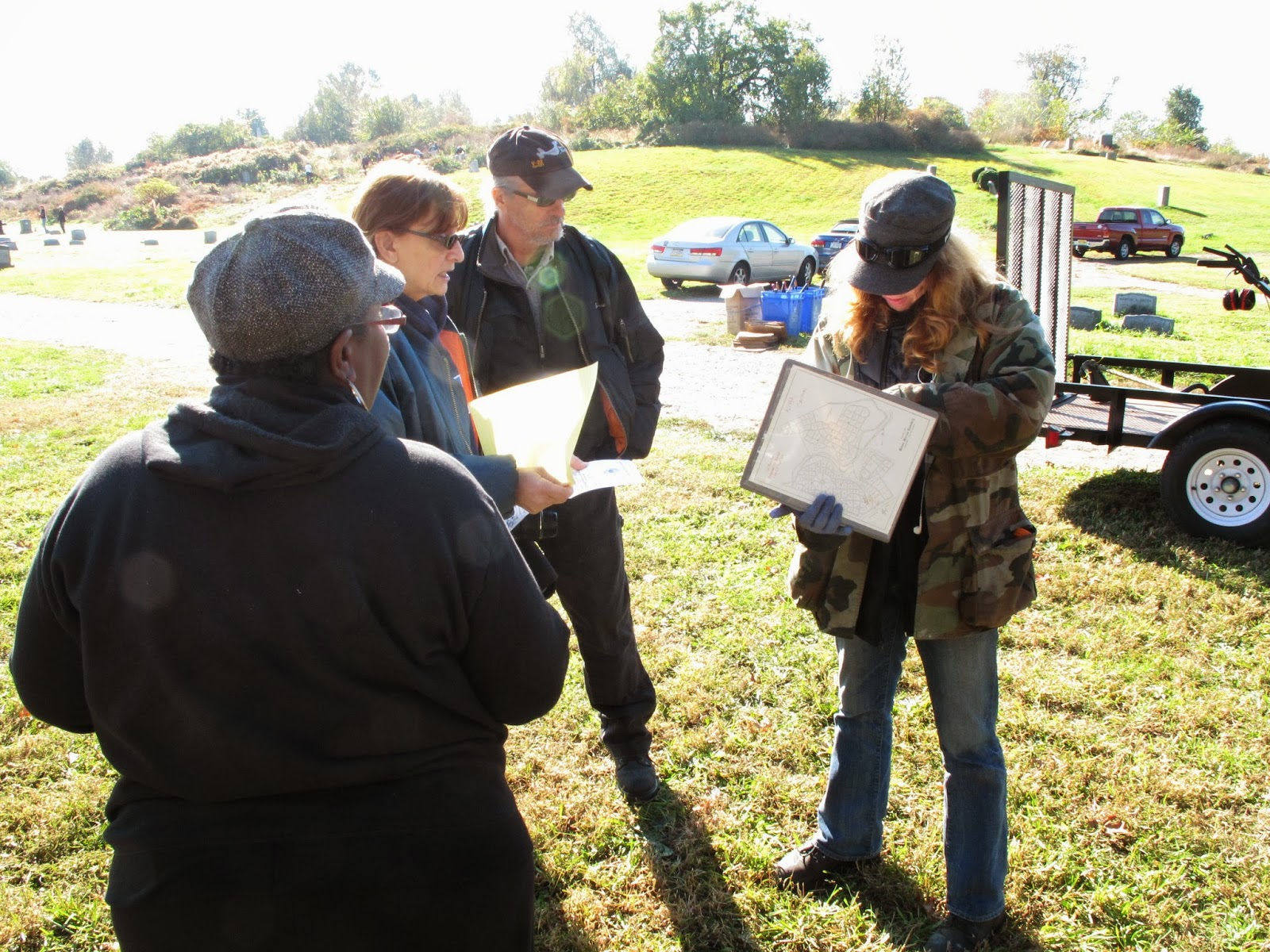
On a crisp, clear, and cool Saturday (Oct. 26, 2013), The Friends of Mount Moriah Cemetery, Inc.  (FOMMCI) held its 2013 Fall Festival/Family and Friends Day. There was frost on the grass across the cemetery when the Friends’ Board members  arrived. Our Second Annual “Family and Friends Day” is a way to thank and acknowledge the hundreds of volunteers who worked so hard this past year to help us keep the grass cut, clear the trash, whack the weeds, cut the trees. Our president wanted us not to work, but celebrate. Well, you can’t keep good people down. Sixty or so volunteers wanted to work, so we provided them with hand tools and let them work.

Early morning setup by (L to R) Ken, Bill, and Peggy
Dawn at Mount Moriah Cemetery
Various Board members showed up at dawn (sunrise pic) to set up the central gathering site (Section 200), so hot coffee would be waiting for the first busload of volunteers when they arrived. Treasurer Ken Smith and his wife Peggy, along with Vice President Bill Warwick took care of this as well as running lines to a generator to provide power.

Treasurer Ken Smith leading the charge of Drexel student volunteers
Contrary to peoples’ perception of a VP and Treasurer being starched-shirt types, Bill and Ken are the guys with the pickup trucks and the chainsaws – people who can always be counted on to haul things around while providing folks with outlet strips, weed-whackers, or anything else that may be needed! Being the Communications and Technology Board member, my day would entail (in addition to helping with setup) running around documenting the activities with my camera and interviewing people.

Temple U. documentarians
As always, the day presented us with a varied group of participants - people from all walks of life showed up for many different reasons. Everyone has his or her own personal reason for helping to save and restore Mount Moriah Cemetery. A group of Temple University film students recognized this and spent the day filming and doing interviews with the people involved. The kids enjoyed the pumpkin-painting table!


Several families came to find their ancestors’ graves, for which we were prepared with maps and laptop with database of burial records. Friends’ Board members Fred and Sue Facciolli ran the genealogy station. One of the services that Board members provide is physically helping visitors to find graves in the cemetery, if that is requested. Several such missions were accomplished, often by FOMMCI Board member Donna Morelli (who many people know as her Facebook persona “The Haunt of Mount Moriah”), who knows the site better than most.

Drexel students clearing hillside weeds from around graves
We had about sixty people show up to work from various organizations, among them: PowerCorpsPHL (Mayor's Office of Civic Engagement & Volunteer Service), The Church of Jesus Christ of Latter-Day Saints (LDS or Mormon Church), and Drexel University. Drexel sends its freshmen as part of its (required) Civic Engagement course. Students are able to decide where they want to volunteer their time and effort ; this busload of students chose Mount Moriah. We are immensely grateful for the work the Drexel students accomplished clearing the hillside brush and weeds in Section 15.

Askin mausoleum (Section 28) before and during excavation

Askin mausoleum after clearing!
Many volunteers working along with the LDS group tackled the Askin mausoleum and hillside in Section 28. As you can see from the photos above, the structure was not even visible prior to the day’s cleanup effort. Afterward – what a transformation! Everyone here today seemed driven to accomplish some good, and their efforts surely paid off. Our Board members and other volunteers set up and served hot food and drinks all day – we are grateful to KC, Dawn Dyer, and Jen O’Donnell for running the tables and keeping the lines moving.


Board member Sam Ricks leading "Congressional Medal of Honor" tour
Betsy Ross' grave
We coaxed the volunteer workers to take some breaks, and enjoy the tours provided by FOMMCI Board members Sam Ricks and Ed Snyder. Sam ran the lecture tour "Remembering our Congressional Medal of Honor Veterans" in the Naval Asylum Plot and provided information on Mount Moriah’s twenty-one Congressional Medal of Honor recipients. Ed provided an “Art and Architecture” tour, which included the 1855 gatehouse, the (Masonic) Circle of St. John, and Betsy Ross’ grave.

At day’s end, I was interviewed by the Temple University students who were making a documentary about the Friends’ involvement with Mount Moriah Cemetery. The last question went something like this: “Has your experience caring for this abandoned cemetery changed your view of how you want to be remembered after you die?” I wasn’t prepared for that one, but answered in all honesty: “I hope people care for my final resting place in the same way we are trying to do that at Mount Moriah. Its all about respect – respect for the person, respect  for that person’s memory.”

Board member Ed Snyder giving "Art and Architecture" tour (photo by Frank Rausch)
Paulette (L) and Donna (R) help locate graves
All in all, it was a fun, fulfilling, and enjoyable day. Thanks to all who came out to celebrate! In the words of FOMMCI President, Paulette Rhone, “Thank you all for joining us for our second Annual Family and Friends Fall Festival … More importantly, thank you for being a Friend of Mount Moriah … it was a great day to get to know each other….”

For more information on the Friends of Mount Moriah Cemetery, Inc., please visit us on Facebook and on our website.

Thursday, January 17, 2013

A Retrospective Show

While it is certainly true that artists exhibit their work to show it off and to sell it, there is a more subtle reason: to see how it affects other people. I don’t do this consciously myself, but after a recent exhibit, it was apparent to me that many people were affected by my photographs in various ways. The show was a retrospective spanning 15 years of my cemetery photography, though I hadn’t planned it that way. I just gathered together all the framed pieces I had lying around and set them up at a gallery for a one-night show. It was ad hoc, initiated at the request of a friend.

The gallery owner, Richard Prigg of Sycamore Studio in Lansdowne, Pennsylvania (a southwestern suburb of Philadelphia) needed art in a hurry as his scheduled artist backed out at the last minute. Each month, he has a one-day exhibit of his own paintings and stained glass work along with that of a guest artist. So I delivered about seven each 16x20 and 11x14 framed photographs, some images of which I've included here in this article.

"Stone Emotion," Holy Cross Cemetery, Yeadon, PA, 1997.
"Blessing," 2012
A few days later at the reception, I was quite pleased at how he hung my work in his gallery. One side of the white room were his original paintings and stained glass art, the other side had my photography. As I viewed the hodge-podge of my work on display, I realized that it was a loose retrospective of the cemetery photography that I've done over the past 15 years. From “Stone Emotion” - one of the very first stone angel images I’d made, back in say, 1997, to very recent work in the abandoned Gladwyne Jewish Cemetery ("Blessing," see right). There were also pieces from near and far – many from the Philadelphia area (where I live) to California and Rome, Italy. Looking at some of my more recent work, I could easily see some photographic miscegenation, which is just a nice way of saying that everything is derivative.

"Eros and Psyche"
A few nights later when people began showing up for the opening reception , I was frankly amazed at how most of them came up to me and asked me about my work, either in general or about some specific aspect. Oddly, no one but the gallery owner asked me the most obvious question, which is “Why do you photograph cemeteries?” (I really have no good answer to this.) But all topics and questions brought up were astute observations or probing questions, such as those related to the image at left: "What is this?" and "How did you manage the lighting?" It was very enjoyable discussing my work at both the artistic as well as technical levels. (This image, by the way, will be used as the front cover for the January 2013 issue of the [British] Journal of the Centre for Freudian Analysis and Research - the issue topic will be "Love.")

Sometimes people just show up at these opening receptions for the cheap wine and cheese doodles. This did not happen at Sycamore Studio (for the record, the gallery owner actually served craft beer, good wine, and fine crudités!) Most of the attendees were friends of his, and most were involved somehow in the arts - even the retired police officer/artist who used to sketch nudes on the backs of his reports. (Once when the judge was reading one of his reports at a hearing, the district attorney started laughing because everyone could see the nude on the back!) Since it was really an unusual experience for me to literally talk myself hoarse to dozens of people about so many aspects of my work, I thought I'd blog about it. Here are some of the topics and questions raised:

"Angel Face"
  • "How do you title your work?" Not well, I'm afraid. Descriptive titles work better for me than artist gibberish. For example, "Angel Face" to describe the image at right, versus, oh I don't know, something like "Space and the Passage of Time.
  •  "How do you print your work?" Well, I pay other people to do it. In my book, Digital Photography for the Impatient (available from Amazon.com), the chapter on printing is the shortest! That's because its really difficult to do it yourself and trying to explain how and where to get professional prints made from digital media is an enormous topic. Also, the technology changes rapidly.
  • "Have you photographed the wonderful oceanic view cemeteries of Ireland or Hawaii?" Um, no, but I have been to Baltimore.

By Ed Snyder (Amazon link)
I really appreciate the fact that some old friends of mine came too. It certainly takes some of the pressure off! There were also people in attendance who are involved with the Lansdowne Arts Board, a group of people exemplifying and promoting various artistic endeavors in the town. One project they are currently funding is an “art house,” in which people can take classes in the arts. The plan is for it to be staffed by three artists-in residence: a poet, a painter, and a sculptor. The fact that such a vibrant arts community exists in Lansdowne,  Pennsylvania was surprising to me, as I used to live nearby and had no idea this was all happening!  

    "Under the Betsy"
  • Have you visited the abandoned buildings in Centralia [Pennsylvania]?” No, but it is on my bucket list. Along with the cemetery there. I think this came up as we were discussing my images of the discarded tombstones under Philadelphia’s Betsy Ross Bridge (click here for that bizarre story!). A photographer at the opening wondered if I thought it possible to film the  tombstones from underwater!
  • Would you like to do a show of your work in the old one-room schoolhouse in St. Paul’s cemetery?” [This is in Ardmore, PA, a suburb of Philadelphia]. Why certainly, thank you for asking.
  •  “How do you achieve these photographic effects, Photoshop?” I'm always flattered when people ask this as I rely mostly on my skills to achieve the best initial image capture; very rarely will I Photoshop something afterwords.

Perhaps one of the most fascinating conversations I had was with a woman who was on the board of a non-profit organization called “In Company with Angels.” For those of you who appreciate Tiffany stained glass, this is noteworthy. She told me the fascinating story of how seven early-1900s Tiffany angel stained glass windows were found in a barn near West Chester, PA, in 2001. "In Company with Angels, Inc. was founded by people from a small town in Pennsylvania who were inspired to share their rediscovery of a unique set of seven Tiffany angel windows with the world." The angels are part of a traveling exhibit, currently at the Montgomery [Alabama] Museum of fine Arts. I'm sure these are amazing and hope to see them (and photograph them!) one day.


Rick Prigg, the owner of Sycamore Studio, is in fact a stained glass artist in addition to being a PAFA-educated painter (Pennsylvania Academy of Fine Arts). As I have photographed and written a bit about mausoleum stained-glass windows (and had a photograph of one in the exhibit, see above), I was able to discuss such things with him on at least a peripheral level. He shared some fascinating stories about retrieving valuable stained glass windows from old churches for the Archdiocese of Philadelphia which it had been closed by the Archdiocese over the years. Trying to remove stained glass windows as vandals were actively throwing bricks through them from the outside must have been a trying experience!


So, sometimes you do a show of your art work to score a point or just stay even. Sure, you might make a few sales, but perhaps the best reason for showing your work publicly is to stimulate discussion. This may (or perhaps should) result in the stirring of your own creativity. It may reinforce what you're doing right and make you consider ways to improve your weaker areas. So my advice to anyone who publicly exhibits their artwork: don't ever pass up an opportunity. As for an answer to the question sometimes posed to me of “Why do you photograph cemeteries?” The best answer may very well be to stimulate discussion in related areas. And since cemeteries are really all about us, I suppose anything and everything can be a related area!