Thursday, September 19, 2013

The Grave of Guitar Maker C.F. Martin ... Almost

This summer, my brother Tim had the great idea to visit the Martin guitar factory in Nazareth, Pennsylvania. He (traveling south from Wilkes-Barre) would meet my son Christopher and I (traveling north from Philadelphia) in Nazareth to take the tour through the factory. We are a rather musical family - Chris and I both play guitar, while Tim occasionally plays a compact disc player.

Factory worker at Martin Guitars, Nazareth, Pennsylvania
Martin is the manufacturer of the most highly-regarded factory-produced acoustic guitar in the world. They’ve been in business for 180 years – Christian Frederick Martin, Sr. started the company in 1833 when he arrived in America from his native Germany. The company is currently run by C.F. Martin, IV. Martin guitars are extremely expensive. If you play one, you immediately see why. Not only do they sound wonderful, but they look and feel like beautifully crafted objets d’art. At the tour’s end, we were all given souvenir soundhole cutouts from the guitar-making process, probably the only Martin guitar-related item that I could ever afford to own!

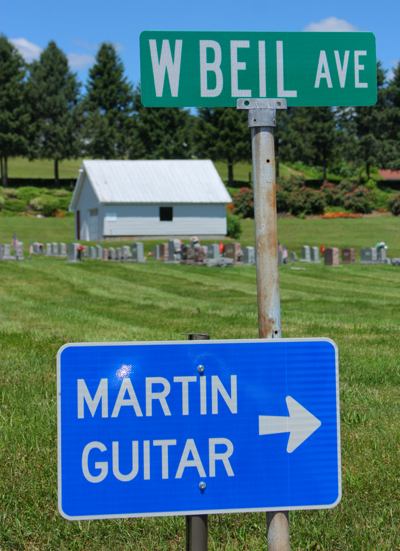
So where am I going with this and what does it have to do with cemeteries? Well, I always check out the local cemeteries when I travel, and was surprised to find that Nazareth is basically a small town loaded with cemeteries (which of course will require a follow-up visit!). In fact, there’s one right down the street from the guitar factory at Beil Ave. and North Broad Street - “Schoeneck Moravian” cemetery (which you can see in the photo just beyond the blue sign).

Strange stones in most of these cemeteries – flat thick marble ones, like full sized headstones, but lying down instead of upright. I wonder if this is where they got the idea for memorial parks, with uniform flush-to-the ground markers? These are not flush, though, they stand anywhere from four to eight inches off the ground.

Another local cemetery is Moravian Cemetery (Center and Willow Streets), in which repose the remains of one Lucia Otilia Martin, wife of Christian Frederick Martin, Sr., founder of the company. So, there’s the big tie-in between the Martin Guitar Factory tour and the Cemetery Traveler – the grave of the patriarch’s wife. Must visit. But what about C.F. Martin, Sr. himself? Where doth repose his mortal remains? My guess is right next to his wife, who died a year before him in 1872. But if that's the case, why an unmarked grave? Perhaps instead his body was shipped back to his homeland for burial – Saxony, Germany. Who knows? I tried to get in touch with the company’s current president, C.F. Martin IV, to see if he knows. I received no reply.

So after the wonderful tour of the Martin Guitar factory, Tim, Chris, and I had lunch at the restaurant down the street, across from Schoeneck Moravian Cemetery. I then sprung my request on them to visit the Martin grave, a couple miles away. All were game. Then I popped out the piece of paper with the photo of her grave from the Find-a-Grave website. I showed it to them saying, “I don’t know how big the cemetery is or how easy it will be to find this, but maybe you guys can help. I promise if it takes more than twenty minutes, I’ll give up.” My compatriots were ok with that, bless their souls. So we drove off and found Moavian Cemetery with little trouble.

My car parked in Nazareth, PA's Moravian Cemetery
It’s an interesting visual – cemetery on a hillside. Blazing hot August sun, around 4 pm. Drove my car up the main cemetery road to about mid-terrace, and pulled in to a crossroad. I stopped my car, my brother pulling his car in behind mine. I rolled down the windows and stepped out onto the grass, Chris getting out the passenger side. As I began to announce my plan for finding the grave to those gathered before me, I felt a sharp sting on my ankle. I thought there was a picker bush so I looked down. At the same time as I saw all the hornets swarming out of the hole in the ground next to my foot, I felt two more stings under my arm (I assume I was waving said arms wildly at the time, allowing the little buggers easy access to my more tender parts)!

Did I mention that since it was so hot that day, I was wearing shorts and a short-sleeved Black Sabbath t-shirt? Yeow! I ran around my car and jumped into the passenger seat, over the shifter and jammed the key in the ignition – had to get the windows up! Oh, man, those stings started to REALLY hurt!

Son Chris and brother Tim searching Moravian Cemetery, Nazareth, PA
I got out of the car, manufacturing new curse words as I grabbed my camera and began to instruct Chris and Tim about how we would fan out and look for the Martin grave. As we began walking, I could not BELIEVE how these three bee stings hurt! Omigod! And to think some people get themselves stung regularly for medicinal purposes or worse - those bizarre tribal rituals involving hundreds of bee stings ….

I really had no idea whether we would actually find the Martin grave – every stone in the place looked exactly the same! And everything was flat, so you actually had to look down at every stone to read it – no cursory glancing around. So I was rather amazed when I found the stone in about five minutes. Snapped a few photos and that was it – the grave of Lucia Otilia Martin (formerly Kühle), the matriarch of Martin Guitars. (Oddly, the Martin website refers to her as "Ottilie Lucia Kühle.") My quest was successful and I got to spend a fun day with my son and brother (at least until the bees got involved). Those stings hurt for DAYS afterward!

Epilogue - A Bit of History

Lucia Otilia Martin's grave marker
So, I’ve been flipping this “Moravian” term around like I know what I’m talking about. The Internet tells me that Moravia was one of the “historical countries” (meaning it no longer exists) of Eastern Europe. The area is now Czechoslovakia. The Moravian Church is one of the Protestant denominations (ref.).

Nazareth, Pennsylvania was founded in 1740 by Germans, and was “… specifically Moravian by charter. Outside faiths were not allowed to purchase property within Nazareth, a basically all German Protestant community.” (ref.) Nazareth itself was named after the Biblical town where Jesus Christ was born. There’s a great holiday gift shop on the outskirts of town where you can buy gift baskets loaded with beef sticks, farmer’s cheese, crackers, and the like – the place is called “Cheeses of Nazareth.” (I just made that up – sorry, couldn’t resist!)

References and Further Reading:

Friday, September 13, 2013

Yom Kippur and Jews in the Confederate Army

On the eve of Yom Kippur, the Jewish Day of Atonement, it is somehow appropriate to relay this story of recognition, given 150 years after the fact. A few weeks ago (August 2013), I witnessed (for me, anyway) a most unusual event: the formal recognition of a Jewish Confederate soldier, buried in Philadelphia’s Mikveh Israel Cemetery. On the grave of Sgt. Julian Camden Levy was placed a "U.S. Confederate Veteran" medallion and flag by the "Sons of Confederate Veterans, Lt. General John C. Pemberton Camp #2060, Philadelphia, PA." GPS coordinates were taken and entered into the database by the Graves Registrar for the organization.

It might surprise you to know that Jews fought in the American Civil War. It may also surprise you that not every Confederate veteran is buried in the South, and not every Union veteran is buried in the North.

Philadelphia’s Congregation Mikveh Israel Cemetery (Beth Hahayim) “Number Two,” as it is sometimes called, is located at Eleventh and Federal Streets in South Philadelphia. Number One, the original congregation cemetery established in 1740 (and the “oldest tangible evidence of Jewish communal life in Philadelphia” (ref.), is located at Eighth and Spruce Streets. Number Three, which is the one with more recent burials, is located at 55th and Market Streets.

As the congregation grew and more space was needed for burials, more space had to be purchased at various distances from the original synagogue. All three burial grounds are kept in fine condition, with grass mowed regularly. All are walled, fenced, and under lock and key. You can only gain access by having the rabbi let you in. 

Rabbi Gabbai unlocking gate to Mikveh Israel Cemetery
A few weeks ago, my friend Sam Ricks, Graves Registrar for the Pennsylvania Division of the Sons of Confederate Veterans, told me he was planning to visit Mikveh Israel Cemetery Number Two to install a veteran marker and flag on the grave of a Jewish Confederate Civil War veteran. I asked if I could tag along. Graciously, he said yes. So on a hot sunny August afternoon, Sam and I met Rabbi Albert Gabbai at the gate. In the photo above, the gate is being unlocked by the Rabbi and Sam is at right. The small cemetery is in the middle of a residential neighborhood in South Philadelphia (near my house), with a school on one side (Andrew Jackson Elementary).

Sgt. Levy's unmarked grave (large flat stone in ground)
Sam Ricks volunteers his time identifying and marking the graves of Confederate veterans buried in the Philadelphia area. Why would there be Confederate veterans buried north of the Mason-Dixon Line? Well, in the case of Julian Levy, he fought for the Confederacy with the Alabama Infantry, and was killed in action in Virginia in 1862. His body was brought north in 1899 to be buried with his parents, who were Philadelphia residents. Not unusual, as I am led to believe. (Prior to the war, Levy was a cotton merchant in Mobile, Alabama.)

Sam Ricks posting Confederate flag
Until I met Sam Ricks, I always thought that Northern and Southern sensibilities ran deep and along very tight boundaries. Naively, I assumed entire families were either for or against slavery. It never occurred to me that a son would fight for the Confederacy while the parents lived in Philadelphia and may have been abolitionists. I also assumed that all Union veterans were from Northern states and were therefore buried in the North, and that all Confederate veterans were from Southern states and were therefore buried in the South. Amazing how much you can learn by hanging around cemeteries!

The school kids on the other side of the wall (shown in the photo above) learned a bit about cemeteries that day. The cemetery is typically locked and no one can get inside. While we were there, a basketball flew over the stone wall onto the grass at Sam's feet. He promptly picked it up and tossed it back over the wall! I'm sure the kids in the schoolyard were surprised!

Sergeant Levy does not have a government-issued “CSA” (Confederate States of America) headstone (his is the large flush-to-the-ground marble gravestone, the inscription on which is barely legible). One reason might be the reluctance of Northerners to draw attention to that fact that he fought for the Confederacy. Personally, I am wondering how long the Southern Cross flag will continue to wave over Levy’s grave in this little Jewish cemetery in Philadelphia. (A month after Sam installed it, it is still there.)

Further Reading and Reference:

Read more about Sergeant Julian Levy here.
Mikveh Israel Website  


From the Sons of Confederate Veterans Website:


Grave of Sgt. Julian Levy, CSA (Mikveh Israel Cemetery, Philadelphia)
"In 1896, the Sons of Confederate Veterans was founded by the veterans and progeny of veterans who fought in the War Between the States. The Sons of Confederate Veterans was established as, and remains, an independent organization that supports the protection and preservation of Confederate heritage. Current members are descendants of the original defenders of Confederate heritage, and are not aligned or affiliated with any other organization."


Thursday, August 29, 2013

A Long Visit from Mississippi

On August 19, 2013, The Friends of Mount Moriah Cemetery in Philadelphia was host to Mr. and Mrs. Robert Long, who were visiting from Starkville, Mississippi. Mr. Long, who is in his seventies, was born and raised in Philadelphia but moved away when he was eighteen when he joined the Air Force. His mother and grandmother (the names you see on this headstone) are buried in Mount Moriah Cemetery.

Mr. Long served as an engine mechanic in the United States Air Force and spent time in Japan post-WWII.  His mother passed away when he was four months old.  He does not have any pictures of her nor does he know how she died.  Mr. Long’s father is also deceased.  Recently, Mrs. Long, Sue, began searching the internet for answers to the questions related to her husband’s family history and came across the Friends of Mount Moriah Cemetery website. She sent us an email and we located the grave in question, which you see in the photo above. Elizabeth Long was his mother and Ida May Reed was his grandmother.

The Longs were very appreciative for the information provided to them by the Friends and inquired about a visit to Mount Moriah. (This is one of the volunteer services we offer, along with keeping the grass and weeds cut and clearing large areas of overgrown trees and other foliage throughout the several-hundred-acre cemetery.)

Bob and Sue Long's plan was to drive to Philadelphia from Mississippi to visit the grave. Ken Smith (photo at right), Treasurer on the Board of The Friends took it upon himself to tackle the weeds in the section where Mr. Long’s relatives are buried. He and other volunteers labored many hours during the week prior to the Long’s visit to cut the high grass over the entire Section F (on the Philadelphia side of the cemetery) and clear the overgrown grass from the hillside walkway. The latter was done to allow Mr. Long clear access to climb the hill in his motorized wheelchair.


On Monday morning, August 19, the Longs completed their 1000 mile 15-hour trip by minivan to Philadelphia. They were met and directed to Mount Moriah Cemetery by Ken Smith. Several Board members were on hand to greet them, including Paulette Rhone (President), Ed Snyder (Communications and Technology Chair), and Sam Ricks (Education and history Chair). Ed Snyder brought his four-year-old daughter Olivia, who graciously carried the flowers brought by the Longs to decorate the grave.

Bob and Sue Long were extremely grateful to the Friends for making them welcome and assisting them in their journey. It was a very emotional time – along with Mr. Long’s memories, they brought a flag and a small statue of a boy labelled “Bobby.” Mr. Long told me his mother used to call him that. Ken and Ed helped to secure the statue to the headstone.


The Longs came prepared with a caulking gun and tube of builder’s cement, clippers and a can of … Play-Doh! Daughter Olivia asked if she could play with the Play-Doh. Mrs. Long told us she brought it to hold the flag in the little cup held by the “Bobby” statue. She told Olivia that she would only need enough to hold the flag in place and that she could have the rest.  She said, “I had to buy four cans and I left three home for my grandkids. You can have this one.” Olivia was thrilled!

“Bobby” wasn’t very secure on the headstone so Ken drove off to the old gatehouse to find a suitable piece of stone on which to mount the statue. He returned with a heavy piece of granite which we dug in next to the headstone. We then glued “Bobby” on to the new stone. I asked Mr. Long why the flag. He told me he was a veteran, and had been an engine mechanic in the United States Air Force. I told him my great uncle was also in the Air Force, but retired with far less marketable skills - great uncle Raymond had been a tail-gunner. Mr. Long laughed.

After returning to Mississippi, the Longs had the following to say about the Friends and their visit. This from Sue Vaughan Long via Facebook:
"It is such a great thing that all of you good people are doing for this cemetery. And thanks again for helping us decorate the grave and to Ken for showing us how to get to the cemetery and back to the Hotel we were staying at. May God bless each and every one of the Friends of Mount Moriah Cemetery.
Long Friends of Mount Moriah are just wonderful people. You have to have a big heart to undertake what you are doing for the Cemetery. As I have said before several times, we cannot thank you enough for what you have done for us. Bob says for him it was a dream come true after 76 years to finally go to his Mother's final resting place."

The experience was one that we will all remember for a long time. It is yet another example of the mission of The Friends of Mount Moriah Cemetery - “honoring the memory of those interred in her folds through restoration, historic research, education and community engagement.” 

**************************************
If you would like to volunteer your time to help the Friends in any capacity - please contact us via our website or our Facebook Group Page:

The Friends of Mount Moriah Cemetery, Inc. website 
The Friends of Mount Moriah Cemetery, Inc. on Facebook

Monday, August 26, 2013

Exhibition Opens: "Sacred to the Memory"

Photographic Exhibition:

Sacred to the Memory - 
the Historic Cemeteries of Philadelphia

Sept. 9 - Nov. 1, 2013
Free Library of Philadelphia
Parkway Central Library
1901 Vine Street
Philadelphia, PA 19103-1189

Artists: Frank Rausch, Robert Reinhardt, Ed Snyder
(Image above from Laurel Hill Cemetery, by Frank Rausch)


Opening Reception Sept. 16, 6 - 8 pm


The Historic Cemeteries of Philadelphia - Laurel Hill, Woodlands, and Mount Moriah 

Ed Snyder
 "Sacred to the Memory" is an historic exhibition that catches three historic cemeteries of Philadelphia at a moment in time - 2013, over a hundred and fifty years after they were originally established. Frank Rausch, Robert Reinhardt, and Ed Snyder are local photographers who share a passion for documenting these historic and beautiful sites. Their goal was to provide a clear picture into how each artist sees these individual memory gardens - Laurel Hill Cemetery, Woodlands Cemetery, and Mount Moriah Cemetery. Each site has its own personality and architectural features.  Each photographer has his own unique style. Together all three artists provide a complete visual diary of their visits and adventures in these Victorian sculpture gardens.

Book and eBook available from Blurb.com
A book was created to accompany the exhibition at Philadelphia's Main Public Library, and is available from Blurb.com (click here to see it in hardback, paperback, and eBook forms). Also, a poster (shown below) is being made available for a limited time. Autographed copies of the poster and book will be offered for sale during the Opening Reception. 

Exhibition Poster
A portion of the proceeds from poster sales made during the exhibition will be donated to the Friends of Mount Moriah Cemetery, Inc. for direct care of the grounds. (This is a nonprofit organization dedicated to the preservation and promotion of the Mount Moriah Cemetery by honoring the memory of those interred in her folds through restoration, historic research, education and community engagement). The poster can be purchased by contacting Ed Snyder, Chairman of Communications and Technology for the Friends at mourningarts@yahoo.com).

Laurel Hill Lion (Snyder)
The photographs in this exhibition express the passion each of the artists has for documenting these three Victorian-era cemeteries. Whether the inspiration stems from an interest in the past, a spiritual journey, or just the desire to create strong visual images, each photograph brings to the surface the beauty of these eternal resting places. Garden cemeteries were the bucolic getaways for city people in the 1800s, they were the first public parks - landscaped sculpture gardens where people picnicked and strolled long before public parks and museums came into being.

Frank Rausch
“[We have] been able to create images that bring awareness to the beauty and fragility of our cherished resting places as well as showing the necessity to restore and preserve these exquisite places for future generations to enjoy." - Photographer Frank Rausch


Mount Moriah Cemetery Gatehouse (Snyder)
Some of these images capture the delicate partnership these graveyards have co-existing with nature. Others document the skilled craftsmanship of the artists and architects who created and constructed them. Yet others explore and hint at the myth and mystery that surrounds the persona of each of these silent and reflective sites. Whichever explanation you choose, the photographs seek to celebrate the significance of these graveyards. These images not only document our history, culture, and artistic trends of the past, they also hold the eternal silent voices of the past and once again bring to life the markers erected in their honor.

Robert Reinhardt
“Each site possesses a unique slice of history, culture, religion, art, and architecture of the time period in which it was created. These images attempt to bring to life a strength that lives on in these eternal monuments.” - Photographer Robert Reinhardt

The artists will host an Opening Reception at the Library on September 16, 2013 (6 – 8 pm). The exhibit hall is on the first floor of the Philadelphia Central Library, off the main lobby. This extensive exhibit will include nearly sixty images as well as display cases of artifacts created by each of the three historic cemeteries. Representatives from Laurel Hill, Woodlands, and Mount Moriah cemeteries will also be in attendance. The exhibition will run from September 9 to November 1, 2013. 

Woodlands reflection (Reinhardt)
You see here among these words a few images that will be on display. We invite you to see the exhibit in person, if possible. And by all means, please visit these landmarks of architectural and botanical beauty, these memory gardens of great historical significance. If you live in Philadelphia, you owe it to yourself to add these sites to your “must see” list along with the Liberty Bell and Independence Hall. Cemeteries speak to us on many different levels – the intent of this exhibit is to preserve the memories and voices of the past so they can be handed down for the appreciation of others in the future.

Perhaps this is best described by Gwen Kaminski, Laurel Hill’s Director of Development and Programs, in the following passage which is excerpted from the book, "Sacred to the Memory" - The Historic Cemeteries of Philadelphia:”

Laurel Hill blanketed in snow (Rausch)
"Laurel Hill Cemetery appeals to the senses. Walking through her gates, one steps into nineteenth century Philadelphia. Surrounded by a symphony of nature and noise; immersed in a thick forest of white marble; looking down on the river – the city of the living just below – one gains a new perspective on the world, and on our place within it. This place – our place – is ever changing. It shifts with the shades and shadows cast by each morn, noon and night. We see the shifts, though our finite gaze cannot yet pierce them. 

Laurel Hill Mausoleum lock (Rausch)
Yes, here at Laurel Hill, our senses are charmed. Our sight is heightened; our observations profound. Since her founding in 1836 – eighteen decades past, and too many comings and goings to count – Laurel Hill has been immortalized in art. Displays of greens and grays have given way to the whitest of winters. Branches bare are clothed again in the blooming buds of springtime. The landscape is refreshed by roaring rains, and takes on new shapes with each setting of the sun. So many names and numbers give testament, chiseled into stones not quite as heavy as the words that they bear – each one fighting the toll of time on memory, on mortality.

Fleeting glances of all this and more have become permanent visions in oil, charcoal, clay, graphite, marble, watercolor, celluloid, and now pixels. These photographs are a collection of moments memorialized. What you see herein of Laurel Hill Cemetery you shall not see again beyond these printed pages. The view through the lens has already shifted. Our eyes have grown another day older – our gaze another day closer to piercing the shifts."

Further Reading and Reference:
The artists encourage you to visit these cemeteries, as well as their websites:
Historic Laurel Hill Cemetery (established 1836)
The Woodlands Cemetery (established 1840)
Mount Moriah Cemetery (established 1855)